How to Become an E3D Designer: Skills, Training and Career Roadmap
Dreaming of a career in plant design? This guide explains what an E3D designer does, the skills and software you need, a step-by-step career roadmap, and how to choose the right AVEVA E3D training institute to become job-ready.
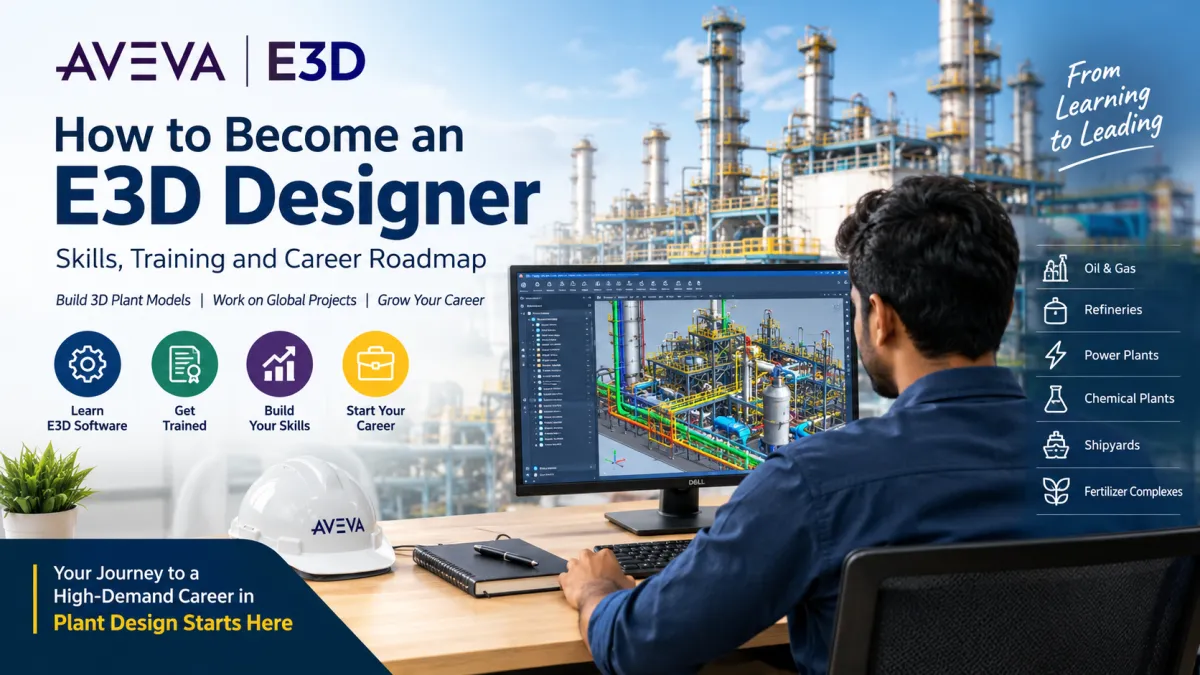
If you are an engineering graduate, a diploma holder or an ITI-qualified technician looking for a stable, well-paying career in core engineering, E3D design deserves a serious look. Oil and gas plants, refineries, power stations, chemical units, shipyards and fertilizer complexes all need accurate 3D plant models before a single pipe is installed on site. The professionals who build those models are E3D designers.
In this guide, we explain what an E3D designer does, the skills you need, the training path to follow, the career roadmap, and how to choose the right institute. By the end, you will know exactly how to go from beginner to job-ready.
What Is E3D and Why Does It Matter?
AVEVA E3D (Everything3D) is a leading 3D plant design software used across process and power industries. It is the next-generation successor to AVEVA PDMS (Plant Design Management System), which engineers have used for decades. E3D lets design teams create intelligent 3D models of piping, equipment, structures, cable trays and HVAC in one shared environment.
Why do companies prefer it?
- Accuracy: Clash detection finds interferences between pipes, steel and equipment before construction begins.
- Faster deliverables: Isometrics, general arrangement drawings and material take-offs can be generated directly from the model.
- Collaboration: Piping, civil, structural, electrical and instrumentation teams work on the same model at the same time.
- Less rework: Fixing a problem in the model costs far less than fixing it at the construction site.
Because EPC companies and design consultancies around the world depend on this software, trained E3D professionals are in steady demand.
What Does an E3D Designer Do?
An E3D designer converts engineering inputs such as P&IDs, equipment data sheets and plot plans into a detailed 3D model and the drawings needed for construction. Typical day-to-day work includes:
- Modelling equipment, nozzles and platforms
- Routing piping as per piping class and project specifications
- Placing valves, supports, instruments and fittings
- Modelling structural steel, pipe racks and cable trays
- Running clash checks and resolving design conflicts
- Producing piping isometrics, GA drawings and material reports
- Coordinating with piping engineers, stress engineers and project managers
- Incorporating review comments and client revisions
Who Can Become an E3D Designer?
One reason this career is so popular is its wide eligibility. You can start if you have:
- A B.E./B.Tech in Mechanical, Civil, Chemical, Marine or Production Engineering
- A Diploma in Mechanical or a related branch
- An ITI qualification in Draughtsman (Mechanical) or similar trades
- Experience in AutoCAD or other drafting tools and a wish to move into plant design
Freshers can enter the field after proper training, while working professionals use E3D skills to switch from general drafting to higher-paying plant design roles.
Skills You Need to Become a Successful E3D Designer
Technical skills
- Engineering drawing fundamentals: Reading orthographic views, sections and dimensions.
- Piping basics: Pipe sizes, schedules, flanges, fittings, valves, gaskets and piping classes.
- P&ID reading: Understanding process flow, line numbers, instruments and control loops.
- Codes and standards: Familiarity with ASME B31.3, ASME B16.5, API and other common standards.
- AVEVA E3D (or PDMS) tools: Modelling, catalogues and specifications, drawing production, isometrics and reports.
- Plant layout knowledge: Equipment spacing, access, maintenance clearances and safety requirements.
- Supporting software: AutoCAD basics, Microsoft Excel and a model review tool such as AVEVA Review.
Soft skills
- Attention to detail, since small errors in a model can lead to costly rework
- Spatial thinking and visualisation
- Clear communication with engineers and clients
- Time management when working to project deadlines
- Willingness to keep learning as software and standards evolve
Step-by-Step Career Roadmap to Become an E3D Designer
Step 1: Build your engineering foundation
Start with your degree, diploma or ITI qualification. Strengthen your knowledge of engineering drawing, mechanical fundamentals and basic manufacturing and materials.
Step 2: Learn piping and plant design fundamentals
Before opening the software, understand how a plant works. Learn about process flow, piping components, line routing rules, pipe supports and plant layout. This knowledge is what separates a designer from a software operator.
Step 3: Join a structured E3D training programme
Self-study from videos can only take you so far. A professional course gives you guided practice on real project-style models, expert feedback and a clear learning sequence. Look for training that covers:
- E3D interface and navigation
- Equipment, piping, structure and support modelling
- Catalogues and specifications
- Clash detection and model checking
- Isometric and drawing generation
- Project-based assignments
If you are searching for this kind of programme, the AVEVA E3D training course from Talent Brothers is designed to take learners from the basics to industry-ready skills, with training options for students in Chennai, Tamil Nadu, Kerala, Bangalore and Hyderabad.
Step 4: Practise on real-style projects
Employers want proof that you can handle a complete design task. Build a small portfolio that includes a modelled equipment area, a piping network with supports, a pipe rack, and a set of isometrics and reports. A portfolio like this will set you apart in interviews.
Step 5: Prepare your resume and interview skills
Highlight your software skills, project work and knowledge of codes. Be ready to answer questions on piping classes, line routing, clash resolution, isometric creation and the difference between PDMS and E3D.
Step 6: Start as a Junior E3D Designer or Trainee
Most freshers begin as a trainee designer or junior piping designer in an EPC company or engineering consultancy. In this stage you will work under senior designers, learn project standards and build speed and accuracy.
Step 7: Grow into senior roles
With experience, you can move up the ladder:
- Junior Designer / Trainee Designer: Learning project workflows
- Piping Designer: Handling full piping areas independently
- Senior Designer: Reviewing models and guiding juniors
- Lead Designer / Design Supervisor: Managing a design team and deliverables
- Design Engineer / Project Coordinator: Linking design, engineering and project management
Industries That Hire E3D Designers
- Oil and gas (upstream, midstream and downstream)
- Refineries and petrochemicals
- Power plants (thermal, nuclear and renewable)
- Chemical and fertilizer industries
- Pharmaceutical plants
- Shipbuilding and offshore structures
- Water and wastewater treatment
- EPC and engineering consultancy firms
These sectors operate in India and across the Gulf, Europe and Southeast Asia, so E3D skills can also open doors to international opportunities.
Salary and Career Growth
Salaries depend on your skills, location, company and experience. As a general idea, freshers usually start at an entry-level package, while designers with a few years of experience and strong project exposure can see a significant increase. Senior designers and design leads working in major EPC companies or overseas projects typically earn much higher packages. Since pay varies widely, check current job listings in your city to understand realistic ranges.
How to Choose the Right E3D Training Institute
Not every course delivers the same value. Before you enrol, ask these questions:
- Does the syllabus cover both piping fundamentals and E3D software?
- Are the trainers experienced industry professionals?
- Will you work on practical, project-based assignments?
- Is there help with resume building, interview preparation and job guidance?
- Are flexible options available, such as classroom and online training?
- Does the institute have a good reputation among learners and employers?
At Talent Brothers, the focus is on practical, career-oriented training that prepares learners for the realities of the engineering job market. You can explore the full range of courses on the website and see the AVEVA E3D training details here.
Common Mistakes to Avoid
- Learning only the software: Without piping knowledge, your models will lack engineering logic.
- Skipping practice: E3D skills improve through repeated hands-on modelling.
- Ignoring codes and standards: Companies expect you to follow project specifications precisely.
- Having no portfolio: Show your work, not just your certificate.
- Stopping after the course: Keep learning about new E3D features, related tools and industry practices.
Frequently Asked Questions (FAQs)
1. What is the difference between PDMS and E3D?
E3D is the modern successor to PDMS. It offers an improved interface, better performance, stronger collaboration features and more efficient workflows, while keeping the core design concepts that PDMS users already know.
2. Can a fresher become an E3D designer?
Yes. Freshers with a mechanical, civil, chemical or related background can become E3D designers after completing structured training and practising on project-style models.
3. Is coding required to learn E3D?
No. Basic E3D design work does not require programming. Advanced users may later learn customisation, but it is not needed to get started.
4. How long does it take to learn E3D?
The duration depends on the course and your prior knowledge. A focused training programme combined with regular practice can make you job-ready in a few months.
5. Is E3D design a good career in India?
Yes. With steady demand from EPC companies, oil and gas, power and process industries, E3D design offers strong career stability and growth, along with chances to work on overseas projects.
6. Where can I learn AVEVA E3D in Chennai and other cities?
Talent Brothers offers AVEVA E3D training for learners in Chennai, Tamil Nadu, Kerala, Bangalore and Hyderabad.
Conclusion
Becoming an E3D designer is a practical and rewarding path for engineering students and professionals who enjoy design, technology and real-world projects. Build your fundamentals, learn the software through structured training, create a strong portfolio and start at the entry level. With consistent effort, you can grow into senior design and leadership roles in a global industry.
Ready to start? Explore the AVEVA E3D training course at Talent Brothers or visit talentbrothers.com to learn more about our programmes and take the first step towards your plant design career.