How Multilingual AI can support Indian Students?
Discover what students need to know about AI in education in 2026, including AI literacy, personalized learning, responsible AI use, and exam preparation.
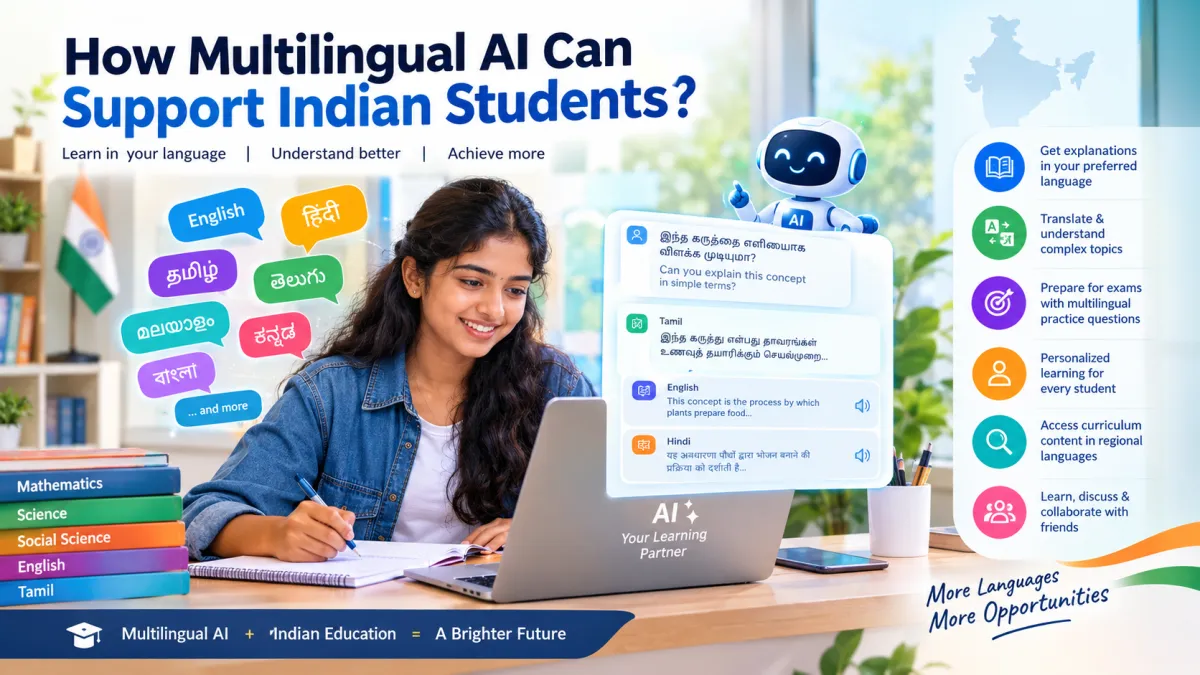
Multilingual AI is creating new possibilities for students who learn across India's many languages. From translating difficult concepts to answering questions in a familiar language, AI can make digital learning more accessible and personalized.
For Indian students, this is especially relevant because language can influence how comfortably a learner understands a subject. A student may study a textbook in English but understand a difficult explanation more easily in Tamil, Hindi, Telugu, Malayalam, Bengali, or another familiar language.
The opportunity is not simply about translation. Multilingual AI can connect language, curriculum, explanation, search, revision, and personalized learning in one learning experience.
Key takeaway: Multilingual AI should help students understand educational content better—not replace textbooks, teachers, or independent thinking.
What Is Multilingual AI?
Multilingual AI refers to artificial intelligence systems that can understand, process, translate, retrieve, or generate content across multiple languages.
In education, this can allow students to:
- Ask questions in different languages
- Translate educational explanations
- Understand difficult terminology
- Search learning materials using regional languages
- Receive explanations in their preferred language
- Move between English and Indian languages
- Learn using both native and non-native languages
- Use voice or text-based learning tools
For example, a student could ask a question in Tamil, search curriculum content written in English, and receive an explanation in Tamil.
That ability can make digital learning more flexible.
Why Multilingual AI Matters in India?
India has a highly diverse linguistic environment. The National Education Policy (NEP) 2020 emphasizes multilingualism and encourages high-quality bilingual teaching and learning materials, particularly for subjects such as science and mathematics. Education.gov.in
The Ministry of Education also describes multilingualism as an important part of India's educational and cultural context, including efforts to make learning resources available in multiple languages. Education.gov.in
This creates an important role for technology.
Traditional digital resources may be available primarily in one language. Multilingual AI can potentially act as a bridge between the language of the resource and the language in which a student understands the concept most comfortably.
The goal is not to choose one language over another.
It is to make learning more accessible across languages.
1. Multilingual AI Can Make Difficult Concepts Easier to Understand
A student may understand a subject but struggle with the language used to explain it.
For example, a student studying physics might understand the basic idea of a concept but find a complex English explanation difficult.
With multilingual AI, the student can request:
Explain this concept in simple Tamil.
Then they could ask:
Now explain the same concept in English using exam terminology.
This creates a useful bridge between conceptual understanding and academic language.
A simple learning process:
Textbook concept → Explanation in familiar language → Understanding → English/academic terminology → Practice
This can be especially useful for students who are developing proficiency in more than one language.
2. Students Can Ask Questions in Their Comfortable Language:
Students do not always think of a question in the same language in which their textbook is written.
A learner may:
- Read in English
- Think in Tamil
- Ask in Tanglish
- Discuss the topic in their regional language
- Write an examination in English
Multilingual AI can potentially support these transitions.
For example:
Student question:
Photosynthesis epdi nadakkuthu?
Learning task:
Understand photosynthesis.
Academic output:
An English explanation using the appropriate scientific terminology.
This type of cross-lingual learning can reduce friction when students move between languages.
3. Regional Languages Can Improve Access to Digital Learning:
Digital education becomes more inclusive when students can interact with learning tools in languages they understand comfortably.
India's BHASHINI initiative focuses on multilingual AI and language technology to help overcome language barriers and digital and literacy divides. Its current work includes areas such as translation, regional language models, and voice-first access. bhashini.gov.in
For education, similar technologies can support:
- Regional-language search
- Translation
- Voice-based learning
- Multilingual explanations
- Language conversion
- Digital content accessibility
Important point:
Language accessibility does not mean lowering academic standards.
Instead, it can provide students with another route toward understanding the same academic concept.
4. Multilingual AI Can Support Personalized Learning:
Not every student needs the same explanation.
One learner may prefer English. Another may understand the concept more comfortably in Tamil. Another may want a bilingual explanation.
AI can make it possible to request different forms of support.
For example:
Beginner:
Explain this in simple Tamil.
Intermediate:
Explain it in Tamil with an example.
Exam preparation:
Explain it in English using important textbook terms.
Revision:
Give me five key points in both Tamil and English.
This gives students more control over how they learn.
5. It Can Help Students Move Between Regional Languages and English:
English remains important across many Indian academic and professional environments.
At the same time, students may understand difficult concepts faster when those concepts are first explained in a familiar language.
Multilingual AI can support a two-stage learning approach:
Stage 1 — Understand:
Learn the concept in a familiar language.
Stage 2 — Communicate:
Learn the appropriate academic terminology in English or another required examination language.
This can be especially useful for technical subjects.
For example:
Tamil explanation → Concept understanding → English terminology → Exam answer
The student is not avoiding English. They are using their stronger language as a bridge toward academic communication.
6. Multilingual AI Can Help With Exam Preparation:
Exam preparation often requires students to understand both content and terminology.
AI can support activities such as:
- Generating practice questions
- Explaining difficult questions
- Creating revision notes
- Translating explanations
- Comparing terminology
- Creating quizzes
- Explaining mistakes
- Practising short-answer questions
- Revising important definitions
Example
A student could ask:
Explain this chapter in Tamil and then give me five important exam questions in English.
This combines conceptual learning with examination preparation.
However, students should always compare important answers with their prescribed textbook and teacher's guidance.
7. Multilingual AI Can Support Textbook-Based Learning:
One of the biggest opportunities is combining multilingual AI with curriculum-grounded learning.
General AI systems may provide broad information. Students preparing for examinations often need something more specific:
What does my textbook say about this topic?
A curriculum-grounded system can connect a student's question with the relevant textbook content.
Examozhi, for example, provides textbook-grounded answers and allows students to ask questions in Tamil, English, Hindi, or romanized forms, with responses in the student's language. Examozhi
Its platform also describes cross-lingual search, where queries can be made in one language or script and matched against curriculum content in another. Examozhi
This creates a useful learning model:
Student's language → AI search → Relevant curriculum content → Explanation → Source verification
Explore Examozhi's textbook-grounded learning
8. Students Can Use Romanized Languages Too:
Another interesting use case is romanized or code-mixed language.
Students may type a regional language using English letters.
For example:
Indha concept ah simple ah explain pannunga.
Instead of requiring the student to switch to a native script, multilingual AI can potentially interpret the query and connect it with relevant content.
Examozhi's developer documentation describes support for romanized and code-mixed Indic queries, including examples such as Tanglish and Hinglish. Examozhi
Why does this matter?
Students can focus on asking the question, rather than worrying about whether they are using the correct script.
9. Voice-Based Multilingual Learning Can Help Students:
Multilingual AI does not have to be limited to typing.
Voice-based systems can allow students to ask questions naturally.
A student could speak a question in a regional language and receive an answer in the same language or another preferred language.
This could be useful for:
- Students who prefer speaking to typing
- Language practice
- Accessibility
- Revision while away from a computer
- Interactive learning
- Collaborative study
However, voice systems can make mistakes with pronunciation, accents, background noise, or regional variations.
Important academic information should therefore still be verified.
10. Multilingual AI Can Support Collaborative Learning:
Students often study together.
One student may be comfortable with English, while another may prefer a regional language.
A multilingual learning environment can help both students work with the same academic material.
For example:
Student A: asks a question in English.
Student B: asks for the explanation in Tamil.
Student C: asks for a Hindi explanation.
The underlying concept remains the same while the language of explanation changes.
Examozhi also provides live study rooms where students can study together and ask questions grounded in their textbooks. Examozhi
11. Multilingual AI Can Help Reduce Language-Based Learning Barriers:
Language should not become an unnecessary obstacle to understanding a subject.
The NEP 2020 vision explicitly presents language as something that should not become a barrier to education and supports mother-tongue or regional-language learning. Education.gov.in
Multilingual AI can contribute by providing another layer of accessibility.
Potential benefits include:
- Better comprehension
- Greater accessibility
- More flexible learning
- Regional-language support
- Improved search
- Bilingual explanations
- Personalized study experiences
But AI is only one part of the solution.
Good teaching, quality textbooks, trained teachers, digital access, and reliable educational resources remain essential.
12. Multilingual AI Is Not Just Translation:
This is one of the most important distinctions.
A simple translation system converts text from one language to another.
Educational multilingual AI can go further.
It may combine:
Language understanding + curriculum search + explanation + personalization + question generation + feedback
For example:
Tamil question → Curriculum retrieval → Relevant textbook section → Tamil explanation → English exam terminology → Practice questions
That is more than translation.
It is language-aware learning assistance.
13. The Importance of Curriculum-Grounded Multilingual AI:
AI-generated educational content can sometimes contain incorrect information.
This makes grounding particularly important for students.
A multilingual educational system should ideally connect answers to:
- The correct curriculum
- The correct textbook
- The correct class
- The correct subject
- The correct chapter
- The appropriate language
Examozhi's platform is designed around textbook-grounded retrieval and source-backed answers, including the ability to show the relevant textbook page. Examozhi
This can be especially useful when students switch languages but still need to remain aligned with their prescribed curriculum.
14. What Are the Challenges of Multilingual AI?
Multilingual AI has significant potential, but it is not perfect.
1. Translation Errors
AI may misunderstand a phrase or translate a technical term incorrectly.
2. Regional Variations
The same language can have different vocabulary, pronunciation, or usage across regions.
3. Technical Terminology
Scientific and technical words may not always have a straightforward translation.
4. AI Hallucinations
AI can produce information that sounds convincing but is incorrect.
5. Bias
AI systems may perform better in some languages than others depending on available training and evaluation data.
6. Digital Access
Not every student has the same access to reliable internet-connected devices.
7. Privacy
Students should avoid unnecessarily sharing personal or sensitive information with AI systems.
UNESCO's AI competency framework emphasizes critical judgement, ethics, privacy, inclusion, and respect for cultural diversity when students engage with AI. UNESCO
15. How Students Should Use Multilingual AI Responsibly:
Students can follow a simple approach.
Step 1 — Read the Original Material
Start with your textbook or teacher-provided content.
Step 2 — Ask in Your Comfortable Language
Use the language or script in which you can express your question clearly.
Step 3 — Understand the Concept
Ask for a simple explanation or example.
Step 4 — Learn the Academic Terminology
Ask for important terms in the language required for your course or examination.
Step 5 — Verify
Compare the answer with your textbook or another reliable source.
Step 6 — Practise Independently
Try solving questions without AI.
The purpose of multilingual AI should be to strengthen understanding—not create dependence.
Multilingual AI: Traditional Learning vs AI-Assisted Learning
| Traditional Challenge | Multilingual AI Support |
|---|---|
| Difficult English explanation | Explanation in a familiar language |
| Searching only with exact wording | Cross-lingual search |
| Language switching takes time | AI-assisted language conversion |
| Limited regional-language resources | Multilingual digital assistance |
| Difficult terminology | Bilingual explanations |
| Manual revision | AI-generated practice material |
| One-size-fits-all explanations | Personalized explanations |
AI does not remove the need for traditional learning. It can add another layer of support.
What Does the Future Look Like?
The future of multilingual education could combine:
Text + Voice + AI + Translation + Curriculum + Personalization
Students may increasingly be able to:
- Speak naturally to learning systems
- Search textbooks in different languages
- Receive bilingual explanations
- Switch languages during a lesson
- Practise questions in their preferred language
- Learn technical terminology across languages
- Collaborate with students using different languages
UNESCO's work on AI in education emphasizes that AI should support human agency, inclusion, equity, and cultural diversity, rather than undermine them. UNESCO
That principle is particularly important for multilingual education.
How Students Can Make the Most of Multilingual AI?
Here is a simple checklist:
✅ Use your strongest language to understand difficult concepts.
✅ Learn the required academic terminology.
✅ Use AI to ask questions, not just obtain answers.
✅ Check AI responses against your textbook.
✅ Practise independently after receiving an explanation.
✅ Use multilingual AI to improve—not avoid—language skills.
✅ Protect personal information.
✅ Follow your school's or college's AI policies.