How students can search their textbooks more effectively?
Learn how students can search textbooks more effectively using keywords, concepts, chapters, AI tools, and smart study techniques for faster exam preparation.
Searching through a textbook can sometimes take longer than actually studying the topic. A student may remember the idea of a question but not its exact wording, or know the chapter but not the page where the answer appears.
A better search strategy can make textbook-based learning much more efficient.
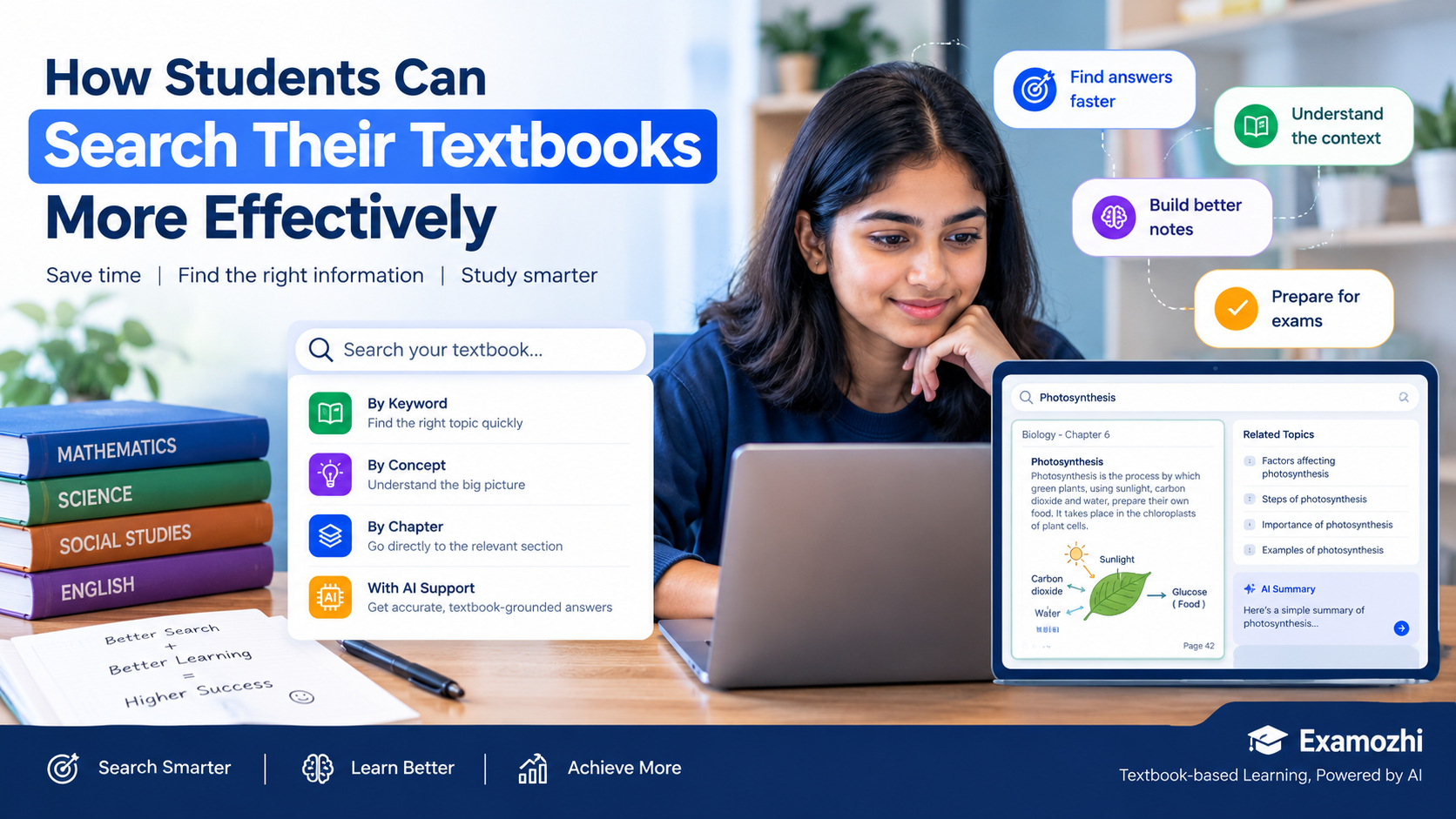
Today, students can combine traditional textbook navigation with keyword search, concept-based queries, chapter filters, and AI-powered textbook search. Platforms such as Examozhi are designed around searching actual curriculum content and returning textbook-grounded answers with source pages. Examozhi
The goal of effective textbook search is not simply to find an answer quickly. It is to find the right information, understand its context, and use it for learning.
1. Start With the Exact Topic:
Before searching, identify what you actually need.
Instead of searching an entire question, identify the main concept.
Example
Instead of:
❌ Explain all the factors that affect photosynthesis in plants.
Try:
✅ Factors affecting photosynthesis
The shorter search focuses on the important concept and can make it easier to locate the relevant section.
Quick Tip
Remove unnecessary words and keep the important academic terms.
2. Use Important Keywords:
Textbooks are usually organized around specific terminology.
If you know the important keywords from your syllabus, use them when searching.
For example:
| What You Remember | Better Search |
|---|---|
| How plants make food | Photosynthesis |
| Movement of blood | Blood circulation |
| Laws related to motion | Newton's laws of motion |
| Storage in computers | Memory |
| Finding errors in programs | Debugging |
Academic keywords are often more effective than long conversational questions.
3. Search by Chapter or Subject:
If you already know the chapter, use that information.
For example:
Subject → Chapter → Topic → Question
This reduces the amount of information you need to search through.
A Simple Example:
Suppose you are studying Physics.
Instead of searching the entire textbook for:
What is the relationship between force and acceleration?
Start with:
Physics → Force and Motion → Newton's Second Law
Then search for:
Force + acceleration
This approach narrows the search considerably.
4. Search for Concepts, Not Just Questions:
Sometimes you may remember the meaning of a question without remembering the exact words used in the textbook.
This is where concept-based searching can help.
For Example
You remember:
The process where cells divide to produce two identical cells.
You might search:
Cell division
or
Mitosis
rather than trying to reproduce the entire sentence.
Modern curriculum search systems can support semantic or concept-based retrieval, allowing related wording to match relevant textbook content. Examozhi, for example, describes its search as supporting concept, chapter, and question-based retrieval across indexed curricula. Examozhi
5. Use Different Search Variations:
If your first search does not find what you need, don't immediately assume the textbook does not contain the answer.
Try changing the wording.
Example
First search:
Causes of corrosion
If the result isn't useful, try:
Corrosion
Then:
Prevention of corrosion
Then:
Factors affecting corrosion
Different wording can lead you to different relevant sections.
Good searching often means trying two or three related keywords.
6. Search for Definitions Separately:
When preparing for exams, students often need definitions.
Instead of entering a long question, search the term itself.
Example
Instead of:
What do you mean by a data structure and what are its types?
Search:
Data structure
Then search:
Types of data structures
This makes it easier to separate the definition from the classification.
7. Search for Questions and Examples:
Textbooks often contain more than explanations.
They may include:
- Examples
- Exercises
- In-text questions
- Activities
- Definitions
- Formulas
- Diagrams
- Case studies
- Review questions
When studying for an examination, search for these specifically.
Useful Searches
Examples of…
Define…
Explain…
Advantages of…
Types of…
Difference between…
Applications of…
Exercise…
This can help students locate different types of learning material faster.
8. Use AI-Powered Textbook Search Carefully:
AI can make textbook searching more convenient.
Instead of manually scanning hundreds of pages, students can ask a textbook-grounded AI system a question and receive relevant content.
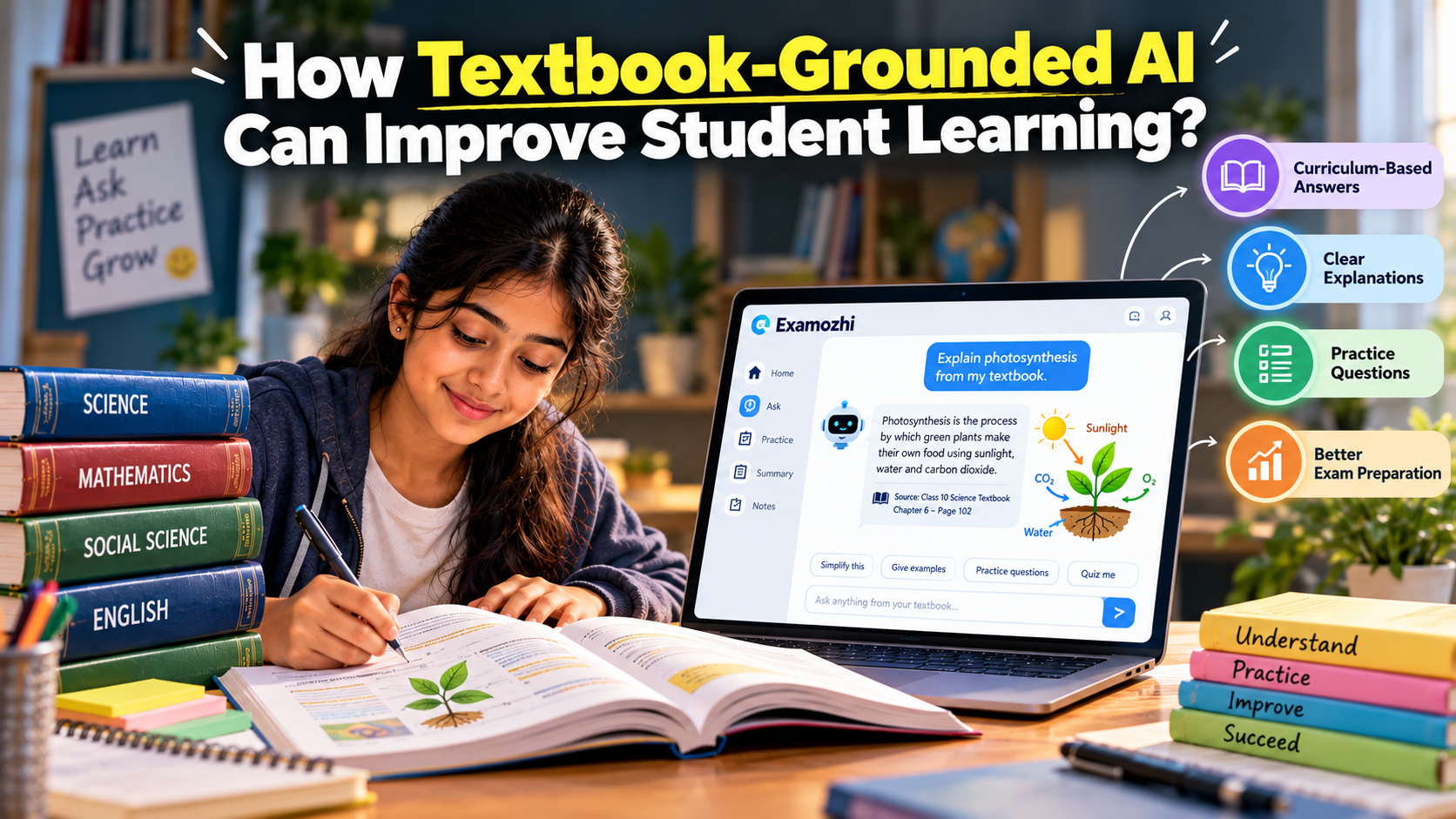
Examozhi's current platform states that it can read actual textbooks, search across curriculum content, and provide source-backed answers with the exact page. Examozhi
This can be particularly useful when you remember the concept but not the exact textbook wording.
Example
A student could ask:
The section about factors affecting photosynthesis.
The important advantage of textbook-grounded search is that the student can connect the result back to the original learning material.
9. Use Page References to Verify the Answer:
Finding an answer is only the first step.
Once you find the relevant content, check the original textbook page.
This helps you understand:
- The surrounding explanation
- Related diagrams
- Examples
- Definitions
- Important terminology
- Questions appearing before or after the section
Examozhi's answer experience provides source pages that students can open, helping them verify the answer against the textbook. Examozhi
Don't just save the answer. Read the source.
10. Search in Your Preferred Language When Possible:
For many Indian students, language can affect how easily they find information.
A student may understand a concept in English but naturally ask the question using another language or a combination of languages.
Examozhi states that its curriculum retrieval supports English, Tamil, Hindi, Telugu, Kannada, Malayalam, Bengali, Gujarati, Marathi, Urdu, and romanized/code-mixed queries. Examozhi
This can make textbook discovery more accessible for multilingual learners.
11. Use Search for Revision, Not Just Doubts:
Textbook search can become a revision tool.
Instead of searching only when you are confused, use it to create a structured revision session.
Try This Method
Search 1: Important definitions
⬇️
Search 2: Key concepts
⬇️
Search 3: Important examples
⬇️
Search 4: Exercise questions
⬇️
Search 5: Difficult topics
⬇️
Search 6: Topics you previously got wrong
This creates a more focused revision process.
12. Search by Exam Requirement:
Students often study according to the marks assigned to a question.
For example:
2 marks → Definition / short point
5 marks → Explanation with important points
10–12 marks → Detailed structured answer
If your learning platform supports exam-oriented responses, you can ask for information according to the required answer length.
Examozhi's chat interface currently allows answers to be shaped according to exam-mark formats from 1 to 20 marks. Examozhi
Example
Instead of:
Explain photosynthesis.
Try:
Explain photosynthesis as a 5-mark answer from my textbook.
This gives the search and explanation a clearer purpose.
13. Don't Depend Only on Exact Keywords:
One common mistake is assuming that the textbook must use exactly the same words as your question.
It may not.
For example, your question might say:
What are the benefits of renewable energy?
The textbook might discuss:
Advantages of renewable sources of energy.
The meaning is related, but the wording is different.
That's why concept-based and semantic search can be useful.
14. Create a Personal Search Strategy:
Different subjects may require different search methods.
| Subject | Useful Search Method |
|---|---|
| Mathematics | Formula, theorem, problem type |
| Physics | Concept, law, formula, application |
| Chemistry | Reaction, compound, definition, process |
| Biology | Process, system, terminology |
| Computer Science | Concept, syntax, algorithm, example |
| History | Event, person, year, movement |
| English | Lesson, character, theme, question |
| Commerce | Definition, concept, example, difference |
Key Point:
The best search strategy depends on the subject.
15. Use Search Results to Build Better Notes:
Once you locate relevant textbook content, don't simply copy everything.
Convert the information into:
- Key points
- Definitions
- Examples
- Formulas
- Diagrams
- Short summaries
- Possible exam questions
For example:
Topic: Newton's Second Law
Definition: → Key textbook definition
Formula: → F = ma
Meaning: → Relationship between force, mass, and acceleration
Example: → Real-world application
Practice: → Solve one problem independently
This creates a more useful revision resource.
16. Use the Textbook as the Source of Truth for Curriculum Study:
AI can provide explanations, but students preparing for curriculum-based examinations should remain connected to their prescribed textbook and teacher guidance.
This is especially important when:
- Preparing for board examinations
- Learning definitions
- Memorizing prescribed terminology
- Studying formulas
- Answering textbook-based questions
- Preparing long-answer questions
Use AI to understand the textbook—not to forget the textbook.
A Simple Textbook Search Formula
Students can remember this five-step method:
1. Identify
What exactly am I looking for?
2. Simplify
What are the 2–5 most important keywords?
3. Search
Try the keyword, concept, or chapter.
4. Verify
Check the original textbook context and page.
5. Study
Read, understand, practise, and recall the information independently.
Remember:
Identify → Simplify → Search → Verify → Study
Traditional Search vs Smart Textbook Search:
| Traditional Search | Smart Textbook Search |
|---|---|
| Browse page by page | Search by keyword or concept |
| Depend on exact wording | Understand related concepts |
| Search manually | Use digital search tools |
| Find an answer and stop | Find, verify, and understand |
| One search approach | Try multiple search variations |
| Focus only on answers | Connect answers to source material |
Smart search does not mean skipping the textbook. It means reaching the right part of the textbook more efficiently.
Final Takeaway
Students don't need to spend several minutes searching through every page whenever they have a doubt.
With the right approach, textbook searching can become much faster and more useful.
Use keywords. Search concepts. Filter by chapters. Try alternative wording. Use AI-powered textbook search when appropriate. Always verify the source. Then study the information independently.
Platforms such as Examozhi are designed around this textbook-grounded approach, allowing students to search curriculum content and connect answers back to their actual textbooks. Examozhi
The best textbook search is not the one that gives you an answer fastest. It is the one that helps you find, understand, and remember the right answer.