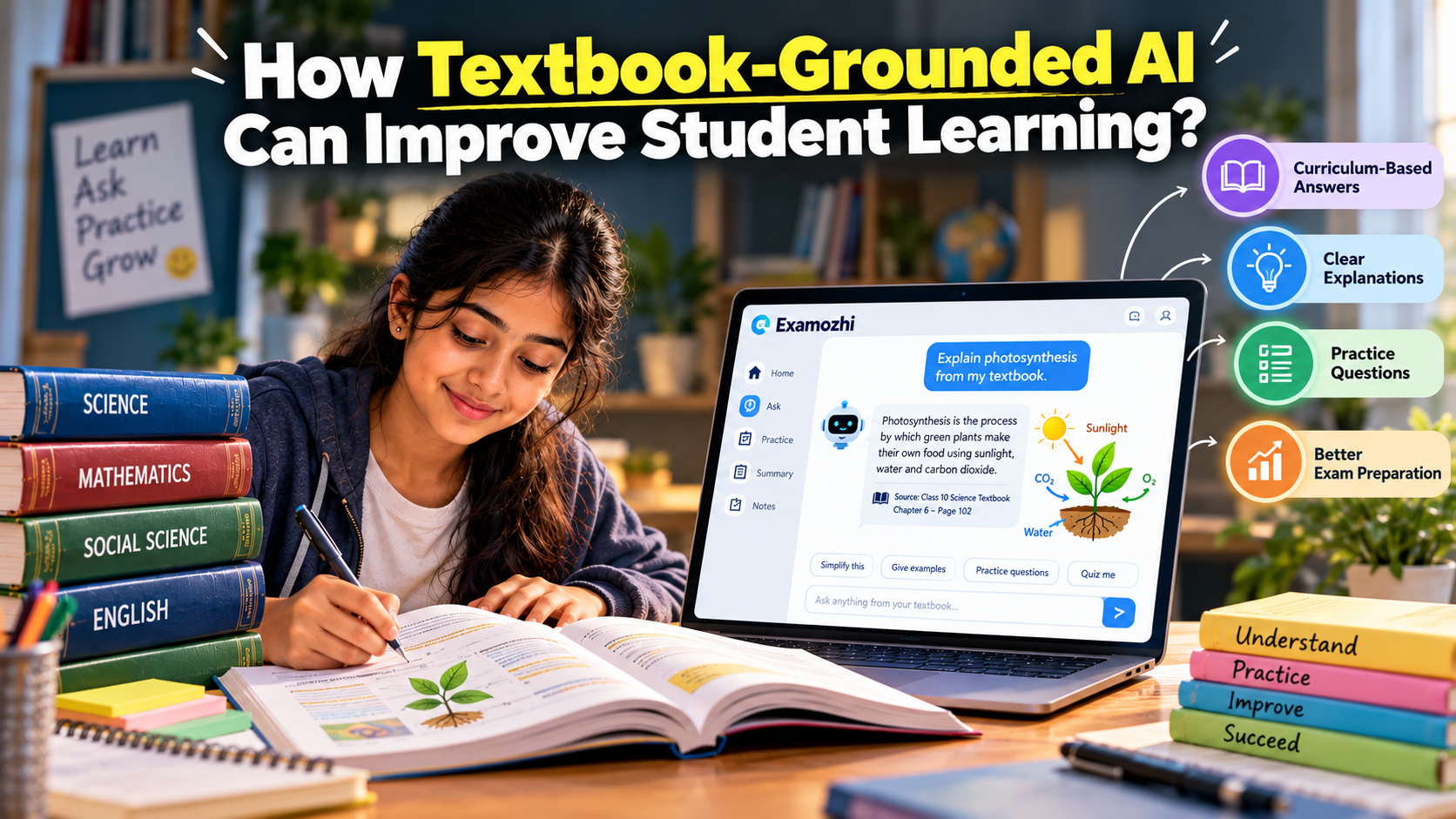
How textbook-Groundrd AI can improve student learning?
Discover how textbook-grounded AI improves student learning with curriculum-based answers, personalized explanations, practice questions, and better exam preparation.
Textbook-grounded AI is changing how students interact with educational content by connecting artificial intelligence with the textbooks they actually study. Instead of relying entirely on general AI-generated information, students can receive explanations, answers, and practice questions supported by relevant curriculum material.
For students preparing for examinations, this creates an important opportunity. AI can become more than a tool for finding quick answers. It can help learners understand difficult concepts, revisit textbook chapters, practise independently, and verify important information.
However, effective learning requires more than accurate-looking answers. Students must still think critically, attempt problems, and use their prescribed learning materials.
The real value of textbook-grounded AI is its ability to combine the structure of textbooks with the flexibility of interactive AI assistance.
This article explores how that combination works, its potential benefits, its limitations, and how Indian students can use it to build stronger study habits.
1. What Is Textbook-Grounded AI?
Textbook-grounded AI is an artificial intelligence approach that uses specified textbook or curriculum material as a source for answering educational questions.
Unlike a general-purpose chatbot that may respond from broad learned knowledge, a textbook-grounded system can search relevant educational content before constructing an answer.
For example, a student might ask:
Explain photosynthesis according to my Class 10 science textbook.
A textbook-grounded system can search the relevant chapter, identify appropriate material, and provide an explanation based on that source.
Depending on the platform, it may also display the textbook title, chapter, or page number.
Key characteristics
Curriculum relevance: Answers can be connected to prescribed educational material.
Source references: Students may be able to check where an answer originated.
Interactive explanations: Learners can ask follow-up questions.
Topic-focused assistance: Questions can be limited to relevant subjects or chapters.
Revision support: Textbook material can be used to produce summaries and practice exercises.
Key takeaway: Textbook-grounded AI combines educational source material with conversational learning support.
2. How Does Textbook-Grounded AI Work?
Many textbook-grounded AI applications use a technology called retrieval-augmented generation (RAG).
RAG allows an AI system to retrieve relevant information from a selected collection of documents before generating a response.
A simplified process involves five stages.
Step 1: Organizing textbooks
Textbook content is converted into a digital format and organized into searchable chapters, topics, or passages.
Step 2: Understanding the question
When a student asks a question, the system identifies the topic and searches for related content.
Step 3: Retrieving relevant passages
The system locates textbook information that appears relevant to the student's request.
Step 4: Generating an explanation
An AI model uses the retrieved material to formulate an understandable response.
Step 5: Providing source references
Where supported, the system shows the source chapter or page for verification.
Example workflow:
Student's question → Textbook search → Relevant passages → AI explanation → Source verification
This design gives students a clearer connection between their questions and the underlying educational material.
However, retrieval does not guarantee correctness. An AI system can still select unsuitable passages or misinterpret retrieved content.
Students should always verify important information, especially formulas, definitions, and exam-specific answers.
3. Why Curriculum-Based Learning Matters
Students preparing for school and college examinations need to understand material relevant to their academic requirements.
A general AI assistant may provide a technically accurate explanation that is too advanced, too broad, or inconsistent with the terminology used in the prescribed textbook.
For example, a student studying Newton's laws may require a simple explanation based on school-level physics.
An unrestricted AI answer might introduce complicated mathematical concepts that are not required for that examination.
Curriculum-grounded learning helps keep explanations connected to the student's actual educational level.
Benefits of curriculum alignment:
- Helps students focus on prescribed concepts.
- Supports preparation for syllabus-specific questions.
- Connects explanations to relevant chapters.
- Reduces unnecessary information outside the learning objective.
- Makes it easier to compare AI answers with classroom material.
- This is particularly important in India, where students follow different educational boards and curricula.
Important: Curriculum alignment does not guarantee examination success. Students must still understand concepts, practise questions, and follow current assessment requirements.
4. How Textbook-Grounded AI Improves Conceptual Understanding
One of the biggest challenges in education is understanding difficult concepts rather than simply memorizing them.
Students may read the same paragraph several times without fully understanding its meaning.
An AI study assistant can offer alternative explanations while maintaining a connection to the source material.
Example: Learning electrical resistance
A student reads about electrical resistance but finds the textbook explanation difficult.
They can ask:
Explain electrical resistance in simple language using my textbook chapter.
After reading the explanation, they can continue with:
Give me a practical example.
Then:
Ask me a question to test whether I understand the concept.
This creates a learning conversation.
The student can move through a sequence of understanding, questioning, practising, and checking.
Why this approach can help
1. Different explanations: Students can request simpler or more detailed descriptions.
2. Relevant examples: AI can connect abstract ideas to familiar situations.
3. Follow-up questions: Students can clarify individual points without searching through multiple resources.
4. Active engagement: The learning process becomes more interactive.
The benefit comes from the student's participation—not merely the AI's ability to produce explanations.
5. Textbook-Grounded AI vs General AI Chatbots
Both general-purpose and textbook-grounded AI can help students.
The difference lies primarily in how responses are supported by educational sources.
| Learning Feature | General AI | Textbook-Grounded AI |
|---|---|---|
| Knowledge scope | Broad information | Specified curriculum or textbooks |
| Syllabus relevance | Depends on the prompt | Designed around selected sources |
| Explanations | Flexible and wide-ranging | Can reference prescribed content |
| Source verification | Depends on the system | Often provides textbook references |
| Practice questions | Can generate general questions | Can generate questions from selected lessons |
| Accuracy | Requires verification | Still requires verification |
| Best use | Broad exploration | Curriculum-focused studying |
A general AI tool may be useful for exploring related ideas, brainstorming projects, or learning about unfamiliar subjects.
A textbook-grounded system may be more suitable when students need specific explanations connected to their syllabus.
The right choice depends on the learning objective.
For curriculum-based examinations, textbook relevance and source transparency are particularly valuable.
6. Personalized Learning With Textbook-Based AI
Students differ in their learning pace, confidence, and understanding of individual subjects.
A concept that seems simple to one student may require several explanations for another.
Textbook-based AI can support personalization by allowing students to request help at different levels.
For example, a student studying chemical reactions could ask:
Beginner: "Explain chemical reactions in simple words."
Intermediate: "Give me three examples from this chapter."
Advanced: "Create an application-based question."
Exam-focused: "Ask me a five-mark question and check my response."
This flexibility allows students to interact with the same educational content in different ways.
Supporting different learning needs
- AI can also help students:
- Request shorter explanations.
- evisit foundational concepts.
- Ask for additional examples.
- Generate questions at different difficulty levels.
- Focus on topics they find challenging.
Personalization should be based on the student's demonstrated needs and learning goals.
AI does not automatically know a student's abilities, emotions, or educational requirements. Students and teachers must still guide the process.
7. How AI-Generated Practice Questions Support Learning
Understanding a concept is only one part of exam preparation.
Students also need to retrieve information from memory and apply it independently.
Textbook-grounded AI can generate different question types from specific lessons.
These may include:
- Multiple-choice questions
- Fill-in-the-blanks
- Very short-answer questions
- Short-answer questions
- Long-answer questions
- Application-based problems
- Example study activity
After completing a biology chapter, a student could request:
Create five MCQs, three short-answer questions, and two application-based questions from this chapter. Do not show the answers until I finish.
The student attempts the questions independently.
AI can then provide feedback, while the student verifies important answers using the textbook.
This method encourages retrieval practice, an established learning strategy involving recalling information rather than simply rereading it.
Key takeaway: AI-generated questions are most useful when students attempt them before seeing the answers.
8. Making Exam Preparation More Effective
Preparing for exams often involves revisiting multiple chapters, identifying weak topics, and practising different question formats.
Textbook-grounded AI can support a more organized study process.
Before revision
Students can use AI to identify important concepts within a chapter and create a study checklist.
During revision
They can request concise summaries, explanations, and additional examples grounded in the prescribed material.
After revision
AI can generate practice tests and help students review mistakes.
Example revision routine
10 minutes: Read the textbook.
10 minutes: Ask questions about difficult concepts.
15 minutes: Attempt textbook and AI-generated practice questions.
5 minutes: Review mistakes and identify the next revision topic.
This is an illustrative routine, not a scientifically prescribed duration. Students should adjust it to the subject and their learning needs.
Successful exam preparation depends on consistent practice, accurate understanding, and independent problem-solving—not simply the number of AI-generated answers received.
9. Helping Students Learn in Multiple Languages
Language can influence how easily students understand educational explanations.
In multilingual classrooms, learners may be comfortable speaking one language while studying textbooks written in another.
AI systems with multilingual capabilities can help bridge this gap.
For example, a student studying an English science textbook may request a simpler explanation in Tamil or Hindi.
The student can then compare the translated explanation with the original terminology.
Potential multilingual benefits
Improved accessibility: Students can ask questions in familiar languages.
Concept clarification: Difficult terminology can be explained more simply.
Bilingual revision: Students can compare concepts across languages.
Greater participation: Learners can ask questions without being limited to one language.
However, scientific and academic terms can be difficult to translate precisely.
Students should verify essential definitions and examination terminology against the original prescribed material.
Multilingual AI works best when it supports understanding while preserving the accuracy of curriculum concepts.
10. Reducing the Risk of AI Hallucinations
An AI hallucination occurs when a system generates incorrect or unsupported information that may sound convincing.
For students, such errors can be harmful when memorized for examinations.
Textbook-grounded AI can help address this issue by connecting responses to relevant source documents.
This makes it easier to investigate whether an explanation is supported by the prescribed material.
What source-grounding can improve
Source visibility: Students can inspect the underlying material.
Relevant retrieval: Systems can prioritize information from selected textbooks.
Answer transparency: Some platforms identify the passages used to generate a response.
Verification: Teachers and students can compare answers with published content.
However, textbook-grounded AI is not automatically hallucination-free.
Errors can still arise from poor source retrieval, outdated editions, incorrect document processing, or flawed interpretation.
UNESCO's guidance on generative AI in education emphasizes the importance of human oversight, responsible implementation, and protecting learners.
The safest approach is to treat AI explanations as learning assistance and verify important information using trustworthy sources.
11. How Teachers Can Benefit From Textbook-Grounded AI
- Students are not the only people who can benefit from curriculum-grounded educational tools.
- Teachers may also use them to support lesson preparation, revision activities, and classroom discussions.
- For example, a teacher could generate additional practice questions based on a textbook chapter.
- They could then review the questions, correct any errors, and select suitable examples for students.
Practical classroom applications
- Preparing topic-based quizzes.
- Generating different difficulty levels.
- Creating additional explanation examples.
- Developing revision worksheets.
- Identifying common misconceptions.
- Supporting multilingual explanations.
The OECD's Digital Education Outlook 2026 describes the potential of educational AI to support teaching and tutoring when implemented with appropriate educational goals.
Importantly, teachers remain responsible for evaluating content and guiding students.
AI can help prepare educational material, but professional teaching judgment remains essential.
12. Why Textbook-Grounded AI Matters for Indian Students
India has a diverse education system with multiple boards, languages, and curriculum structures.
Students preparing for CBSE, ICSE, NCERT-based, and state-board examinations often need explanations related to their prescribed textbooks.
A curriculum-grounded AI system can help connect this material with interactive learning support.
Supporting syllabus-specific study
Students can ask questions about concepts from their own chapters rather than relying on unrestricted information.
Supporting board-exam revision
AI can help create topic-based practice questions and concise summaries that students can compare with prescribed materials.
Supporting regional languages
Multilingual interaction can help learners understand difficult concepts more comfortably.
Supporting independent learning
- Students can ask follow-up questions while studying at home, especially when immediate teacher assistance is unavailable.
- Platforms such as Examozhi are designed around Indian curriculum content and textbook-grounded learning.
- The platform describes support for curriculum material including CBSE, ICSE, TN Samacheer Kalvi, and NCERT.
For Indian students, the main advantage is the ability to connect interactive AI assistance with familiar academic material.
13. How Examozhi Supports Textbook-Based AI Learning
Examozhi focuses on combining curriculum-based educational content with AI-powered assistance.
Rather than treating AI as an unrestricted answer generator, its platform emphasizes searching actual textbook material and providing source-backed responses.
Its published capabilities include:
- Textbook-grounded explanations: Students can ask questions connected to relevant curriculum content.
- Source-backed answers: The platform is designed to display references to the textbook material used.
- AI-powered question generation: Students can create additional practice questions from educational topics.
- Curriculum search: Learners can explore chapters and concepts using natural-language questions.
- Multilingual interaction: The platform describes support for student questions in Tamil, English, Hindi, and romanized language forms.
Exam-oriented answers: Its student assistant supports responses shaped around examination mark allocations.
Students can also explore Examozhi's study rooms, which are designed for collaborative revision using textbook-backed answers.
These features illustrate how a specialized educational platform can connect familiar study materials with interactive AI capabilities.
The objective is not to replace the textbook. It is to make textbook knowledge easier to search, understand, practise, and discuss.
14. Best Practices for Using Textbook-Grounded AI
Students can get more educational value from AI by using a clear learning process.
1. Begin with the textbook
Read the original lesson to understand the topic and its context.
2. Ask focused questions
Instead of requesting an entire chapter summary immediately, identify the concepts you find difficult.
3. Request simple explanations
Ask the system to explain complicated ideas using familiar examples.
4. Check textbook references
Review the relevant source material when available.
5. Practise without assistance
Attempt problems independently before requesting solutions.
6. Analyse mistakes
Ask AI to explain why an attempted answer was incorrect.
7. Return to difficult topics
Use additional examples and practice questions to strengthen understanding.
8. Follow classroom guidelines
Respect your teacher's instructions and institutional rules about AI use.
9. Protect personal information
Avoid sharing unnecessary sensitive data with AI platforms.
10. Test your understanding independently
Close the AI tool and try explaining the concept in your own words.
A simple learning framework is:
Read → Understand → Ask → Practise → Verify → Revise
The strongest use of textbook-grounded AI is not obtaining answers faster. It is helping students become more confident, capable, and independent learners.
Conclusion
Textbook-grounded AI offers a practical way to bring artificial intelligence into curriculum-based education.
By connecting interactive learning support with prescribed educational material, it can help students understand concepts, practise questions, prepare for examinations, and verify information more effectively.
However, the technology works best when students remain active participants in their learning.
Textbooks provide the foundation. AI provides flexible assistance. Teachers provide guidance. Students develop the understanding.
When these elements work together, textbook-grounded AI can become a valuable part of a modern, responsible, and effective learning experience.