How AI can become your personal study assistant
Learn how an AI personal study assistant can help students understand concepts, revise lessons, practise questions, and build smarter study habits.
How AI Can Become Your Personal Study Assistant
Studying does not always fail because students lack time. Sometimes the real problem is knowing what to study, how to understand a difficult concept, and how to practise effectively.
A student may spend 30 minutes searching for an explanation, another 20 minutes creating revision notes, and even more time finding suitable questions to practise. Artificial intelligence can bring many of these activities into one learning workflow.
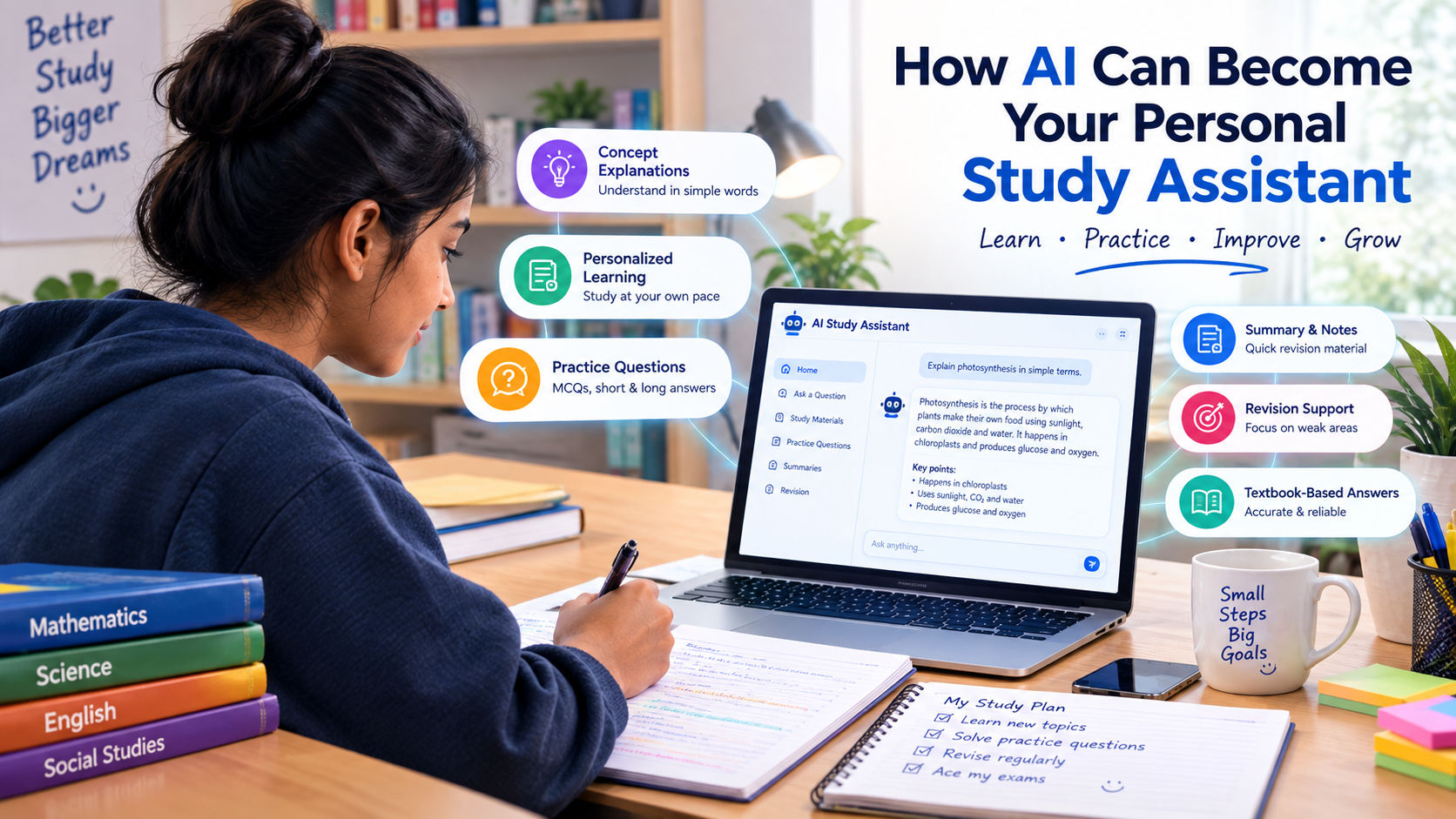
An AI personal study assistant can explain concepts, answer questions, generate practice exercises, summarize study material, and help students review topics. Instead of treating AI as a machine that simply gives answers, students can use it as an interactive learning partner.
This approach is becoming increasingly relevant as AI becomes part of everyday education. The OECD's Digital Education Outlook 2026 notes that generative AI can support learning when it is used with clear educational principles, while simply outsourcing tasks to AI may improve the finished task without necessarily producing meaningful learning gains.
The difference comes down to how students use the technology.
What Is an AI Personal Study Assistant?
An AI personal study assistant is an artificial intelligence system that helps a learner with different parts of the study process.
Instead of performing only one task, an AI study assistant can support multiple activities, such as:
- Explaining difficult concepts
- Answering study-related questions
- Summarizing lessons
- Creating practice questions
- Helping with revision
- Providing examples
- Giving feedback on attempted answers
- Finding relevant information in study material
- Supporting different learning styles
- Helping students organize their study process
The important word is assistant.
The purpose is not to replace the student's thinking. It is to make learning more interactive and provide support when the student needs it.
For example, a student studying photosynthesis could ask an AI assistant to explain the concept in simple language, provide an example, create five questions, and then test the student's understanding.
That turns a static lesson into an interactive learning session.
How an AI Study Assistant Can Help Students
1. It Can Explain Difficult Concepts
One of the most common study problems is getting stuck on a concept.
A textbook may provide the correct explanation, but a student may still need another way of understanding it.
An AI assistant can provide explanations in different formats.
A student could ask:
“Explain this concept in simple words.”
Then follow up with:
“Give me a real-life example.”
Or:
“Explain it as if I am learning it for the first time.”
This ability to ask follow-up questions makes AI different from simply reading a page of notes.
The student can keep asking questions until the concept becomes clearer.
2. It Can Turn Questions Into a Learning Conversation
Traditional study often involves reading information and trying to remember it.
AI can make the process conversational.
For example:
Student: Explain Newton's second law.
AI: Provides the explanation.
Student: Give me an example.
AI: Provides an example.
Student: Now ask me a question.
AI: Generates a question.
Student: Check my answer.
AI: Provides feedback.
The student is no longer only consuming information. They are interacting with it.
That interaction can make revision more active.
3. It Can Create Personalized Practice
Students do not always need the same questions.
Someone who has just learned a topic may need basic questions, while a student preparing for an examination may want more challenging application-based questions.
An AI assistant can create different levels of practice.
For example:
Beginner: Define the concept.
Intermediate: Explain how it works.
Advanced: Apply it to a situation.
Exam level: Answer it in the format expected for the required marks.
This gives students a way to move gradually from understanding → practice → application.
AI Can Make Revision More Efficient
Revision is not simply reading the same chapter repeatedly.
Effective revision involves recalling information, testing understanding, identifying weak areas, and returning to topics that need more attention.
AI can support each of these activities.
Create Quick Summaries
After completing a chapter, students can use AI to create a concise summary containing:
- Important concepts
- Definitions
- Key points
- Formulas
- Important examples
- Potential questions
However, students should compare AI-generated summaries with their original textbook or trusted study material rather than assuming every generated summary is automatically correct.
Generate Revision Questions
Instead of rereading a chapter, students can ask an AI assistant to create a short test.
For example:
“Create 10 questions from this chapter. Don't show the answers until I finish.”
The student can then attempt the questions independently.
This makes AI useful not just for giving information, but also for testing knowledge.
Identify Weak Areas
Another useful approach is asking:
“Based on the questions I got wrong, which topics should I revise again?”
This can help students focus their revision instead of spending equal amounts of time on every topic.
Textbook-Based AI Can Make Study Assistance More Relevant
For students preparing for curriculum-based examinations, general information is not always enough.
An explanation found online might be accurate but may not match the terminology, scope, or content used in the student's textbook.
This is where textbook-grounded AI can be useful.
Examozhi, for example, describes itself as an AI system that reads students' actual textbooks and provides answers with the relevant source page. It currently indexes curriculum content including CBSE, ICSE, TN Samacheer Kalvi, and NCERT.
Its "textbook-grounded answers" (https://examozhi.com/answers) are designed around real board-exam questions and provide the source page associated with the answer.
This approach can reduce the gap between "What does AI know?" and “What does my curriculum actually require me to learn?”
An AI Study Assistant Can Support Different Study Modes
Not every study session should look the same.
Students can use an AI assistant in different modes depending on what they are doing.
Learning Mode
Use AI when learning a new concept.
Example:
«"Explain this topic step by step and give me one simple example."»
Revision Mode
Use AI after completing a chapter.
Example:
«"Give me the five most important concepts from this lesson."»
Practice Mode
Use AI when testing yourself.
Example:
«"Give me 10 questions without answers. I will attempt them first."»
Doubt-Clearing Mode
Use AI when something is confusing.
Example:
«"I understand the first step, but I don't understand why the second step is necessary."»
Exam Mode
Use AI to practise answers according to the expected format.
Example:
«"Give me an exam-style question and wait for my answer before showing the solution."»
Using different modes prevents AI from becoming just an answer-generation tool.
From "Give Me the Answer" to “Help Me Learn”
There is a major difference between these two approaches.
Less Effective Use| Learning-Focused Use
"Give me the answer."| “Help me understand the concept.”
Copy the generated response| Attempt the problem first
Read a summary only| Compare the summary with the textbook
Ask AI to solve everything| Ask AI to explain mistakes
Memorize generated answers| Practise recalling concepts
Depend completely on AI| Use AI alongside independent study
The second approach makes the student an active participant.
This matters because successful completion of an AI-assisted task does not automatically mean that learning has occurred. The OECD highlights the risk that students may outsource cognitive work to general-purpose AI tools and achieve better outputs without equivalent learning gains.
How to Use AI Without Becoming Dependent on It
The most useful AI study routine follows a simple rule:
Try first. Ask second. Verify third.
Step 1: Try the problem yourself
Before asking AI for a solution, spend some time attempting it.
Step 2: Ask for guidance
If you are stuck, ask for a hint or explanation instead of immediately requesting the final answer.
Step 3: Complete the problem
Use what you learned to finish the question yourself.
Step 4: Compare your answer
Ask AI to identify mistakes or differences between your answer and the expected solution.
Step 5: Verify important information
Check important facts, formulas, definitions, and syllabus-specific information against your textbook or another trusted source.
This keeps independent thinking at the centre of the learning process.
AI Can Also Support Group Study
An AI study assistant does not have to mean studying alone.
Students can combine AI with group learning.
For example, a group can:
1. Choose one chapter.
2. Ask AI to generate discussion questions.
3. Each student answers a question.
4. The group compares their explanations.
5. AI is used to clarify disagreements.
6. Everyone completes a short test at the end.
Examozhi also offers "live study rooms" (https://examozhi.com/rooms), where students can revise textbook material together and ask questions with answers grounded in the relevant textbook.
This illustrates another possible role for AI: supporting collaboration rather than replacing it.
The Importance of AI Literacy for Students
Using AI effectively requires more than knowing what to type into a chatbot.
Students also need to understand that AI-generated information can have limitations.
UNESCO's AI Competency Framework for Students emphasizes areas including a human-centred mindset, ethics of AI, AI techniques and applications, and AI system design. It also emphasizes the ability to understand, apply, and create with AI.
Similarly, the OECD and European Commission's 2026 AI literacy framework describes AI literacy as helping learners understand AI systems, critically evaluate their outputs, and use AI responsibly and creatively.
For students, this means asking questions such as:
- Is this answer supported by my textbook?
- Can I explain the concept without AI?
- Does this information make sense?
- Should I verify this fact?
- Am I using AI to learn or simply to avoid thinking?
These questions are becoming part of responsible digital learning.
A Simple Daily AI Study Workflow
Students do not need to use AI for every part of their day.
A simple workflow can be enough.
Before Studying
Ask AI to help identify the key topics you need to cover.
During Studying
Read the textbook or class material first. Use AI when you encounter a difficult concept.
After Each Topic
Ask for a few practice questions and attempt them independently.
At the End of the Session
Ask AI to create a short revision test.
Before the Exam
Use practice questions and your own notes to identify topics that need another round of revision.
The complete cycle becomes:
Learn → Question → Practise → Check → Revise → Test
This is much more valuable than simply asking AI to generate notes and memorizing them.
What the Future of Personal Study Assistants Could Look Like
AI study assistants are moving toward more specialized educational experiences.
Instead of providing generic answers, educational AI can be connected to curriculum structures, textbooks, chapters, topics, assessments, and learning goals.
Examozhi, for instance, describes capabilities including curriculum search, source-backed answers, summaries, explanations, question generation, multilingual search, and curriculum versioning.
This direction could make AI more useful for students because the assistant can be connected to the material they are actually expected to study.
But the goal should not be to create a system that does all the thinking for students.
The better goal is to create a system that helps students think better, practise more, and understand more clearly.
Final Thoughts
An AI personal study assistant can become a useful part of a student's learning routine.
It can explain difficult concepts, answer questions, generate practice material, support revision, and help students interact with their textbooks in new ways.
But AI works best when students remain actively involved.
Read first. Think first. Attempt first. Then use AI to strengthen your learning.
When used this way, AI is not simply an answer machine. It becomes a tool that can support the learning process while leaving the most important part—the actual understanding—to the student.