How AI is changing the way students preparing for exams
Discover how AI for exam preparation helps students revise, understand concepts, generate practice questions, and study more effectively.
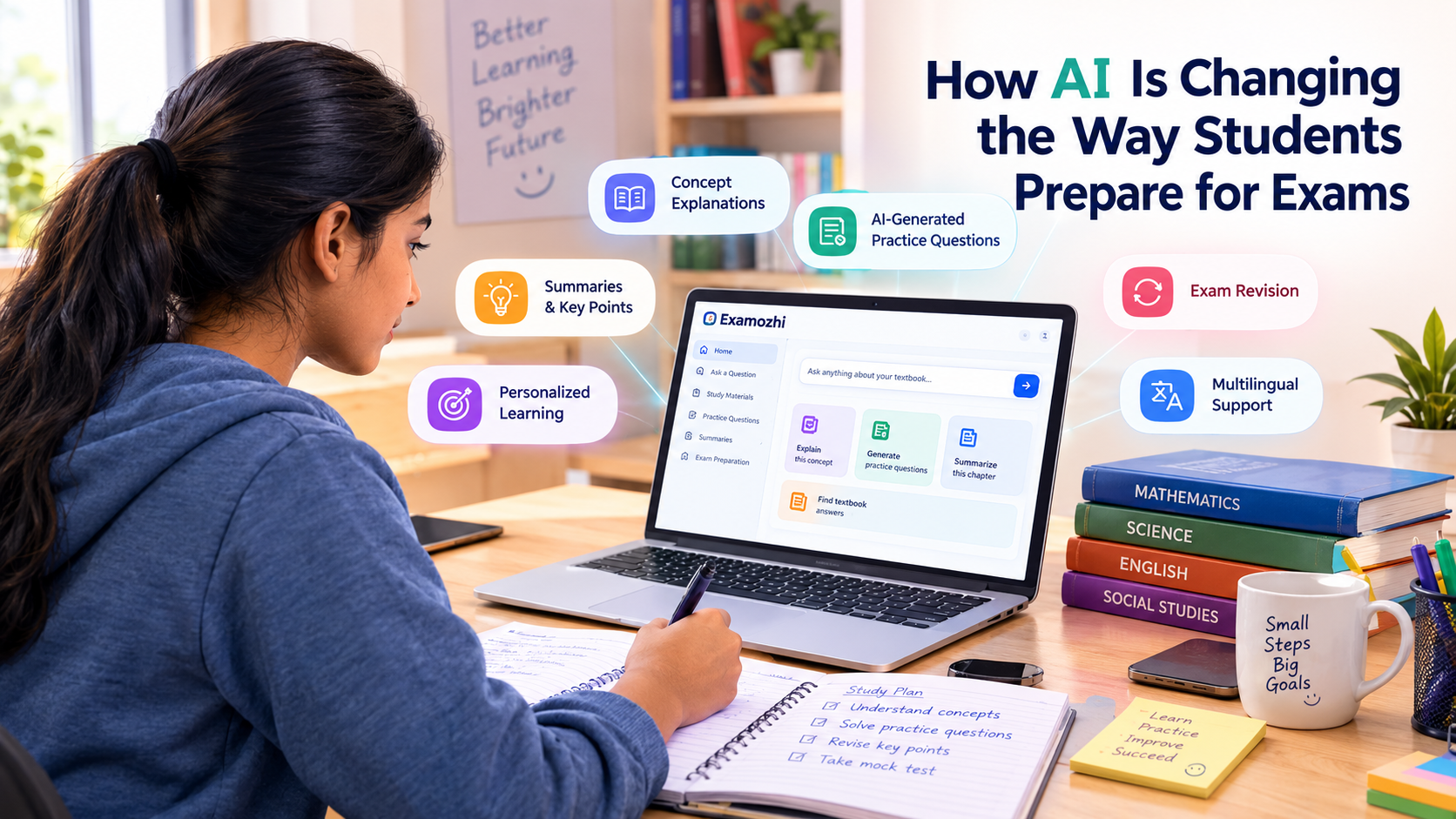
How AI Is Changing the Way Students Prepare for Exams
Preparing for an exam has traditionally meant reading textbooks, making notes, memorizing important points, solving previous-year papers, and asking teachers or friends when a topic becomes difficult. Artificial intelligence is adding another layer to this process.
With AI-powered learning tools, students can ask questions in natural language, receive explanations, create practice questions, summarize study material, and revise concepts interactively. This does not mean AI should replace textbooks, teachers, or independent thinking. Instead, when used thoughtfully, it can become an additional study assistant.
The growing use of AI in education has also created an important question: Does using AI actually help students learn, or does it simply help them complete tasks faster?
The answer depends largely on how the technology is used. The OECD's Digital Education Outlook 2026 notes that generative AI can support learning when it is used with clear educational and teaching principles, while simply outsourcing cognitive tasks to AI may improve task performance without producing meaningful learning gains.
For students, this makes the goal clear: use AI to understand, practise, question, and revise, rather than simply copy answers.
What Is AI for Exam Preparation?
AI for exam preparation refers to the use of artificial intelligence tools to support activities such as studying, revision, practice, explanation, and assessment.
Instead of searching through multiple websites for every question, students can use AI-based systems to interact with their study material in a more direct way.
Depending on the tool, students can use AI to:
- Explain difficult concepts in simpler language
- Summarize chapters and topics
- Generate multiple-choice questions
- Create short-answer and long-answer practice questions
- Identify areas that need additional revision
- Provide step-by-step explanations
- Turn textbook content into revision material
- Search for information using natural-language questions
- Practise answering questions before an exam
- Study in different languages
The quality of the result, however, depends on the quality and reliability of the underlying information. For curriculum-based exams, an AI system that is grounded in the student's actual textbook or syllabus can be particularly useful.
For example, "Examozhi" (https://examozhi.com/) is designed around Indian curriculum content and provides textbook-grounded answers, explanations, summaries, question generation, and curriculum search.
How AI Is Changing the Exam Preparation Process
AI does not necessarily change what students need to learn. Instead, it can change how they interact with what they need to learn.
1. From passive reading to interactive learning
Traditional studying can sometimes become a one-way activity: read a chapter, underline important points, and try to remember them later.
AI can make this process more interactive.
A student studying Newton's laws, for example, could ask:
«"Explain Newton's second law in simple language."»
Then the student can continue with:
- “Give me a real-life example.”
- “Ask me five questions about it.”
- “Give me a difficult question.”
- “Explain where my answer went wrong.”
This creates a question-and-answer learning loop rather than simply reading information.
2. Faster explanations of difficult concepts
Students do not always struggle because a topic is inherently difficult. Sometimes the explanation in their study material simply does not match the way they understand concepts.
AI can provide explanations at different levels of complexity.
For example, a student could request:
- A simple explanation
- A detailed explanation
- An example-based explanation
- A step-by-step explanation
- A short revision version
Educational AI tools can therefore help students approach the same concept from different angles.
3. Personalized revision
Not every student needs to spend the same amount of time on every chapter.
One student may understand a topic after one explanation, while another may need additional examples and practice.
AI can support this type of personalized learning by allowing students to ask targeted questions based on their difficulties.
A practical revision cycle could look like this:
Learn → Ask → Practise → Check → Revise → Test
This is more useful than repeatedly reading the same notes without checking whether the concepts have actually been understood.
4. AI-generated practice questions
Practice is one of the most important parts of exam preparation.
AI can generate different question formats from a topic, including:
- MCQs
- Fill-in-the-blank questions
- Short-answer questions
- Long-answer questions
- Conceptual questions
- Application-based questions
This can reduce the time students spend creating their own practice sets.
Examozhi, for example, provides question-generation capabilities that can create MCQ, short-answer, and long-answer questions from curriculum content.
The important step is not merely generating questions. Students should attempt them without looking at the answer first.
5. Faster revision before exams
During the final days before an examination, students often need concise revision material rather than another complete reading of every chapter.
AI can help transform larger study material into shorter revision formats.
For example:
Full chapter → Key concepts → Important definitions → Formulas → Practice questions → Final revision
This can be especially useful when a student needs to revisit several topics.
However, summaries should be checked against the original textbook or trusted study material, especially when preparing for syllabus-specific examinations.
Traditional Exam Preparation vs AI-Assisted Preparation
Traditional Approach| AI-Assisted Approach
Manual revision| AI-supported revision
Search through multiple notes| Ask targeted questions
Manually create practice questions| Generate practice questions
One explanation style| Multiple explanation styles
Static study material| Interactive learning
Manual topic summaries| AI-assisted summaries
Teacher or friend for every doubt| AI for immediate preliminary explanations
Revision based mainly on memory| Revision combined with practice and feedback
AI does not make traditional methods unnecessary. Textbooks, teachers, classroom learning, problem-solving, and independent revision remain important.
Instead, AI can act as another layer between the student's study material and their learning process.
The Importance of Textbook-Grounded AI
One of the biggest challenges with general-purpose AI tools is that a fluent answer is not necessarily the same as a syllabus-correct answer.
This matters during exams.
A student may ask a general AI tool about a topic and receive a technically reasonable explanation that does not match the terminology, depth, or content expected by their curriculum.
Textbook-grounded AI approaches this problem differently.
Instead of treating the entire internet as the source of an answer, the system can retrieve information from specified curriculum content and use that material to construct the response.
Examozhi describes its approach as allowing students to ask questions from their actual textbooks and receive source-backed answers, including the relevant textbook page. Its platform currently covers curriculum content including CBSE, ICSE, TN Samacheer Kalvi, and NCERT.
This type of approach can be particularly relevant for students preparing for curriculum-based examinations.
How Students Can Use AI Effectively for Exam Preparation
AI becomes more useful when students give it a specific learning task.
Use AI as a tutor, not an answer-copying machine
Instead of asking:
“Give me the answer.”
Try:
“Explain this concept first, then give me a practice question.”
This forces the learning process to include understanding before answering.
Ask AI to test you
After studying a chapter, ask AI to create a short test.
For example:
1. Answer five MCQs without help.
2. Attempt three short-answer questions.
3. Try one application-based question.
4. Review mistakes.
5. Revisit the relevant topic.
This turns AI into a practice partner.
Ask for different difficulty levels
Students can gradually increase difficulty:
Level 1: Basic definition
Level 2: Conceptual question
Level 3: Application question
Level 4: Exam-style question
Level 5: Challenging problem
This can help students identify whether they genuinely understand a topic or only remember its definition.
Use AI to find gaps in understanding
A useful prompt is:
“Ask me five questions about this chapter and identify the topics I need to revise based on my answers.”
The purpose is not to let AI decide everything about a student's preparation. It is to provide another way of identifying areas that deserve attention.
What Are the Risks of Using AI for Studying?
AI-assisted learning also has limitations.
1. Overdependence
If students ask AI for every answer without attempting problems themselves, they may become less comfortable with independent problem-solving.
The OECD's 2026 research highlights this concern: simply outsourcing cognitive work to generative AI can improve the quality of a completed task without necessarily creating corresponding learning gains.
2. Incorrect information
AI systems can sometimes produce incorrect or misleading information.
For exam preparation, students should therefore verify important facts, formulas, definitions, and syllabus-specific answers against reliable educational sources.
3. Reduced critical thinking
Students should not automatically accept every AI-generated explanation.
They should ask:
- Does this match my textbook?
- Can I explain it in my own words?
- Is the calculation correct?
- Does this answer actually address the question?
- Is there evidence for the claim?
UNESCO's guidance on generative AI in education emphasizes a human-centred approach that considers safety, ethics, privacy, equity, and meaningful educational use.
4. Academic integrity
Using AI to understand a topic is different from submitting AI-generated work as one's own.
Students should follow their school's or college's rules regarding AI use, particularly for assignments, assessments, and examinations.
A Practical AI-Powered Exam Preparation Workflow
Students can integrate AI into an existing study routine without allowing it to replace actual studying.
Step 1: Learn the chapter
Read the textbook, lecture material, or teacher-provided notes first.
Step 2: Identify difficult topics
Write down concepts you could not understand clearly.
Step 3: Ask AI for explanations
Use AI to simplify those specific concepts.
Step 4: Practise without assistance
Attempt questions yourself before asking AI for the solution.
Step 5: Check your mistakes
Use AI to understand why an answer was incorrect.
Step 6: Generate additional questions
Create new questions based on the same topic.
Step 7: Perform a final revision
Use concise summaries, key points, formulas, and practice questions to revise.
This creates a healthy balance:
Textbook + Teacher + AI + Independent Practice
rather than:
AI → Copy → Memorize → Forget
The Future of AI-Powered Exam Preparation
AI in education is moving beyond simple chatbots.
Current educational AI systems are increasingly being designed around specific learning purposes, curriculum content, assessment, retrieval, and personalization.
The OECD's 2026 Digital Education Outlook argues that educational GenAI is more promising when it is designed or used with clear pedagogical intent rather than simply used to outsource tasks.
AI literacy is also becoming increasingly important. A 2026 OECD/European Commission framework describes AI literacy as including the ability to understand AI systems, critically evaluate their outputs, and use AI responsibly and creatively.
For students, this means the future of AI-assisted exam preparation is unlikely to be simply about getting answers faster.
It will increasingly be about asking better questions, practising more effectively, checking information, and understanding where AI should—and should not—be trusted.
How Examozhi Fits Into AI-Based Exam Preparation
Platforms such as "Examozhi" (https://examozhi.com/) demonstrate how curriculum-grounded AI can support exam preparation.
Its student-focused tools allow learners to interact with textbook content, ask questions, receive source-backed answers, generate practice questions, and access explanations. Examozhi also provides an "answers section" (https://examozhi.com/answers) focused on textbook-grounded responses to Indian curriculum and board-exam questions.
The underlying idea is straightforward: AI becomes more useful for education when it is connected to the content students are actually expected to learn.
For a student preparing for an exam, that can mean spending less time searching for scattered information and more time understanding and practising the material.
Conclusion
AI is changing exam preparation by making studying more interactive, responsive, and personalized.
Students can use AI to explain difficult concepts, summarize material, generate practice questions, test their knowledge, and identify areas that require more revision. But the technology is most effective when it supports active learning rather than replacing it.
The key is to use AI as a study assistant—not a substitute for studying.
Read the textbook. Ask questions. Attempt problems. Check mistakes. Verify important information. Practise without assistance. Then use AI to strengthen the areas where you need help.
That approach allows students to benefit from the speed and flexibility of AI while keeping the most important part of exam preparation in their own hands: learning.