The Future of AI-Powered Learning in Indian Schools
Explore the future of AI-powered learning in Indian schools, from personalized education and AI literacy to teachers, ethics and curriculum changes.
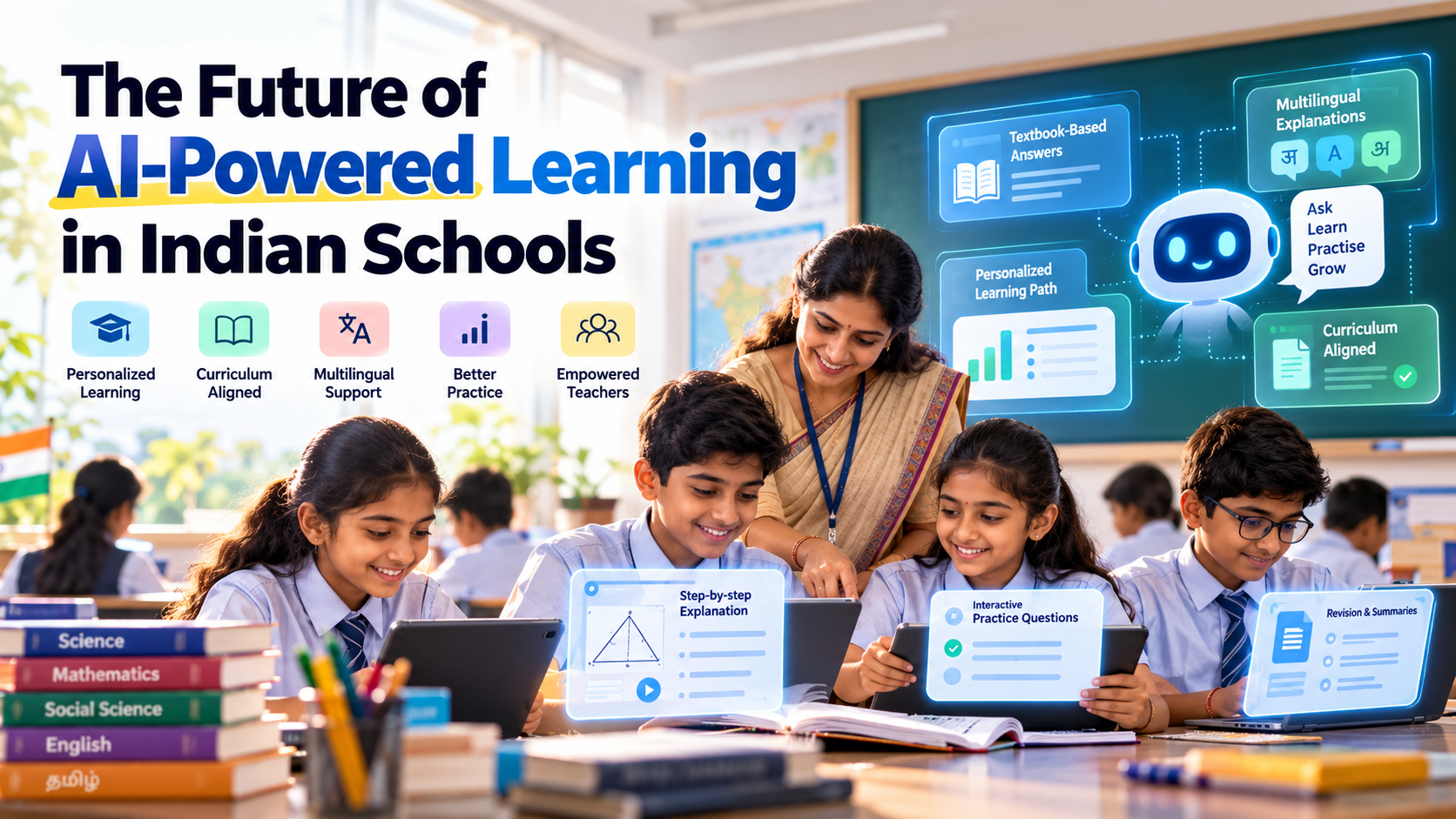
A classroom in India is beginning to look different.
Students still have textbooks. Teachers still explain concepts, ask questions, and guide discussions. But alongside these familiar parts of education, a new layer is emerging: artificial intelligence.
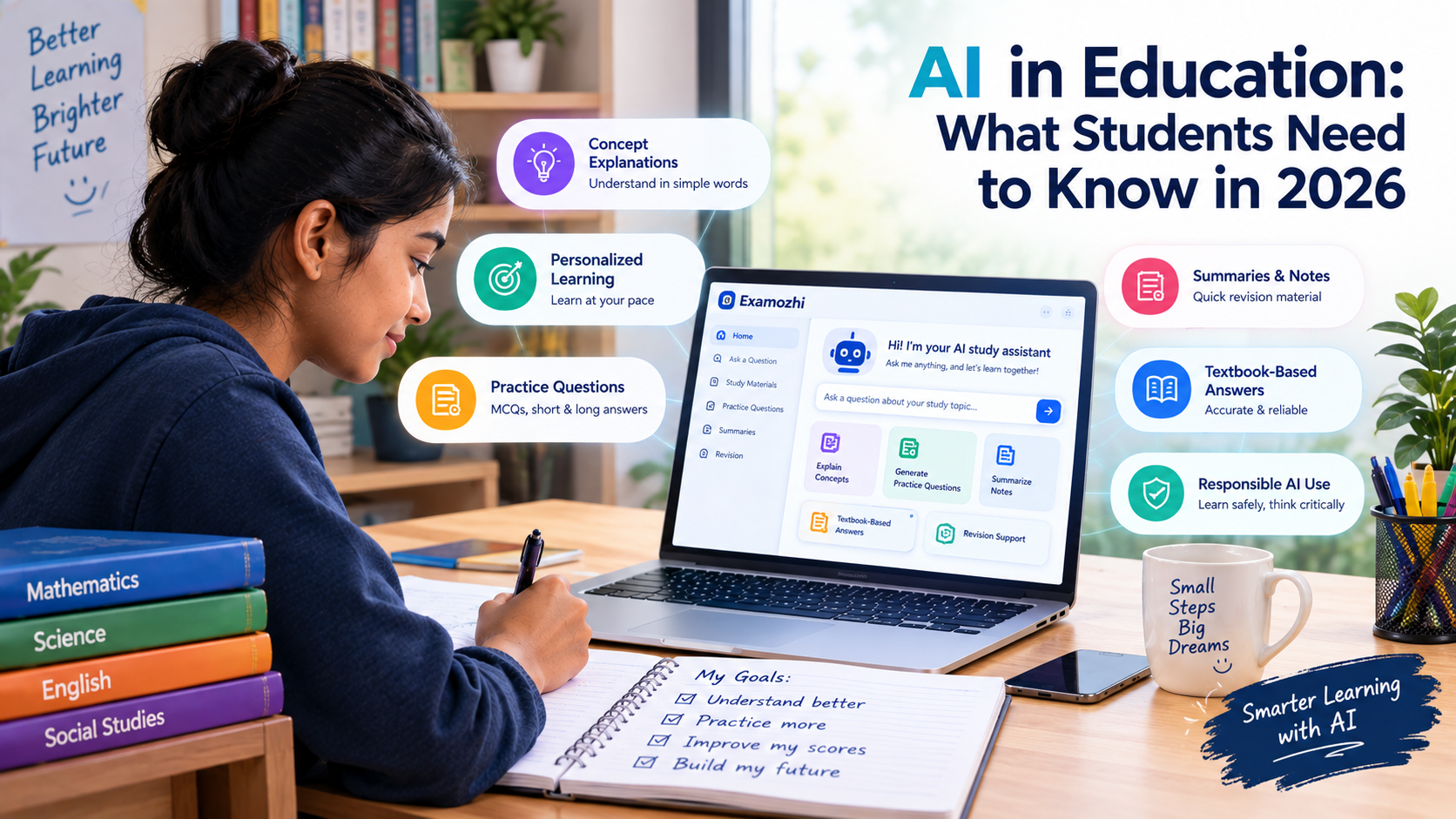
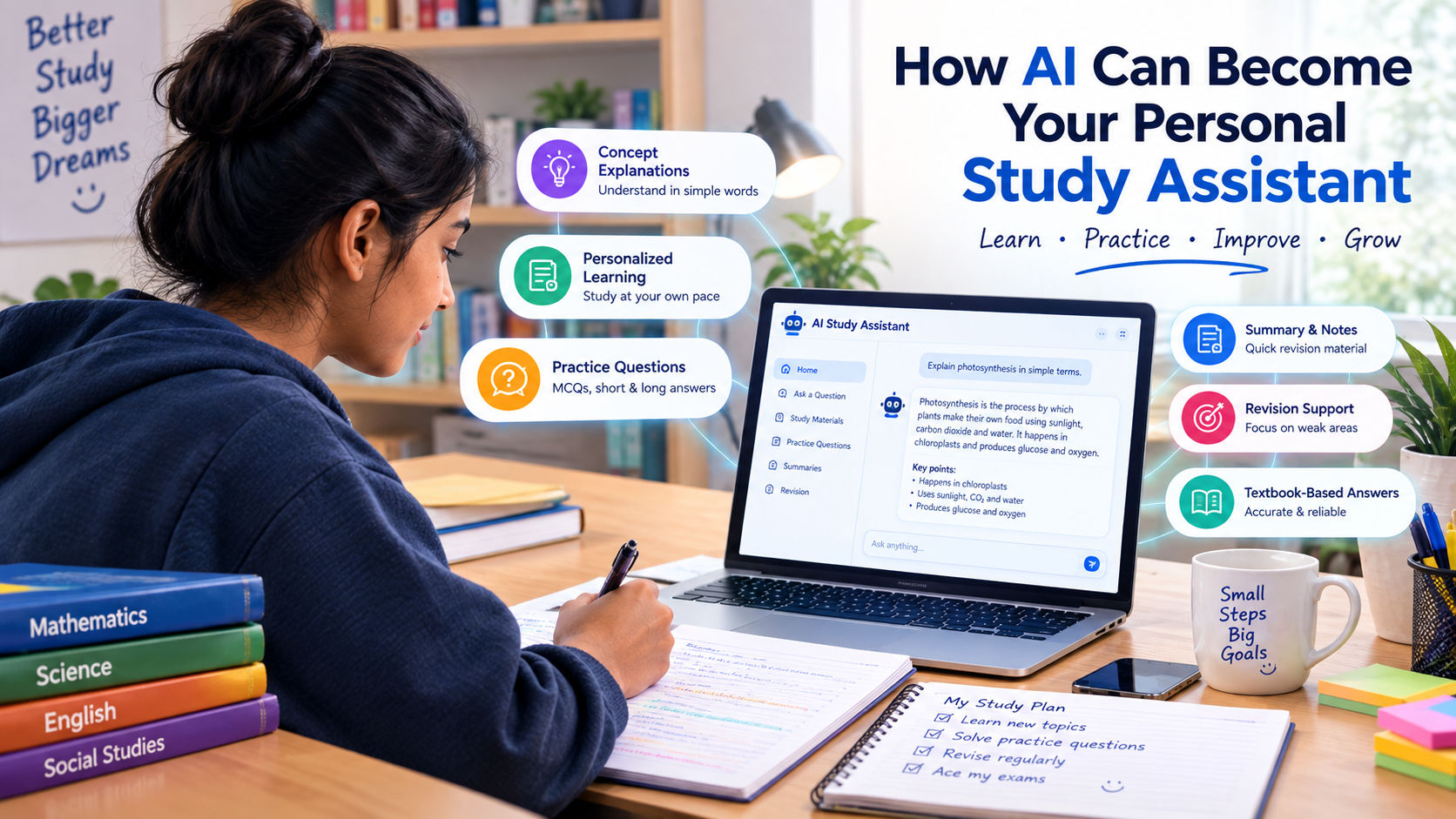
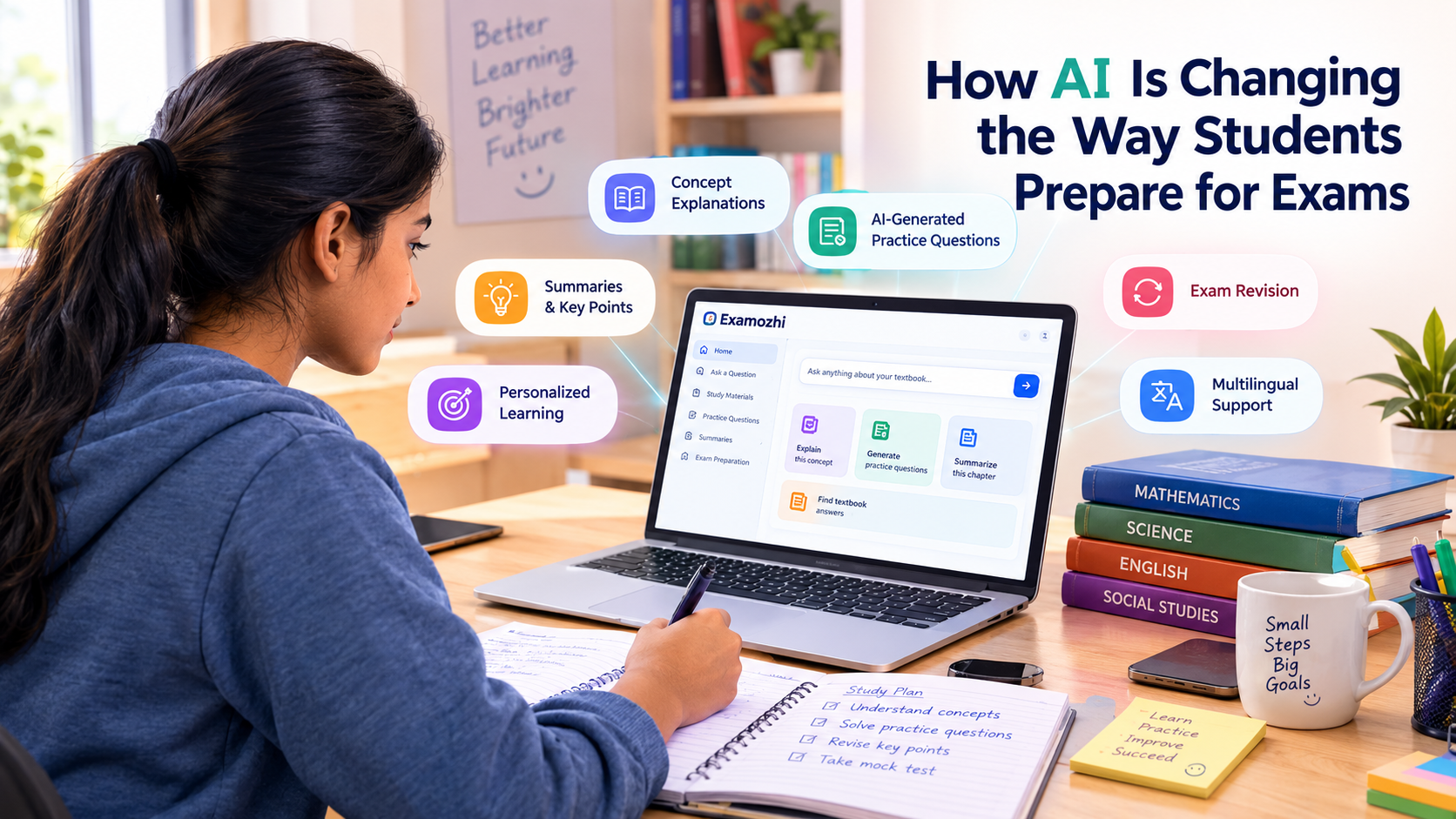
AI can help a student receive another explanation of a difficult concept, generate practice questions, search curriculum content, learn in another language, or revise a chapter interactively. For teachers, it can potentially assist with creating learning material, assessments, differentiated activities, and routine academic tasks.
This shift is no longer only a prediction about the distant future.
In August 2026, India's Ministry of Education stated that NCERT, in collaboration with CBSE, had introduced a dedicated Computational Thinking and Artificial Intelligence curriculum for Classes III to VIII from the 2026–27 academic year, while curriculum for Grades 9–12 in AI and allied subjects had also been finalized. Press Information Bureau
That makes an important question increasingly relevant:
What should AI-powered learning actually look like inside Indian schools?
The most valuable future is unlikely to be one where AI replaces teachers or completes every task for students. It is more likely to be one where teachers, students, textbooks, curriculum, and AI work together.
What Does AI-Powered Learning Mean?
AI-powered learning means using artificial intelligence to support parts of the teaching and learning process.
Depending on the system, AI may help with:
- Personalized explanations
- Practice-question generation
- Student feedback
- Curriculum search
- Language translation
- Interactive tutoring
- Revision and assessment
- Learning recommendations
- Teacher preparation
- Accessibility and educational support
India's National Curriculum Framework for School Education 2023 recognizes the potential use of AI, machine learning, data science, immersive technologies, virtual laboratories, interactive content, and gamification to improve teaching, learning, assessment, teacher development, access, and educational administration. Education.gov.in
However, implementing AI in schools is not simply a matter of giving every student access to a chatbot.
The technology needs to serve an educational purpose.
1. AI Could Make Learning More Personalized
Traditional classrooms generally teach a group of students at the same time.
But students do not always learn at the same speed.
One student may understand fractions immediately while another needs three examples. A science concept that seems simple to one student may require a completely different explanation for another.
AI can potentially help bridge this difference.
A student could ask:
Explain this in simpler language.
Then:
Give me an example.
Then:
Now give me three questions to check whether I understood it.
The lesson becomes more interactive.
The Possible Future
Instead of every student receiving exactly the same digital learning experience, educational systems may increasingly adapt:
Explanation level → practice difficulty → feedback → revision → next activity
according to the student's requirements.
But personalization should not mean allowing an algorithm to control a child's education.
AI can recommend. Teachers and students should remain responsible for important learning decisions.
2. AI Could Turn Textbooks Into Interactive Learning Experiences
Textbooks remain central to school education, particularly when examinations are connected to prescribed curriculum content.
But AI can change how students interact with those textbooks.
Imagine a student reading a chapter on electricity.
Instead of only reading the page, the student could ask:
Explain this paragraph.
What is the most important definition here?
Create five questions from this topic.
Where in the textbook is this answer explained?
This is one area where curriculum-grounded AI becomes important.
Rather than relying only on a general-purpose model's broad knowledge, an educational system can retrieve information from approved curriculum material before constructing an answer.
For example, Examozhi currently presents a textbook-grounded learning experience based on Indian curricula including CBSE, ICSE, TN Samacheer Kalvi, and NCERT, with features such as curriculum search, explanations, summaries, question generation, multilingual interaction, and source-backed responses. Examozhi
This represents an important direction for educational AI:
Move from “Ask AI anything” toward “Ask your curriculum intelligently.”
3. AI Literacy Could Become as Important as Digital Literacy
Students do not only need access to AI.
They need to understand how to use it responsibly.
India's Ministry of Education says the new AI and Computational Thinking curriculum for Classes III–VIII focuses on areas including logical reasoning, pattern recognition, algorithm design, data literacy, and responsible and ethical AI. Press Information Bureau
That is important because using AI effectively requires more than writing prompts.
Students should gradually learn:
- What AI can and cannot do
- Why AI sometimes makes mistakes
- How to evaluate an AI-generated answer
- How to protect personal information
- How bias can affect automated systems
- When to verify information
- How to use AI ethically
- When not to use AI
UNESCO has also developed AI competency frameworks for students and teachers to help education systems build the knowledge and judgement required for responsible AI use. UNESCO
Key Point
Teaching students to use AI without teaching them to question AI would be incomplete AI education.
4. The Teacher's Role Could Become Even More Important
The arrival of AI has sometimes created the impression that technology could eventually replace teachers.
That is a misleading way to frame the future of education.
An AI system may explain a mathematical formula.
But a teacher can notice that a student is confused.
An AI system may create a quiz.
But a teacher understands the classroom, the student's progress, the curriculum, learning objectives, and the social environment in which education takes place.
UNESCO's current work on AI and education emphasizes supporting teachers rather than treating them as replaceable, while its 2026 strategy highlights teacher professional development and digital competencies as priorities for meaningful AI adoption. UNESCO IITE
The future classroom may therefore look more like:
Teacher + AI + Student
rather than:
Teacher vs AI
AI could take on certain repetitive support tasks while giving teachers more opportunities to concentrate on explanation, mentoring, classroom interaction, creativity, and individual guidance.
5. Teachers Could Use AI to Prepare Better Learning Experiences
AI in schools is not only about student-facing chatbots.
Teachers themselves may use AI to:
Generate preliminary lesson ideas → create differentiated questions → design revision activities → produce examples → adapt explanations → prepare formative assessments
For example, a teacher teaching the same science topic could request:
Basic questions for students still developing foundational understanding.
Intermediate questions for normal classroom practice.
Application questions for students ready for greater difficulty.
The teacher can then review, correct, and adapt the generated material.
This is an important distinction.
AI should help teachers create more effective learning experiences—not become an unsupervised source of educational content.
The OECD's Digital Education Outlook 2026 examines GenAI as a potential tutor, partner, and assistant, while emphasizing that effectiveness depends on how the technology is designed and used educationally. OECD
6. Exams Could Shift From Memorization Toward Understanding
If students can instantly generate definitions, summaries, code, essays, and explanations using AI, education systems will increasingly need to consider what assessments are actually measuring.
A question that only tests whether a student can reproduce information may become less meaningful when technology can reproduce that information immediately.
That does not mean knowledge or memory becomes unnecessary.
Students still need foundational knowledge.
But assessments may increasingly need to test:
- Understanding
- Application
- Reasoning
- Problem-solving
- Interpretation
- Creativity
- Communication
- Ability to verify information
The OECD notes an important risk: students may achieve better task outputs using general-purpose GenAI without achieving equivalent learning gains if the technology is simply doing the cognitive work for them. OECD
Future Assessment Question
Instead of only asking:
What is the answer?
schools may increasingly need to ask:
Can the student explain how and why this answer is correct?
7. Multilingual AI Could Matter Greatly in India
India's linguistic diversity makes multilingual education particularly important.
A student may study science in English while understanding a difficult idea more easily when it is initially explained in Tamil, Hindi, Telugu, Malayalam, Kannada, Bengali, or another familiar language.
AI systems can potentially help students move between languages more easily.
For example:
Textbook terminology in English
↓
Explanation in the student's preferred language
↓
Example
↓
Return to original academic terminology
Examozhi currently describes support for multilingual and cross-lingual curriculum interaction, including Tamil, Hindi and English use cases. Examozhi
The important objective should be better understanding, while still helping students become comfortable with the terminology used in their curriculum.
8. AI Could Make Practice More Interactive
Practice is one of the areas where AI can offer immediate value.
Students can already use AI to create:
MCQs | short-answer questions | long-answer questions | conceptual questions | application questions | revision quizzes
But the most effective workflow is not:
Generate question → generate answer → read answer
It is:
Generate → Attempt → Check → Understand → Retry
This keeps the student intellectually involved.
An AI learning assistant could eventually recognize that a student repeatedly struggles with a specific concept and provide more practice around that area.
But again, this should be treated as educational support, not as an infallible diagnosis of the student's abilities.
9. Schools Will Need Strong AI Safety and Privacy Rules
As AI becomes more common in schools, its benefits need to be considered alongside privacy, safety, fairness, and governance.
UNESCO's guidance on generative AI in education recommends a human-centred and age-appropriate approach, including consideration of data privacy, ethical validation, and responsible pedagogical use. UNESCO
Schools therefore need to think carefully about:
What student information an AI system collects
Where that information is stored
Who can access it
Whether students understand how their data is being used
How AI-generated recommendations are reviewed
What happens when AI provides incorrect or biased information
AI adoption cannot simply be a technical decision.
It is also an educational, ethical, and governance decision.
10. The Digital Divide Could Become an AI Divide
AI-powered education offers significant possibilities, but those benefits will not automatically reach every student equally.
Schools vary enormously in access to:
Reliable internet, devices, electricity, technical support, trained teachers, and digital infrastructure.
UNESCO's 2026 education strategy specifically warns that the existing digital divide can develop into an AI divide if students lack meaningful connectivity, devices, and access to appropriate infrastructure. UNESCO IITE
This issue is particularly important for a country as large and diverse as India.
A meaningful AI education strategy therefore cannot focus only on advanced private-school classrooms.
It must also consider accessibility, affordability, regional languages, teacher training, infrastructure, and low-resource learning environments.
11. AI Should Complement Human Thinking, Not Replace It
One of the biggest risks of AI-powered learning is convenience.
If a student asks AI to complete every difficult problem, summarize every chapter, write every answer, and complete every assignment, the technology may make schoolwork easier while making learning weaker.
The better approach is:
| Less Effective AI Use | Better Learning Use |
|---|---|
| Give me the answer | Explain how to solve it |
| Write my assignment | Help me understand the topic |
| Solve every question | Give me a hint |
| Summarize everything | Test me after I read |
| Accept the response | Verify the response |
| Depend on AI | Practise independently |
Students still need opportunities to struggle with problems, make mistakes, rethink an answer, and eventually solve something themselves.
Productive difficulty is part of learning. AI should not remove all of it.
12. What Could an AI-Enabled Indian Classroom Look Like?
Imagine an Indian classroom several years from now.
The teacher introduces a mathematics concept to the whole class.
Students then practise individually.
A learning platform provides additional explanation to students who need help.
One student requests the explanation in Tamil.
Another receives easier practice questions before progressing to the standard level.
A third student completes the normal exercise quickly and receives a more challenging problem.
The teacher sees where students are struggling and decides which concept needs to be explained again to the class.
Students then work together on a problem without AI assistance.
In this model:
AI provides support.
Teachers provide judgement.
Students continue thinking.
That is a much healthier vision than simply placing an AI chatbot in every classroom.
13. AI Education Is Already Becoming Part of India's School Strategy
India's shift toward AI education is already visible.
According to the Ministry of Education, the 2026–27 school-year rollout for Classes III–VIII integrates Computational Thinking and Artificial Intelligence, while the curriculum for Classes IX–XII in AI and allied areas has also been finalized. Press Information Bureau
The government's earlier 2025 announcement also emphasized teacher training, learning materials, digital resources, and collaboration between NCERT and CBSE as important elements of implementation. DSEL Education
This is significant because the future of AI education depends on much more than introducing a new subject.
Schools will need:
Curriculum + teachers + infrastructure + responsible AI tools + assessment methods + student AI literacy
All of these pieces need to work together.
14. Where Platforms Like Examozhi Fit Into This Future
As AI-powered education develops, one important challenge is keeping AI connected to trusted curriculum material.
This is where curriculum-grounded educational systems can play a role.
Examozhi is designed around Indian curriculum content and currently presents features including textbook-grounded question answering, curriculum search, summaries, explanations, question generation, multilingual interaction, and source-backed responses. Examozhi
Instead of using AI only as an open-ended chatbot, this approach connects the learning experience to the student's actual educational material.
For schools, teachers, EdTech platforms, and students, this may represent an important direction:
AI that understands the curriculum should be more educationally useful than AI that simply generates convincing text.
15. What Must Remain Human?
AI capabilities will continue to improve.
But education is not simply information delivery.
Schools also help students develop:
- Curiosity
- Confidence
- Empathy
- Communication
- Teamwork
- Creativity
- Ethical judgement
- Critical thinking
Resilience
Technology may assist these processes, but it cannot reduce education to automated answers and recommendations.
The future of AI-powered education should therefore remain human-centred.
UNESCO's guidance similarly argues for AI approaches that preserve human agency, inclusion, equity, cultural diversity, and meaningful educational use. UNESCO
The Future of AI-Powered Learning in Indian Schools
The biggest transformation may not be that every classroom suddenly becomes filled with futuristic technology.
It may be much simpler.
A student receives a better explanation.
A teacher saves time preparing differentiated practice.
A learner studies a difficult topic in a familiar language.
A textbook becomes searchable and interactive.
A student receives additional practice exactly where it is needed.
And teachers gain better tools while remaining at the centre of the educational process.
The most promising future is not AI replacing education.
It is AI helping education become more personalized, accessible, interactive, and effective—without removing human judgement or independent thinking.
Indian schools are already beginning the transition toward broader AI literacy and Computational Thinking education. Press Information Bureau
What happens next will depend not simply on how powerful AI becomes, but on how responsibly schools choose to use it.