AI in education - What students need to know in 2026
Discover what students need to know about AI in education in 2026, including AI literacy, personalized learning, responsible use, and exam preparation.
AI in Education: What Students Need to Know in 2026
Artificial intelligence is no longer something students only hear about in technology discussions. It is becoming part of how learners search for information, understand difficult concepts, practise questions, create study material, and interact with educational platforms.
But AI in education is not simply about using a chatbot to get answers.
In 2026, students need to understand both sides of the technology: what AI can do for learning and where human thinking still matters. The OECD's Digital Education Outlook 2026 highlights that generative AI can support learning when it is used with a clear educational purpose, while simply handing cognitive tasks over to AI may improve the quality of a completed task without necessarily improving learning.
This makes AI literacy increasingly important.
Students need to know how to ask better questions, check AI-generated information, protect their personal data, understand academic-integrity expectations, and use AI as a learning tool rather than a replacement for thinking.
For students in India, this shift is particularly relevant as AI and computational thinking are increasingly being introduced into school education and discussed as important future-ready skills.
What Does AI in Education Mean?
AI in education refers to the use of artificial intelligence technologies to support teaching, learning, assessment, educational administration, and other academic activities.
AI can perform different functions depending on the system being used.
For students, these may include:
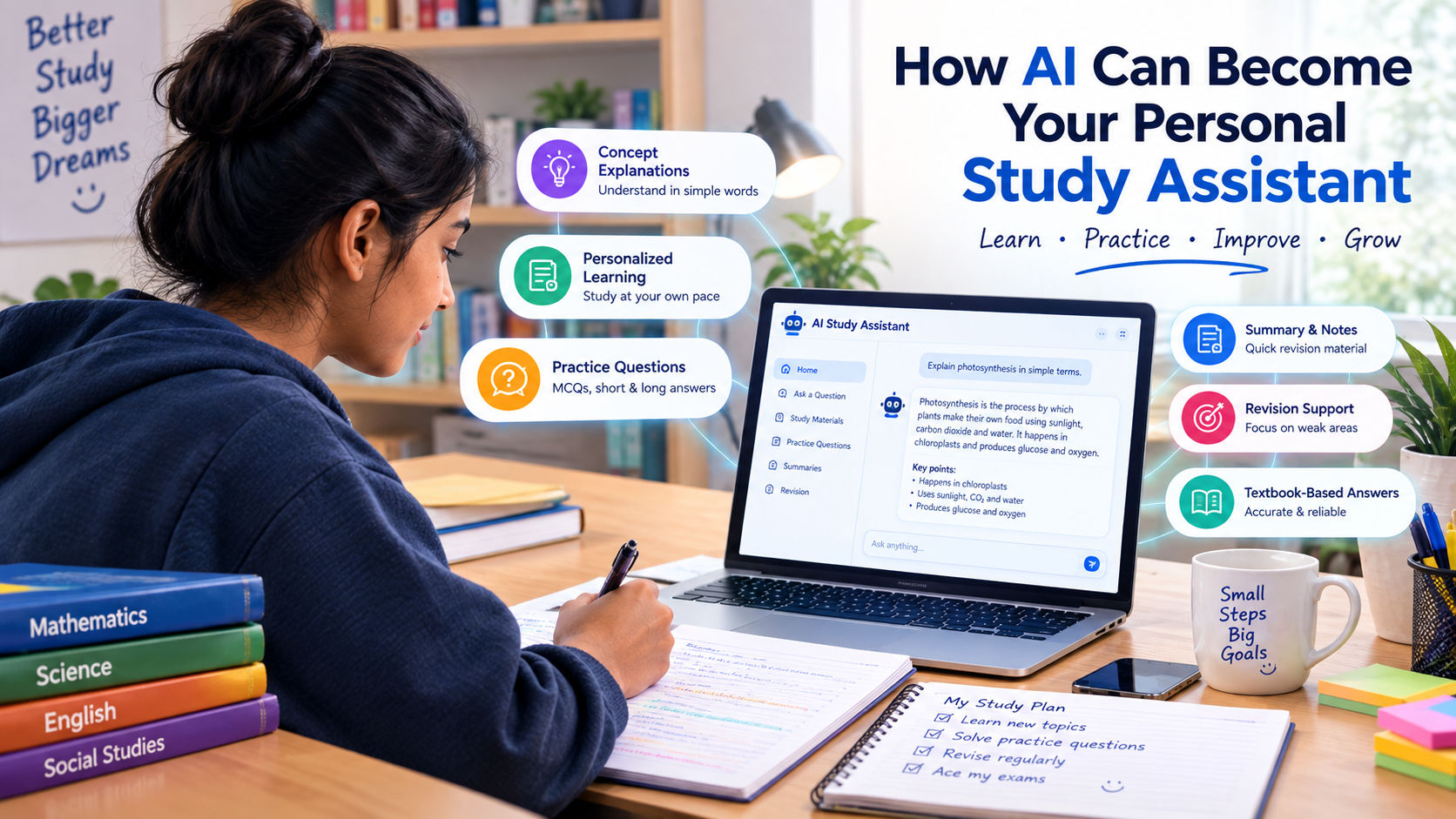
- Explaining difficult concepts
- Answering questions
- Summarizing study material
- Generating practice questions
- Providing personalized learning support
- Translating educational content
- Supporting revision
- Giving feedback on answers
- Searching curriculum content
- Helping students practise different question formats
Generative AI can also create new content such as text, explanations, questions, images, and computer code.
However, AI-generated content should not automatically be treated as correct. Students need to develop the ability to evaluate the information they receive.
Why AI in Education Matters in 2026
The role of AI in education is expanding beyond simple question answering.
The OECD's 2026 Digital Education Outlook describes educational GenAI as potentially useful as a tutor, partner, and assistant, particularly when it is designed or used with an intentional educational purpose.
At the same time, the report warns that completing a task successfully with general-purpose GenAI does not automatically mean that the student has learned the underlying skill.
This distinction is extremely important.
Imagine a student receives an AI-generated answer to a difficult mathematics problem. The answer may look perfect. But if the student cannot solve a similar problem independently during an examination, the technology has helped complete the task without necessarily creating the desired learning.
Therefore, the important question in 2026 is not:
“Can AI do this for me?”
It is:
“Can AI help me learn how to do this myself?”
How Students Can Use AI for Learning
1. Understanding Difficult Concepts
Students can use AI to request explanations at different levels.
For example, instead of simply asking for an answer, a student could ask:
“Explain this concept in simple language.”
Then:
“Give me a real-life example.”
And finally:
“Ask me a question to check whether I understood it.”
This creates an active learning cycle.
AI can therefore act as an additional explanation layer when a textbook or classroom explanation is difficult to understand.
2. Personalized Learning
Students have different learning speeds and different areas of difficulty.
One student may need a simple explanation, while another may want an advanced example or additional practice.
AI systems can support this type of personalization by adapting explanations, questions, or learning material to the user's request.
For example:
Beginner: “Explain the basic idea.”
Intermediate: “Give me an example.”
Advanced: “Give me an application-based problem.”
Exam preparation: “Create a question based on the expected mark format.”
Personalization does not mean that AI knows everything about a student. It means the technology can respond to the learner's stated needs and provide different forms of support.
AI Can Change the Way Students Revise
Traditional revision often involves rereading notes or textbooks.
AI can add more active methods.
Summary-Based Revision
Students can ask AI to identify:
- Key concepts
- Important definitions
- Main arguments
- Formulas
- Important examples
- Potential questions
The resulting summary should still be compared with the original textbook or trusted material.
Question-Based Revision
Students can ask AI to generate practice questions from a specific topic.
For example:
“Create five MCQs, three short-answer questions, and one long-answer question from this chapter.”
The student should attempt the questions before checking the answers.
Mistake-Based Revision
One of the most useful applications is using AI after making mistakes.
A student can provide their attempted answer and ask:
“What did I misunderstand, and how can I avoid making the same mistake?”
This changes AI from an answer generator into a feedback tool.
AI Literacy Is Becoming a Student Skill
Knowing how to use AI does not simply mean knowing how to type a prompt.
AI literacy means understanding what AI does, evaluating its outputs, and using it responsibly.
UNESCO's AI Competency Framework for Students identifies four broad areas:
1. Human-centred mindset
2. Ethics of AI
3. AI techniques and applications
4. AI system design
The framework also describes three levels of progression:
Understand → Apply → Create
This gives students a useful way to think about AI education.
You do not need to become an AI engineer simply because AI is becoming common. But you should understand enough to use AI responsibly and critically.
What Students Should Learn About AI in 2026
There are several skills students can begin developing now.
1. Prompting and Question Formulation
Students should learn to give clear instructions.
Instead of:
“Explain physics.”
Try:
“Explain electromagnetic waves for a first-year engineering student using simple language and three examples.”
A clearer request generally gives the system more useful context.
2. Fact Checking
AI can produce incorrect information.
Students should verify important:
- Facts
- Dates
- Formulas
- Definitions
- Statistics
- References
- Academic claims
For curriculum-based examinations, the prescribed textbook should remain an important reference.
3. Critical Thinking
Students should not automatically accept an AI answer.
Ask:
Does this make sense?
Can I explain it myself?
Does it match my textbook?
Is there evidence supporting this claim?
These questions turn AI use into a critical-thinking exercise.
4. Data and Privacy Awareness
Students should also understand that information entered into digital services can involve privacy considerations.
Avoid unnecessarily sharing sensitive personal information, passwords, private documents, or other confidential material with AI systems.
Students should also follow the privacy and technology policies of their school or college.
AI and Academic Integrity
One of the biggest changes AI brings to education concerns assignments and assessments.
If a student submits AI-generated work as their own where this is prohibited, the technology is no longer simply being used as a study aid.
Schools and colleges may have their own rules regarding acceptable AI use.
Students should therefore understand the difference between:
Using AI to learn
and
Using AI to avoid doing the learning.
For example, asking AI to explain a difficult concept can support learning.
Asking AI to complete an assignment and submitting the result without understanding it can undermine the learning process and may conflict with academic rules.
The OECD's 2026 education research also identifies academic integrity as one of the important challenges associated with GenAI in education.
AI Does Not Replace Teachers
AI can provide fast explanations, generate questions, and support individual practice.
But education involves much more than information retrieval.
Teachers provide:
- Human interaction
- Context
- Feedback
- Encouragement
- Classroom discussion
- Professional judgment
- Social and collaborative learning
The OECD's 2026 findings emphasize that educational GenAI can augment human teaching and tutoring while preserving teacher agency.
The most useful model is therefore not:
Teacher vs AI
but:
Teacher + Student + AI
AI can handle certain repetitive or personalized support tasks while teachers continue to provide human guidance.
AI in Indian Education
AI is becoming increasingly relevant within India's education ecosystem.
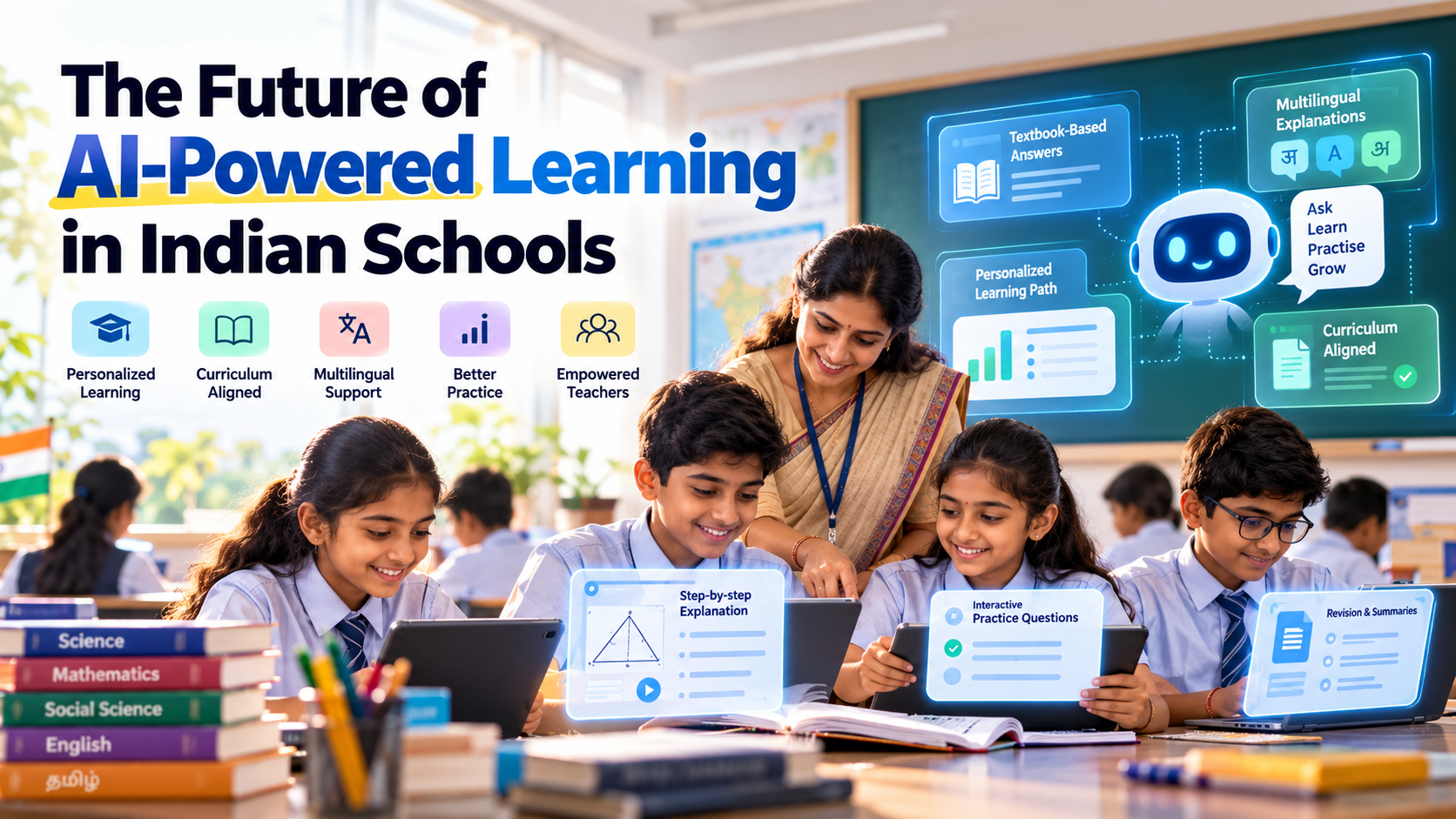
The Ministry of Education has discussed AI applications such as personalized assistance, regional-language access, home-based learning, translation, and student assessment.
India's school education system is also moving toward greater exposure to computational thinking and AI.
A Ministry of Education / PIB release in 2026 stated that CBSE's Computational Thinking and Artificial Intelligence curriculum would be implemented for Classes 3 to 8 from the 2026–27 academic session, with an emphasis on logical thinking, problem-solving, pattern recognition, digital literacy, responsible technology use, innovation, and ethical decision-making.
This means AI literacy is becoming relevant much earlier in a student's educational journey.
For Indian students, learning how to use AI responsibly can therefore become part of broader digital and academic literacy.
Textbook-Grounded AI for Students
General-purpose AI tools can answer questions about almost anything, but students preparing for curriculum-based examinations have a more specific requirement:
The answer should match what they are actually expected to study.
This is where textbook-grounded AI can be useful.
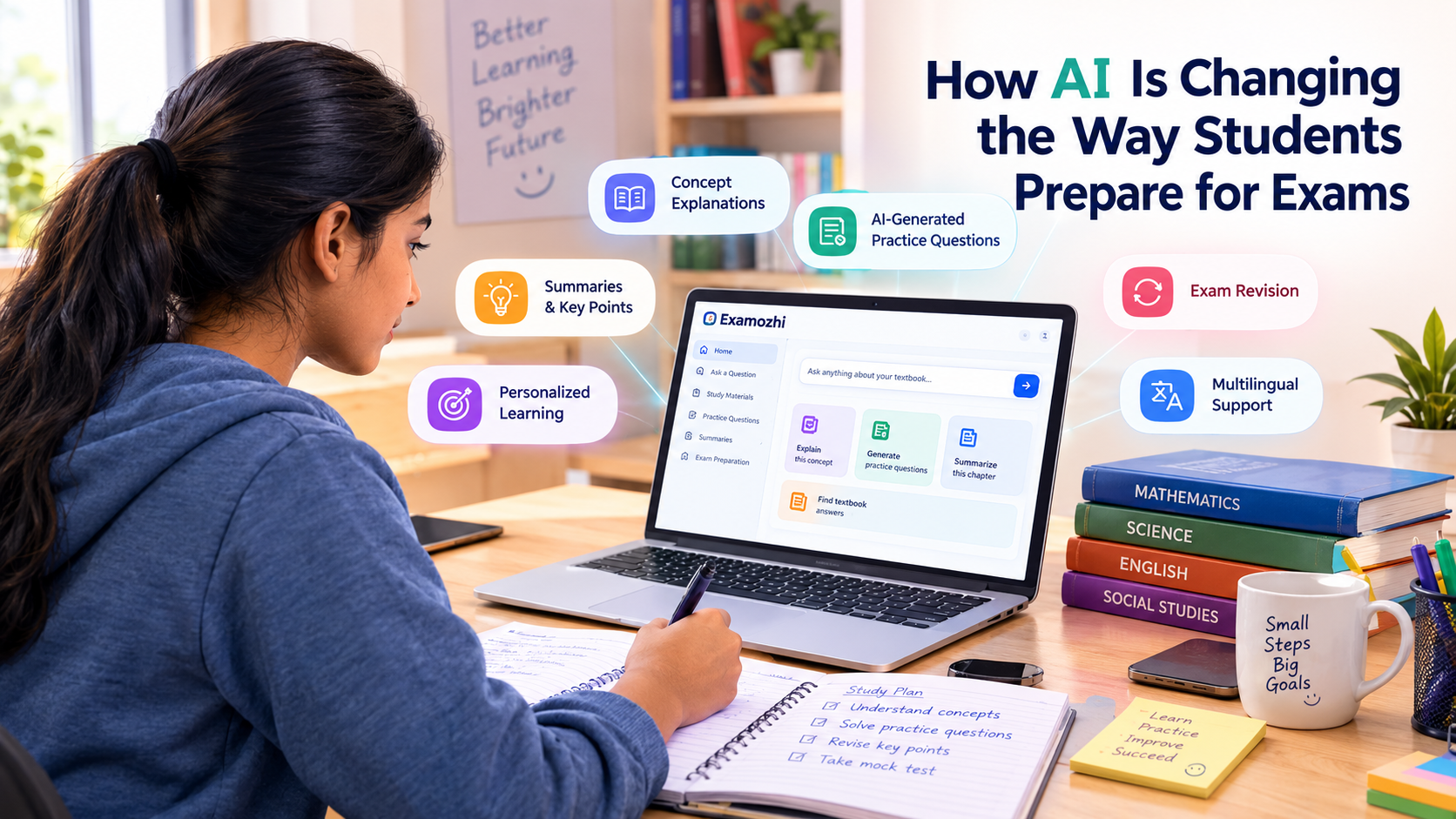
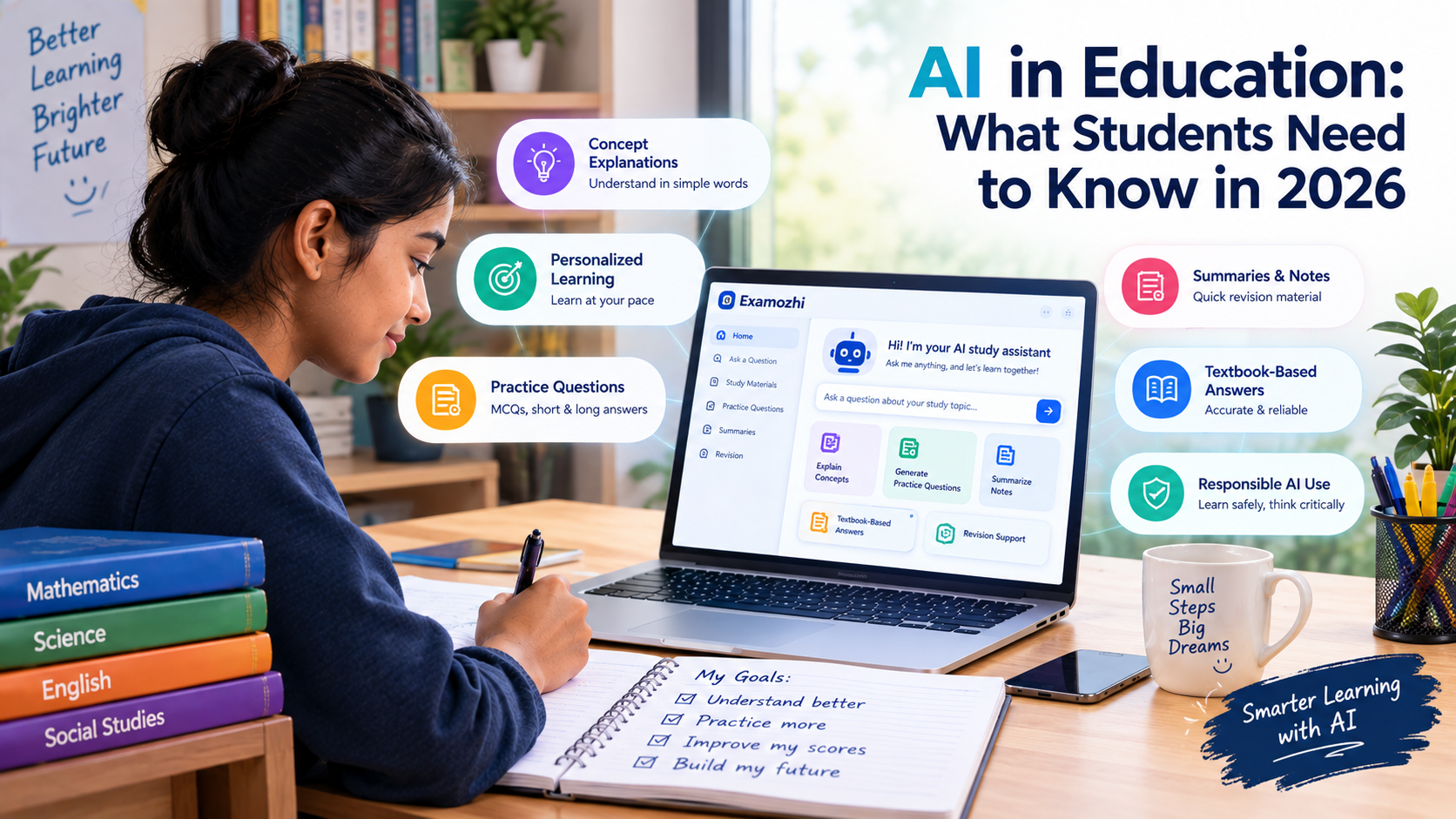
Platforms such as Examozhi focus on connecting AI assistance with Indian curriculum content.
Examozhi describes its student experience as reading the student's actual textbook and providing answers with the relevant source page. Its platform currently includes curriculum content across CBSE, ICSE, TN Samacheer Kalvi, and NCERT.
Its approach includes capabilities such as:
- Textbook-grounded answers
- Curriculum search
- AI explanations
- Summaries
- Practice-question generation
- Multilingual search
- Exam-mark-based answer formatting
For students, the difference is important.
Instead of asking:
“What does AI know about this topic?”
the learning experience can become:
“What does my textbook say about this topic, and can AI help me understand it?”
AI Can Support Multilingual Learning
Language can sometimes become a barrier to learning.
Students may understand a concept better when it is explained in a language they are comfortable with.
AI systems can support multilingual interaction by translating questions, explanations, or learning material.
This can be particularly relevant in India, where students study across multiple languages.
Examozhi, for example, states that students can ask questions in Tamil, English, Hindi, or romanized forms and receive responses in the student's language.
However, multilingual AI should still be checked against the original educational material, especially when precise terminology is important.
What Students Should Not Do With AI
Responsible AI use also means knowing when not to use it.
Students should avoid:
- Copying answers without understanding them
- Treating every AI response as factual
- Using AI during restricted examinations
- Sharing unnecessary personal information
- Depending on AI for every homework problem
- Replacing textbook reading with AI summaries alone
- Submitting AI-generated work where it is not permitted
- Allowing AI to make every learning decision
The goal should be AI-assisted learning, not AI-dependent learning.
A Smart AI Study Routine for 2026
Students can use a simple five-step approach.
Step 1 — Learn
Read the textbook, class notes, or teacher's material first.
Step 2 — Ask
Use AI when you encounter a difficult concept or unanswered question.
Step 3 — Practise
Attempt questions yourself before asking AI for solutions.
Step 4 — Verify
Compare important information with the textbook or another reliable source.
Step 5 — Reflect
Ask yourself:
“Can I now explain or solve this without AI?”
If the answer is yes, AI has supported your learning.
If the answer is no, you may need more independent practice.
The Future: Students as AI Users and Creators
Students should not think of themselves only as consumers of AI.
UNESCO's student competency framework describes learners as potential responsible users and co-creators of AI.
That means students can eventually move from:
Using AI → Understanding AI → Evaluating AI → Building with AI
This is particularly important for students entering fields such as computer science, engineering, medicine, business, design, research, and education.
The future will require people who can work with AI while still applying human judgment, creativity, communication, ethics, and domain knowledge.
Final Thoughts
AI in education is not simply about making studying faster. It is about changing how students interact with knowledge.
In 2026, students need more than access to AI tools. They need the skills to use those tools intelligently.
They should learn how to ask better questions, verify information, protect their privacy, understand academic-integrity rules, and recognize when independent thinking matters more than automation.
The strongest approach is simple:
Learn with AI. Think independently. Verify important information. Practise without AI.
When used this way, artificial intelligence can become a powerful educational assistant without taking away the most important part of education: the student's ability to understand, question, create, and think for themselves.