CBSE vs ICSE vs State board: Understanding different learning needs
Compare CBSE vs ICSE vs State Board to understand curriculum differences, teaching approaches, exam patterns, and which learning environment may suit your child.
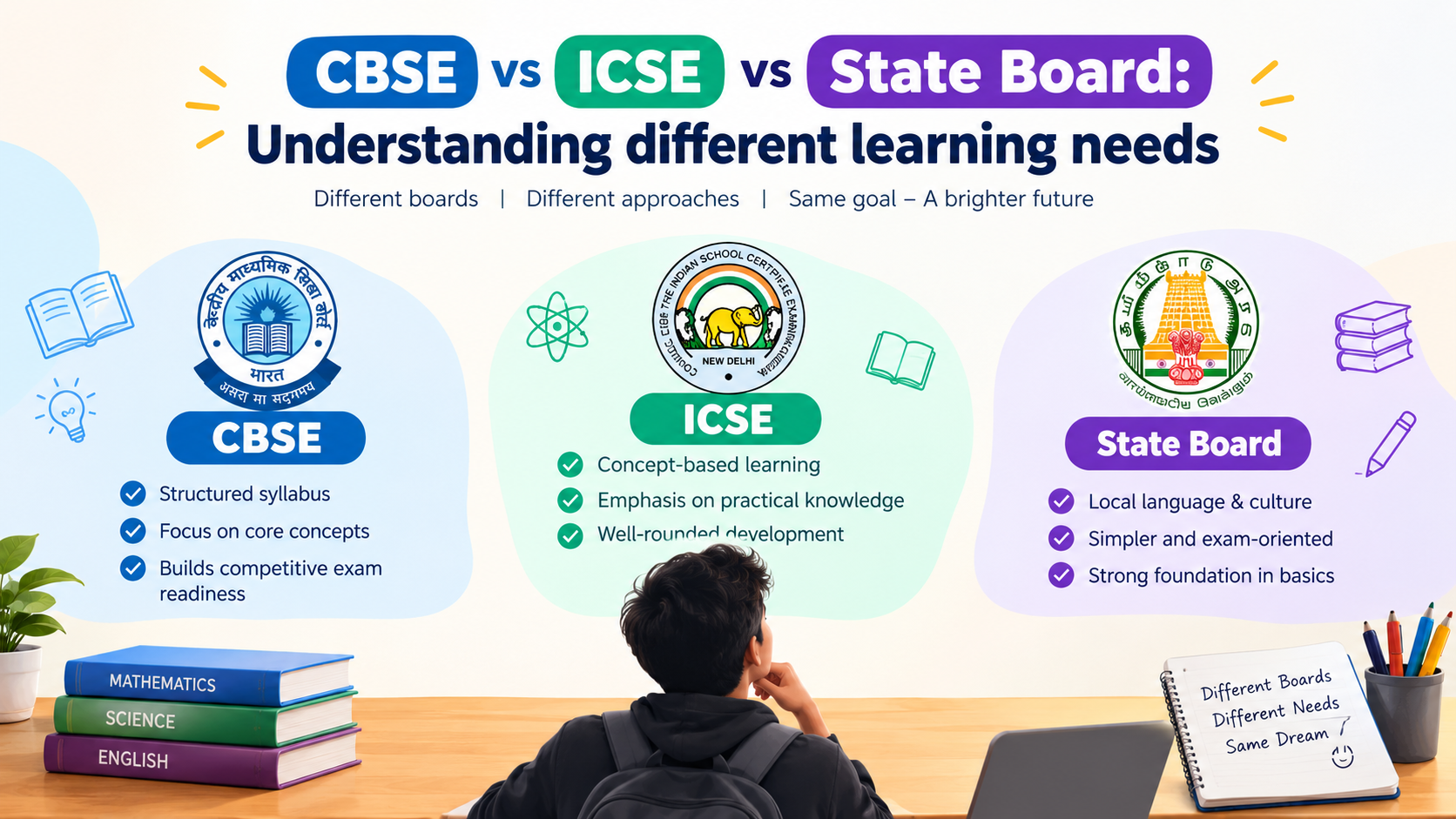
Choosing the right education board is an important decision for students and parents in India. The choice can influence the subjects a student studies, the way concepts are taught, the language of instruction, assessment methods, and the learning resources available throughout school.
When comparing CBSE vs ICSE vs State Board, it is easy to focus only on syllabus difficulty or examination results. However, every student has different learning needs. Some benefit from a structured, nationally oriented curriculum, while others thrive with detailed subject coverage or education closely connected to their state's language and academic requirements.
The right choice depends on more than a board's reputation. Parents should consider the student's interests, preferred learning style, future plans, school quality, and available academic support.
Technology is also creating new opportunities for students to learn according to their individual needs. AI-powered learning platforms, digital study resources, and curriculum-based explanations can help students understand lessons, practize questions, and revise topics more effectively.
In this guide, we compare CBSE, ICSE, and State Boards, explain their key differences, and explore how families can identify an educational environment that supports a student's long-term growth.
What Are CBSE, ICSE, and State Boards?
India has multiple school education boards, each with its own curriculum framework, assessment practices, and educational priorities.
1. CBSE (Central Board of Secondary Education)
CBSE is a national school board that follows a curriculum framework designed for schools across India. Its curriculum places considerable emphasis on structured subject learning and is widely used by students preparing for national-level entrance examinations.
CBSE may suit students who prefer a relatively standardized curriculum and may relocate between cities or states during their school years.
Common considerations:
- A nationally used curriculum framework
- Structured subject content and examination preparation
- Availability of schools across many parts of India
- Potential alignment with preparation for examinations such as JEE and NEET, depending on subjects and preparation methods
2. ICSE (Indian Certificate of Secondary Education)
- ICSE is the Class 10 examination conducted by the Council for the Indian School Certificate Examinations (CISCE). The council also conducts the ISC examination at Class 12.
- The ICSE curriculum is often associated with detailed subject coverage, substantial English-language work, and a broad academic experience. Actual teaching methods and workload vary between schools.
Common considerations:
- Detailed coverage of subjects
- Strong emphasis on English language and written expression
- Opportunities to develop analytical and communication skills
- Assessment that may involve different types of questions and application of concepts
3. State Boards
State Boards are managed by the relevant state or union territory education authorities. Their curricula, examination systems, and language policies differ across states.
For example, Tamil Nadu's State Board follows its own curriculum and examination structure. Other states have different textbooks, subject arrangements, and assessment practices.
Common considerations:
- Curriculum connected to state educational requirements
- Availability of regional-language instruction in many schools
- Familiarity with local academic expectations
- Potential relevance for students continuing their education within the state
Important: State Boards are not one uniform system. Their standards, syllabuses, languages, and examination patterns vary. Families should compare the specific state board and school rather than treating all State Boards as identical.
CBSE vs ICSE vs State Board: Key Differences
The following table offers a broad comparison. Individual schools may differ in teaching quality, learning support, and classroom experience.
| Feature | CBSE | ICSE | State Board |
|---|---|---|---|
| Governing body | National board | CISCE | State or union territory authority |
| Curriculum | Nationally used framework | CISCE curriculum | State-specific curriculum |
| Subject approach | Structured and syllabus-oriented | Often detailed and broad | Varies by state |
| Language | Depends on school and subject rules | Strong emphasis on English | Regional-language options may be available |
| Assessment | Board-specific examination and internal assessment rules | CISCE examination and assessment rules | State-specific examination rules |
| Mobility | Useful for families moving across India | Available through CISCE-affiliated schools | May require adjustment after moving between states |
| Exam preparation | Can support national entrance-exam preparation | Can support strong conceptual and language development | Depends on syllabus, subjects, and supplementary preparation |
| Best starting point | Compare the actual school's curriculum and teaching | Compare the actual school's curriculum and teaching | Compare the relevant state syllabus and school |
No board is automatically best for every student. The school environment, teacher expertise, student motivation, and access to suitable learning resources can be just as important.
How Different Boards Support Different Learning Needs?
1. Students Who Prefer Structured Learning
Some students learn best when topics are organized into clear units, concepts are introduced progressively, and examination expectations are well defined.
For these students, CBSE may be worth considering because of its nationally used curriculum and structured subject frameworks.
However, structure is not exclusive to CBSE. A well-managed ICSE or State Board school can also offer clear teaching plans, regular practice, and systematic revision.
What parents should check: Ask the school how it teaches difficult concepts, monitors progress, and supports students who need additional practice.
2. Students Who Enjoy Detailed Subject Exploration
Some students enjoy reading extensively, exploring examples, writing detailed answers, and making connections between subjects.
An ICSE school may appeal to such students because of its broad curriculum and emphasis on language and subject detail.
That does not mean every ICSE student must prefer a particular learning style. The student's interests and the school's actual teaching approach matter more than general labels.
What parents should check: Review sample textbooks, writing assignments, project work, and examination questions before making a decision.
3. Students Who Benefit From Regional-Language Learning
Language plays an important role in comprehension. Students may understand new concepts more easily when the language of instruction is familiar to them.
A State Board school may be suitable for students who want education through a regional language or whose families value close alignment with the state's curriculum.
Many schools under different boards offer different language options, so the available choices should be verified directly with each school.
What parents should check: Confirm the language of instruction, available textbooks, second-language requirements, and the student's comfort with the language used in class.
4. Students Who Need Additional Academic Support
- Some students require extra time to understand a topic, while others need more challenging exercises to remain engaged.
Rather than assuming one board is better for these students, families should evaluate the school's ability to provide differentiated support.
Useful features include:
- Additional explanations for difficult concepts
- Regular feedback from teachers
- Practice questions at different difficulty levels
- Opportunities to ask questions without hesitation
- Support for revision and examination preparation
- Digital tools can complement these resources by allowing students to revisit lessons and practise at their own pace.
Which Board Is Better for Competitive Exams?
- Parents often compare boards based on preparation for entrance examinations such as JEE, NEET, and other competitive tests.
- CBSE's curriculum may offer a convenient starting point for students preparing for certain national entrance examinations. However, choosing CBSE alone does not guarantee competitive-exam success.
- Students from ICSE and State Boards can also prepare successfully with appropriate study plans, subject coverage, practice, and supplementary resources.
Success depends on several factors:
- Understanding the relevant examination syllabus
- Building strong conceptual foundations
- Practizing exam-style questions
- Reviewing mistakes consistently
- Managing time effectively
- Maintaining a sustainable study routine
- Students should compare the relevant board syllabus with the entrance examination's official syllabus and identify any additional preparation needed.
Practical tip: Before choosing a board for competitive-exam preparation, compare the subjects and concepts taught in school with the current official examination syllabus. Make the decision based on the student's learning needs, not assumptions about board labels.
How AI Is Helping Students Learn Across Different Boards
- Artificial intelligence is creating new ways to support students studying under different education boards.
- Students can use AI-powered tools to request simpler explanations, create revision notes, generate practice questions, and identify topics that require more attention.
- However, a general-purpose AI assistant may not always provide answers that match a particular board's textbook, terminology, or expected answer format.
This is where curriculum-based and textbook-grounded learning can be useful.
For example, a student studying a science chapter could:
- Read the prescribed textbook.
- Ask for an explanation of a difficult concept.
- Generate practice questions from the chapter.
- Attempt the questions independently.
- Compare answers with the textbook and teacher's guidance.
- Revisit concepts that remain unclear.
Platforms such as Examozhi focus on AI-powered, curriculum-based learning, helping students interact with educational material and use AI as an additional study aid.
When evaluating any learning platform, check whether it supports the student's actual board, class, subjects, and textbooks. AI should complement the prescribed curriculum rather than replace it.
How Parents Can Choose the Right Education Board
There is no universal formula for choosing a board. A practical decision should take account of the student, the family, and the schools available.
Step 1: Understand the Student's Learning Needs
- Consider whether the student prefers detailed reading, structured practice, practical activities, visual explanations, or regional-language instruction.
- These preferences are useful starting points, but they should not permanently limit the student's opportunities to develop new skills.
Step 2: Review Future Academic Plans
- Think about whether the student may prepare for national entrance examinations, study in another state, pursue a particular subject, or continue education locally.
- Future plans can inform the decision, but they may change over time.
Step 3: Compare Actual Schools
A strong school under one board may offer a better experience than a poorly matched school under another.
Evaluate:
- Teacher experience and subject knowledge
- Class size and student support
- School facilities and learning resources
- Assessment and feedback practices
- Language options
- Travel time and overall cost
Step 4: Examine the Curriculum
- Review textbooks, sample questions, subject combinations, practical work, and examination requirements.
- Do not rely solely on hearsay about which board is easy or difficult.
Step 5: Consider the Student's Well-Being
A useful learning environment should challenge students without creating unnecessary pressure. Consider the student's interests, confidence, workload, extracurricular activities, and need for rest.
The best choice is the one that balances academic goals with a sustainable and supportive learning experience.
Common Myths About CBSE, ICSE, and State Boards
Myth 1: One Board Is Always Better Than the Others
There is no single board that is ideal for every student. Outcomes depend on the curriculum, school quality, teaching, effort, and learning support.
Myth 2: State Boards Are Always Easier
State Boards differ considerably. The difficulty of a course depends on the specific syllabus, assessment requirements, school, and student.
Myth 3: ICSE Is Only for Students Who Are Good at English
English proficiency can influence a student's experience in an English-medium school, but language skills can develop with practice and support. Families should evaluate the actual curriculum and available assistance.
Myth 4: CBSE Guarantees Competitive-Exam Success
No board guarantees success in JEE, NEET, or another competitive examination. Preparation, conceptual understanding, consistent practice, and exam strategy remain essential.
Myth 5: Changing Boards Is Always Difficult
A transition can require adjustment because textbooks, terminology, subject coverage, or assessment patterns may differ. The level of difficulty depends on the classes involved and the differences between the two curricula. Planning ahead and identifying syllabus gaps can make the transition easier.
Conclusion: Focus on Learning Needs, Not Just Board Names
Comparing CBSE vs ICSE vs State Board is an important step in understanding India's school education options. Each system has its own curriculum, assessment practices, and educational context.
CBSE may appeal to families seeking a nationally used curriculum. ICSE may suit students who value detailed subject coverage and substantial English-language work. A State Board may be a strong option for families who prefer a state-specific curriculum or regional-language instruction.
These are broad tendencies, not guarantees. The quality of the school and the student's individual needs should guide the final decision.
As education becomes more personalized, textbooks, teachers, digital resources, and AI-powered learning tools can work together to help students understand concepts and practice effectively.
Choose a board that supports the student's goals, but remember that good learning depends on more than the board alone.
Help Students Learn With Confidence
Explore Examozhi for AI-powered, curriculum-based learning support that can help students understand educational material, practice questions, and prepare for exams alongside their prescribed textbooks.
Learn at your pace. Practice with purpose. Build strong foundations.