Why curriculum-specific tools matter?
Discover why curriculum-specific tools matter for students and how textbook-aligned AI can make learning, revision, practice, and exam preparation more effective.
Students today have access to more learning resources than ever before. Search engines, videos, online courses, AI chatbots, educational apps, digital notes, and practice platforms can provide answers within seconds.
But there is an important question:
Does having more information always mean learning better?
Not necessarily.
A student preparing for an examination does not simply need information. They need information that matches their class, subject, syllabus, textbook, chapter, learning level, and examination requirements.
This is where curriculum-specific tools become important.
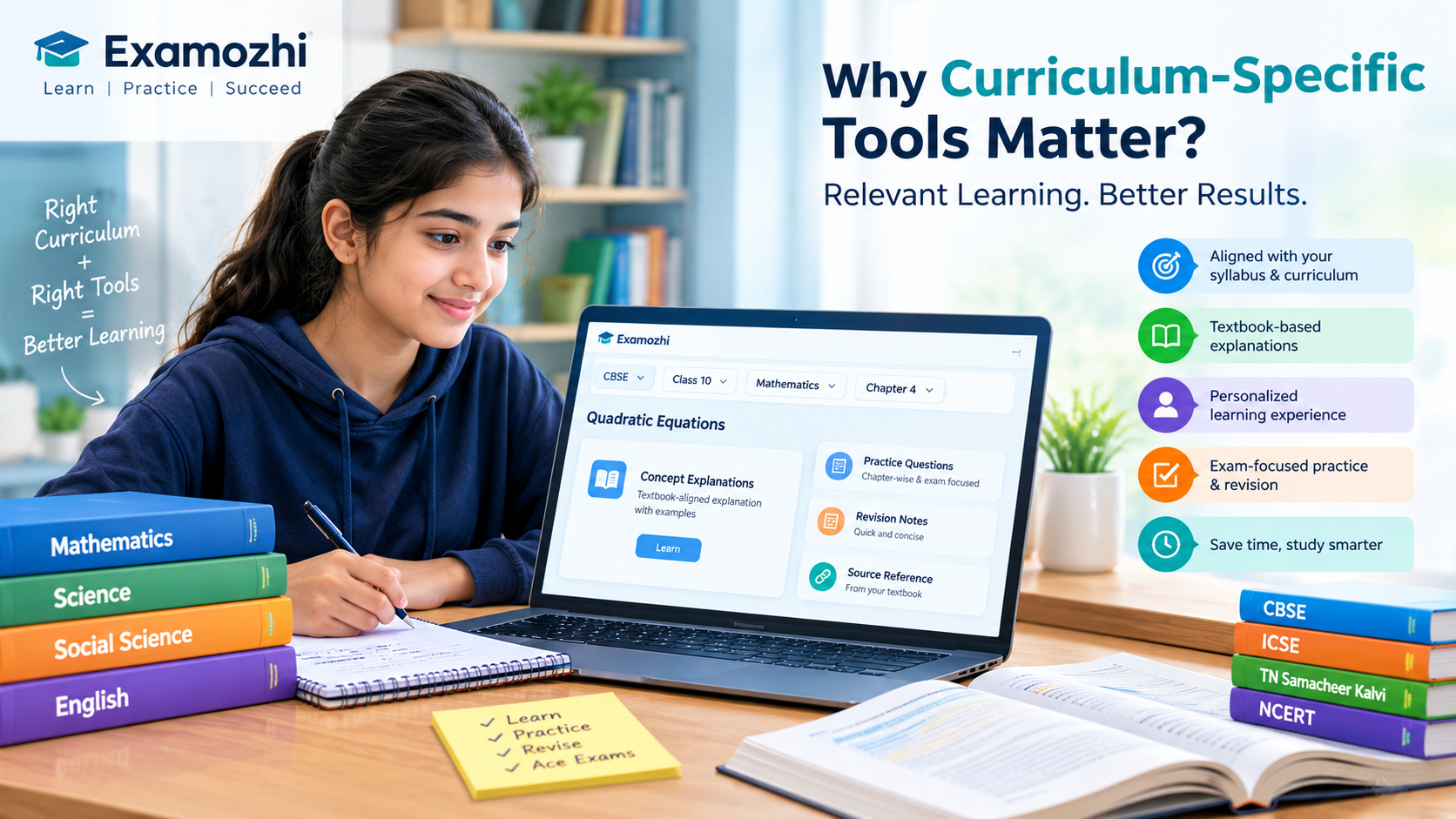
Instead of giving students broad information from the internet, curriculum-specific learning tools are designed around a particular educational curriculum. They can connect learning activities with the actual topics students are expected to study.
This approach becomes even more valuable as artificial intelligence becomes part of everyday education. UNESCO's AI Competency Framework for Students emphasizes the importance of integrating AI-related learning with curricula and developing students' ability to use AI responsibly and critically. UNESCO
For students, the goal should not be to use AI simply because it is powerful. The goal should be to use the right AI for the right learning context.
What Are Curriculum-Specific Tools?
Curriculum-specific tools are educational platforms designed around a particular syllabus, curriculum, textbook, board, course, or learning framework.
For example, a general AI tool might answer:
"Explain Newton's laws of motion."
A curriculum-specific tool can go further by understanding:
- Which class the student belongs to
- Which board or curriculum they follow
- Which subject they are studying
- Which chapter contains the topic
- Which textbook or edition is being used
- What level of explanation is appropriate
- What type of answer is useful for the examination
This creates a more focused learning experience.
General Learning Tool vs Curriculum-Specific Tool:
| Feature | General AI / Search | Curriculum-Specific Tool |
|---|---|---|
| General information | ✅ | ✅ |
| Specific syllabus alignment | Sometimes | Yes |
| Textbook grounding | Usually limited | Core feature |
| Chapter-based learning | Limited | Yes |
| Exam-focused answers | Varies | Can be designed for it |
| Curriculum-specific terminology | May vary | Better aligned |
| Source/page references | Not always | Can be included |
| Revision by chapter | Limited | Yes |
| Board-specific learning | Limited | Yes |
| Personalized practice | Varies | Can be curriculum-based |
The difference is simple:
General tools answer questions. Curriculum-specific tools answer questions within a student's learning context.
1. Students Don't Need More Information — They Need Relevant Information:
One of the biggest challenges students face today is information overload.
Suppose a student is preparing for a particular chapter. They search for a concept online and find:
- University-level explanations
- Different definitions
- International examples
- Advanced concepts
- Videos covering unrelated material
- Different terminology
- Multiple versions of the same answer
Although all this information may be correct, it may not be useful for that student's examination.
A curriculum-specific tool can narrow the learning environment.
Instead of asking:
What information exists about this topic?
the learning experience becomes:
What does my curriculum require me to understand about this topic?
That distinction can save time and reduce confusion.
2. Curriculum Alignment Makes Learning More Focused:
Every curriculum has a structure.
A typical structure might look like:
Class → Subject → Unit → Chapter → Topic → Learning Objective → Questions
Curriculum-specific tools can use this structure to organize learning.
For example:
Mathematics
Class 10 → Mathematics → Algebra → Quadratic Equations → Solving Equations
A student can move through the topic systematically rather than jumping randomly between unrelated resources.
This is particularly useful during examination preparation because students often have limited time.
The National Curriculum Framework for School Education in India recognizes the potential of emerging technologies, including AI, to support teaching, learning, and assessment, while also stressing the importance of understanding technology's impact and using it appropriately. Education Government India
3. Textbook-Based Learning Reduces Unnecessary Confusion
For many students, the textbook remains the foundation of examination preparation.
A textbook provides:
- Definitions
- Concepts
- Examples
- Diagrams
- Formulas
- Exercises
- Chapter structure
- Subject-specific terminology
A general AI model may provide a scientifically correct explanation that is different from the way the student's textbook presents the concept.
That can create confusion.
Textbook-grounded learning works differently
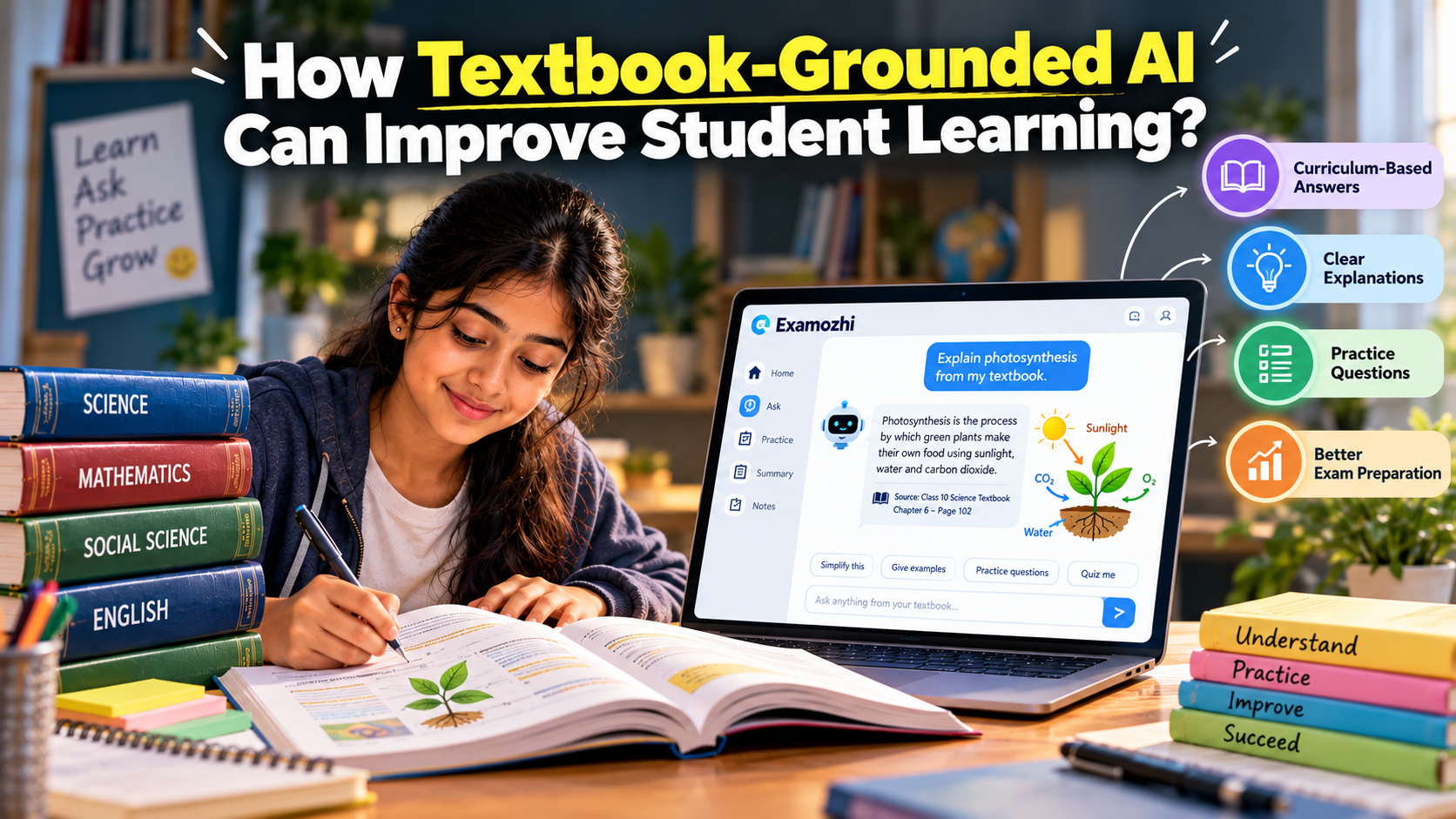
The tool can use the student's curriculum or textbook as the primary reference and then explain the concept in simpler language.
For example:
Textbook concept → AI explanation → Example → Practice question → Revision
This creates a learning chain that remains connected to the student's actual study material.
4. Curriculum-Specific AI Can Make Personalized Learning More Useful:
Personalized learning is not simply about making an explanation longer or shorter.
A useful personalized learning system considers what the student is learning and where they are in that curriculum.
For example, two students may ask:
Explain photosynthesis.
One might be studying it at school level, while another may be studying it as part of an advanced biology course.
The explanation should not necessarily be identical.
A curriculum-aware system can adapt factors such as:
- Difficulty
- Vocabulary
- Examples
- Answer length
- Question type
- Revision style
- Learning objectives
This is one reason curriculum-specific tools can make AI-assisted learning more meaningful.
5. They Can Support Better Exam Preparation:
Exam preparation is one of the strongest use cases for curriculum-specific tools.
Students often need different types of answers depending on the examination.
They may need:
- 1-mark definitions
- 2-mark short answers
- 3-mark explanations
- 5-mark answers
- Long-answer questions
- MCQs
- Important concepts
- Revision notes
- Practice questions
A general AI tool can generate these formats, but a curriculum-specific platform can generate them from the actual topics being studied.
That makes the practice more relevant.
A useful exam preparation workflow
Select class → Select subject → Select chapter → Learn concept → Practice questions → Review mistakes → Revise
This is much more structured than randomly searching for questions online.
6. Curriculum-Specific Tools Can Help Students Save Time:
Students frequently spend significant time searching for the right study material.
Imagine a student wants to revise one chapter.
Without a focused platform, they may need to:
- Search for the chapter.
- Find suitable notes.
- Watch a video.
- Search for questions.
- Find answers.
- Check whether the material matches their syllabus.
- Compare multiple sources.
- Create their own revision notes.
A curriculum-specific learning platform can bring several of these activities into one learning environment.
Instead of searching everywhere:
Learn → Ask → Practice → Revise
This does not mean students should stop using books, teachers, or other learning resources.
Instead, the tool becomes an additional study assistant.
7. Source-Based Answers Are Especially Important in AI Learning:
AI can be extremely useful, but students should not automatically assume that every AI-generated answer is correct.
This is why source grounding matters.
A trustworthy curriculum-specific tool should ideally show students where the information comes from.
For example:
Answer: Explanation of the concept
Source: Class 10 Science textbook, Chapter 5, Page 82
This allows the student to verify the information.
It also teaches an important learning habit:
Don't just ask AI. Check the source.
UNESCO's AI framework emphasizes critical judgment and responsible engagement with AI rather than allowing AI to replace human intellectual development. UNESCO
8. They Can Support Different Learning Languages:
Language can sometimes become a barrier to understanding.
A student may understand a concept better when it is explained in:
- English
- Tamil
- Hindi
- Another regional language
- A combination of languages
Curriculum-specific AI can potentially connect the same curriculum concept with different languages while keeping the underlying subject context consistent.
This is particularly useful in multilingual education environments such as India.
For example:
Question in English → Explanation in Tamil
or:
Question in Tamil → Textbook-grounded explanation in English
The important point is that the language can change while the curriculum context remains the same.
9. Curriculum-Specific Tools Can Help Teachers Too:
These tools are not only useful for students.
Teachers can potentially use curriculum-aware systems to:
- Create practice questions
- Generate revision material
- Explain difficult concepts in different ways
- Prepare quizzes
- Organize chapter-wise activities
- Create differentiated learning resources
- Support students who need additional explanations
India's National Curriculum Framework discusses AI and other emerging technologies as having potential applications in teaching, learning, assessment, teacher development, and educational planning, while also emphasizing responsible implementation. Education Government India
The important principle is:
AI should support teachers, not replace them.
10. They Can Make AI More Relevant to Indian Students:
India has a diverse education landscape.
Students may follow different:
- Boards
- State curricula
- Textbooks
- Languages
- Classes
- Subjects
- Examination patterns
Therefore, a single generic learning approach may not work equally well for everyone.
A curriculum-specific platform can be designed to understand these differences.
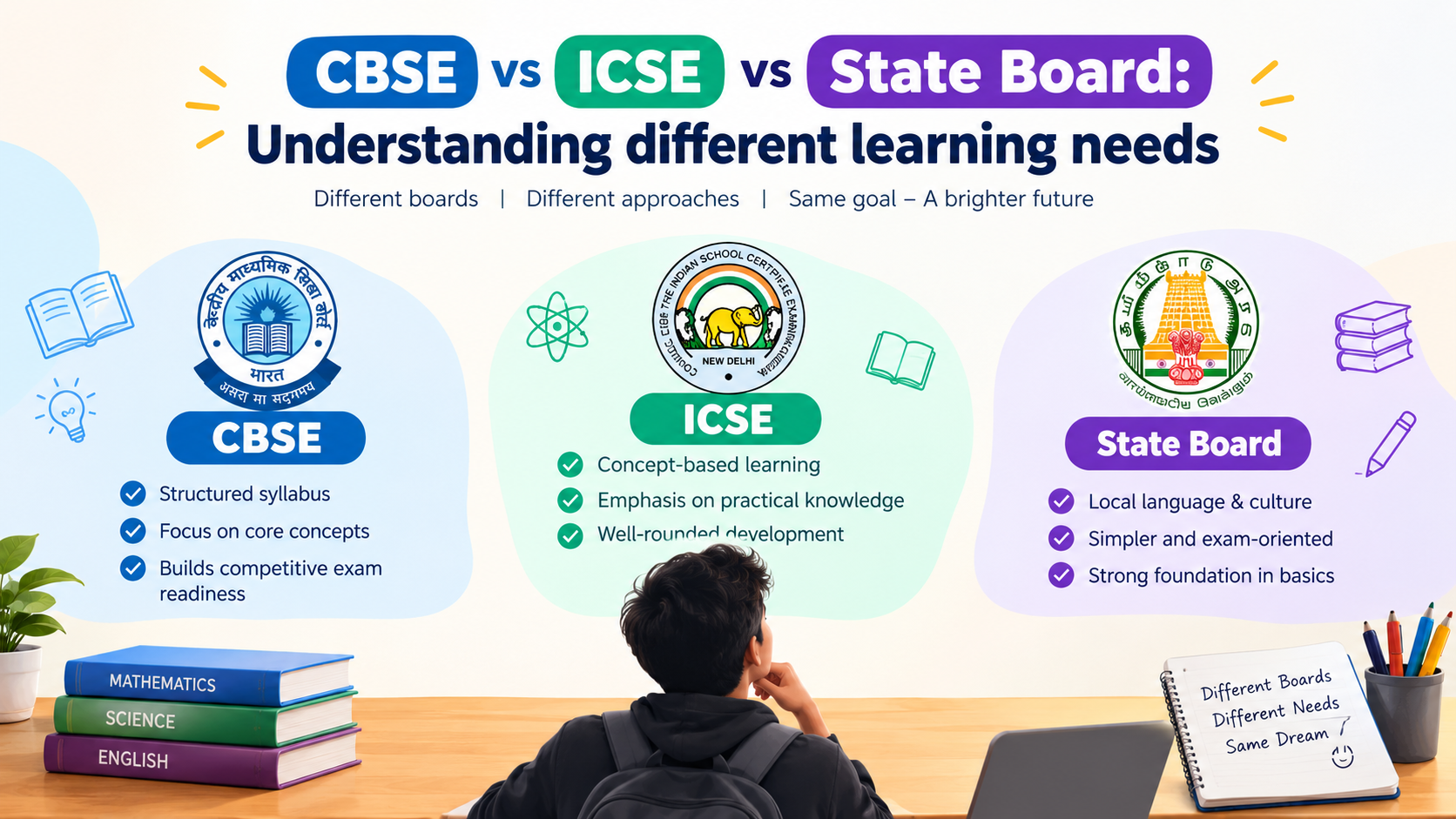
For example, a student following Tamil Nadu State Board may have different textbook content from a student following CBSE.
The same concept may also appear differently across textbooks.
This makes curriculum awareness particularly important.
What Should a Good Curriculum-Specific Tool Provide?
Not every platform that uses the words "AI education" is necessarily curriculum-specific.
Students and educators should look for useful features such as:
1. Curriculum Alignment
The platform should clearly identify the relevant curriculum, board, class, subject, and chapter.
2. Textbook Grounding
Answers should ideally be connected to reliable learning material.
3. Source References
Students should have a way to verify important information.
4. Chapter-Based Search
Students should be able to find concepts within their actual learning structure.
5. Multiple Answer Formats
The tool should support different learning and examination needs.
6. Practice Questions
Learning should involve active practice rather than only reading AI-generated explanations.
7. Multilingual Support
Language flexibility can make learning more accessible.
8. Responsible AI
Students should be encouraged to verify, think critically, and learn rather than simply copy answers.
How Examozhi Uses the Curriculum-Specific Approach
Examozhi is an example of an education platform built around the Indian curriculum and textbook context.
Its learning experience is designed around actual curriculum content rather than treating education as a collection of unrelated internet answers. Examozhi currently supports curriculum-oriented search and textbook-grounded answers across areas including CBSE, ICSE, TN Samacheer Kalvi, and NCERT. Examozhi
Students can use Examozhi Answers to explore textbook-grounded answers and see source-page references. Examozhi
The platform also provides AI-based explanations, question generation, curriculum search, and curriculum versioning. Examozhi
For collaborative revision, students can also use Examozhi Live Study Rooms to study together while keeping discussions connected to textbook content. Examozhi
The broader idea is simple:
AI becomes more useful for education when it understands what students are actually expected to learn.
Curriculum-Specific Tools vs Generic AI: Which Is Better?
The answer depends on the task.
| Student Need | Generic AI | Curriculum-Specific Tool |
|---|---|---|
| General knowledge | ⭐⭐⭐⭐⭐ | ⭐⭐⭐⭐ |
| Syllabus-based learning | ⭐⭐⭐ | ⭐⭐⭐⭐⭐ |
| Textbook-based questions | ⭐⭐⭐ | ⭐⭐⭐⭐⭐ |
| Chapter revision | ⭐⭐⭐ | ⭐⭐⭐⭐⭐ |
| General brainstorming | ⭐⭐⭐⭐⭐ | ⭐⭐⭐⭐ |
| Exam-focused practice | ⭐⭐⭐⭐ | ⭐⭐⭐⭐⭐ |
| Source verification | ⭐⭐⭐ | ⭐⭐⭐⭐⭐ |
| Curriculum-specific explanations | ⭐⭐⭐ | ⭐⭐⭐⭐⭐ |
| Personalized curriculum learning | ⭐⭐⭐ | ⭐⭐⭐⭐⭐ |
The best approach does not have to be AI vs textbooks or AI vs teachers.
Instead:
Textbook + Teacher + Student + Curriculum-Specific AI
can work together as a learning ecosystem.
How Students Can Use Curriculum-Specific Tools Effectively?
Students should use these platforms as learning assistants, not answer-copying machines.
A simple approach is:
Step 1: Choose your curriculum
Select your board, class, subject, and textbook where available.
Step 2: Select the chapter
Focus on one chapter rather than asking random questions across the entire subject.
Step 3: Learn the concept
Ask the tool to explain difficult topics in simple language.
Step 4: Ask follow-up questions
If something is unclear, ask:
- "Explain this with an example."
- "Explain this in simple words."
- "What is the difference between these two concepts?"
- "Give me a short revision summary."
Step 5: Practice
Generate or solve chapter-specific questions.
Step 6: Verify
Compare important answers with your textbook, teacher, or reliable sources.
Step 7: Revise
Use summaries, flashcards, questions, and self-testing to strengthen memory.
This approach keeps the student in control of the learning process.
The Future of Curriculum-Specific Learning
Education is moving toward a combination of AI, digital learning, personalization, and curriculum-aware technology.
But the future is not simply about making AI more powerful.
It is about making AI more relevant.
UNESCO's student AI competency framework describes progression through understanding, applying, and creating, while emphasizing human-centered thinking, ethics, AI techniques, and AI system design. UNESCO
This points toward a future where students do more than ask AI for answers.
They will need to:
- Understand AI
- Question AI outputs
- Verify information
- Use AI ethically
- Solve problems independently
- Create with AI
- Think critically
Curriculum-specific tools can support this future by connecting AI capabilities with the actual educational journey of each student.
Final Thoughts
Curriculum-specific tools matter because education is not one-size-fits-all.
Students do not study "information" in general. They study specific subjects, chapters, concepts, textbooks, curricula, and examinations.
A general AI tool can be powerful, but a curriculum-specific learning tool can make that power more relevant.
The biggest advantage is not simply faster answers.
It is the ability to connect:
Curriculum → Textbook → Concept → Explanation → Practice → Revision → Examination
When used responsibly, curriculum-specific AI can help students learn smarter without losing the importance of teachers, textbooks, critical thinking, and independent learning.
For students exploring AI-powered learning, the goal should therefore be simple:
Don't use AI just because it can answer. Use AI because it can help you understand what you actually need to learn.