The future of Indian curriculum-based learning
Explore the future of Indian curriculum-based learning and how AI, digital textbooks, personalization, multilingual tools, and smart assessment may reshape education.
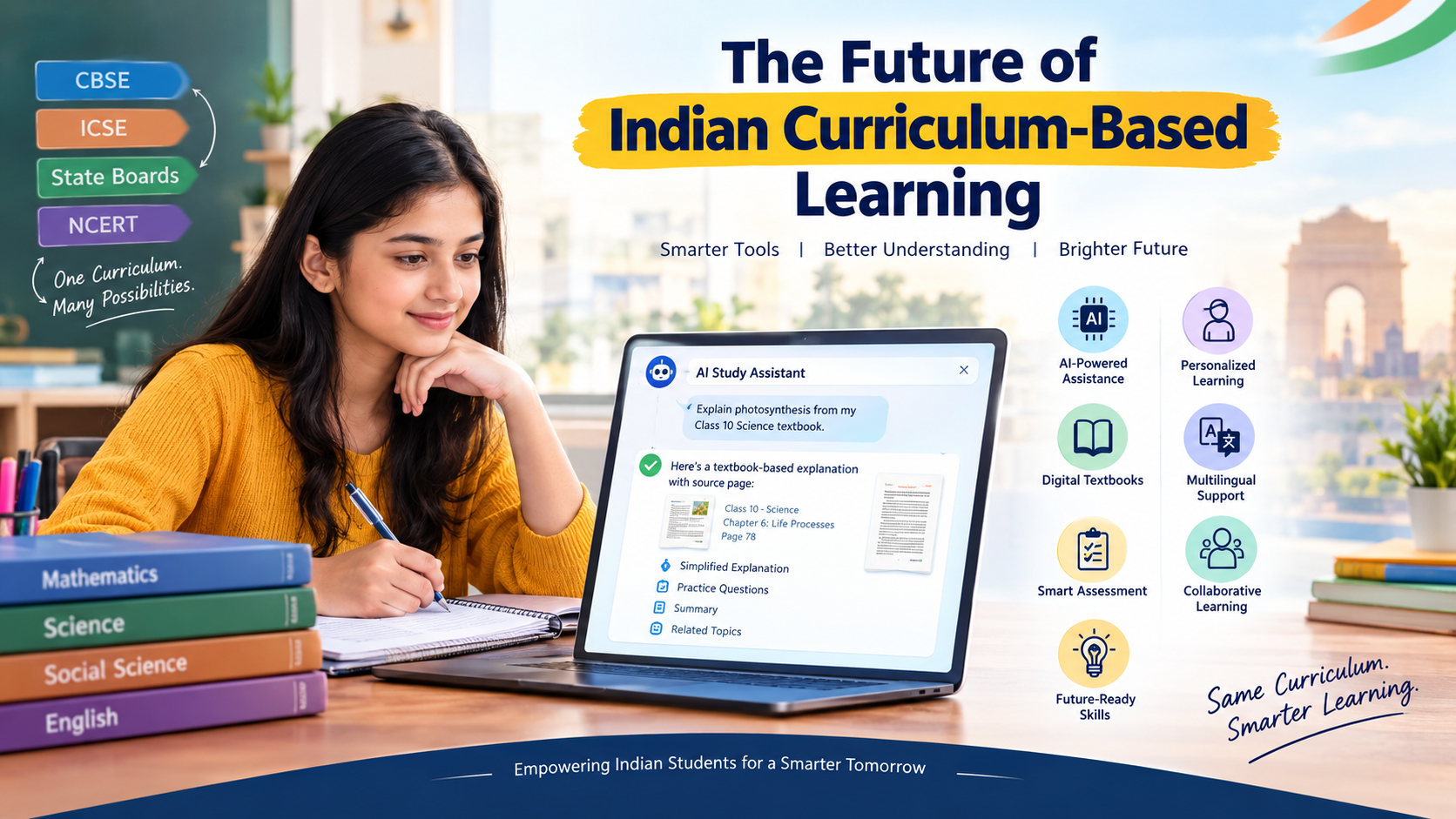
Indian education is entering a period where textbooks, technology, artificial intelligence, and personalized learning are increasingly coming together. For decades, curriculum-based learning has relied heavily on prescribed textbooks, classroom teaching, homework, revision, and examinations. These foundations remain important, but the tools students use to understand and practise their curriculum are changing.
India's National Education Policy (NEP) 2020 promotes more holistic, flexible, experiential, inquiry-driven, and learner-centred education. Government initiatives are also increasingly connecting education with artificial intelligence, computational thinking, digital infrastructure, and emerging technologies. Press Information Bureau
This does not mean textbooks are becoming less relevant.
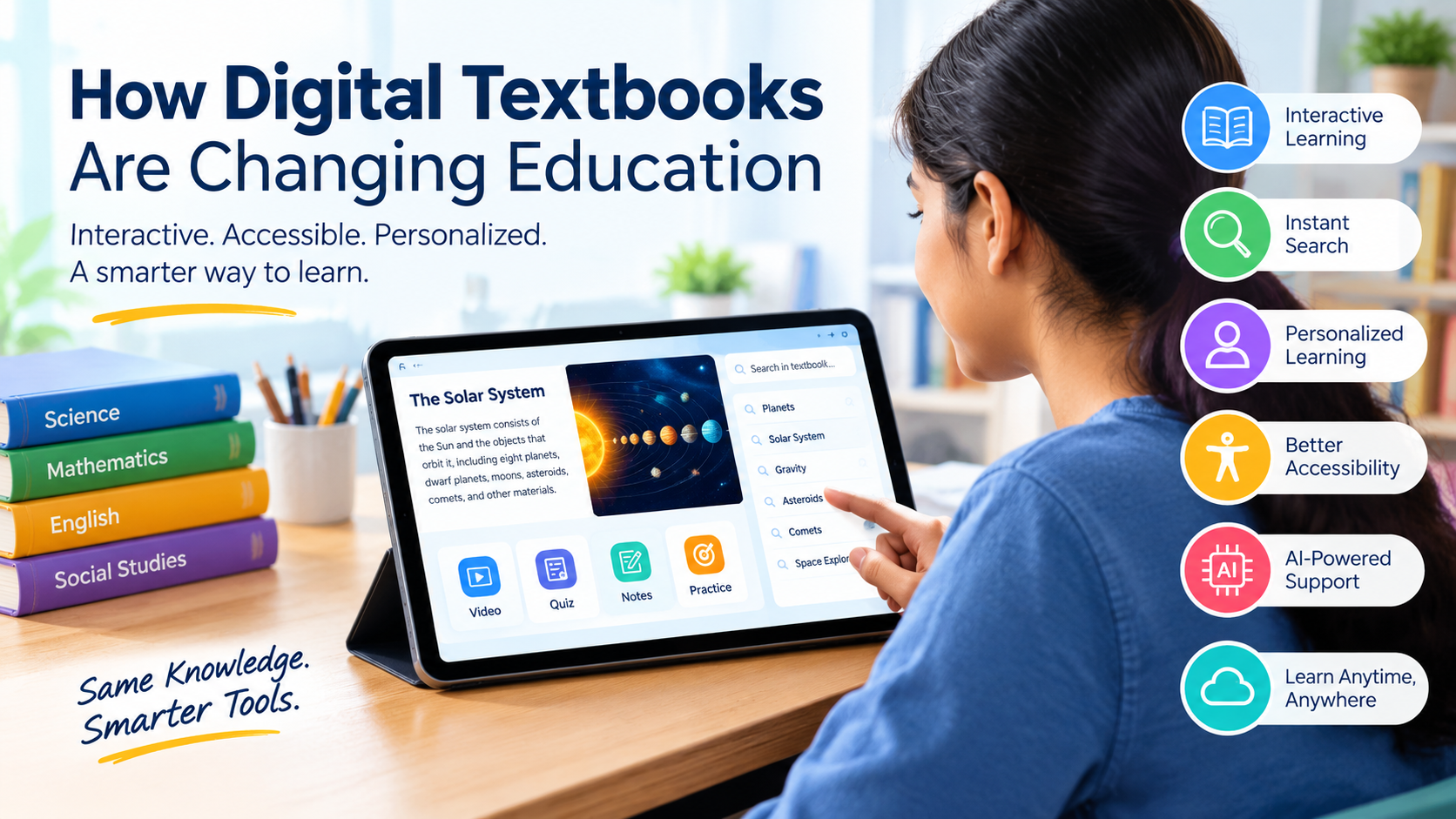
Instead, the future may involve making textbooks more searchable, interactive, accessible, personalized, and connected to modern learning tools.
The future of Indian curriculum-based learning is not about replacing the curriculum with technology. It is about using technology to help students understand the curriculum better.
What Is Indian Curriculum-Based Learning?
Indian curriculum-based learning refers to education that follows a defined academic curriculum, including prescribed subjects, textbooks, learning objectives, examinations, and assessment patterns.
Students may study under different boards and educational systems, including:
- CBSE
- ICSE
- State Boards
- NCERT-based curricula
- Other recognized educational frameworks
Each curriculum can have different textbooks, chapters, terminology, learning objectives, and examination expectations.
This makes curriculum alignment especially important.
A student preparing for an examination does not simply need a general explanation of a topic. They often need an explanation that matches their class, subject, textbook, chapter, syllabus, and expected answer format.
That is one reason curriculum-focused educational technology is becoming increasingly valuable.
Why the Future of Curriculum-Based Learning Is Changing?
Several developments are influencing the way students learn.
1. Artificial Intelligence
AI can support explanations, question generation, search, summarization, translation, and personalized learning.
2. Digital Textbooks
Digital versions of educational material can make searching and accessing information easier.
3. Personalized Learning
Technology can adapt explanations and practice activities according to a student's needs.
4. Multilingual Learning
Digital tools can make educational content more accessible across India's diverse linguistic environment.
5. Skill-Based Education
Education is increasingly focusing on skills such as problem-solving, communication, computational thinking, creativity, and critical thinking.
6. Digital Assessment
Technology can support new approaches to practice, feedback, and assessment.
Together, these developments are creating a more flexible learning environment around the traditional curriculum.
1. AI Will Make Curriculum Content More Interactive:
- One of the biggest changes will be the way students interact with their textbooks.
- A traditional textbook generally presents information in a fixed format.
- A digital learning system can allow students to interact with that information.
For example, a student reading a chapter could potentially:
- Ask a question about a paragraph
- Request a simpler explanation
- Search for a concept
- Generate practice questions
- Create a summary
- Find related sections
- Translate an explanation
- Test their understanding
This changes the textbook from something students only read into something they can interact with.
Key Idea
The textbook remains the source of knowledge, while technology becomes an additional layer for interacting with that knowledge.
2. Textbook-Grounded AI Can Improve Learning Relevance:
General-purpose AI can provide broad information, but students following a specific curriculum often need something more precise.
For example, a student may ask:
Explain Newton's Second Law.
A general AI system might provide a scientifically correct explanation.
But an exam-focused student may instead need:
Explain Newton's Second Law according to my Class 9 textbook and give me a 5-mark answer.
The second request is more curriculum-specific.
Textbook-grounded AI aims to connect AI responses with actual educational content.
Examozhi is an example of this approach. Its platform describes itself as reading students' actual textbooks and providing answers with source pages. It currently indexes content across CBSE, ICSE, TN Samacheer Kalvi, and NCERT. Examozhi
Its Examozhi Answers experience also focuses on textbook-grounded answers to board-exam questions with the relevant source page. Examozhi
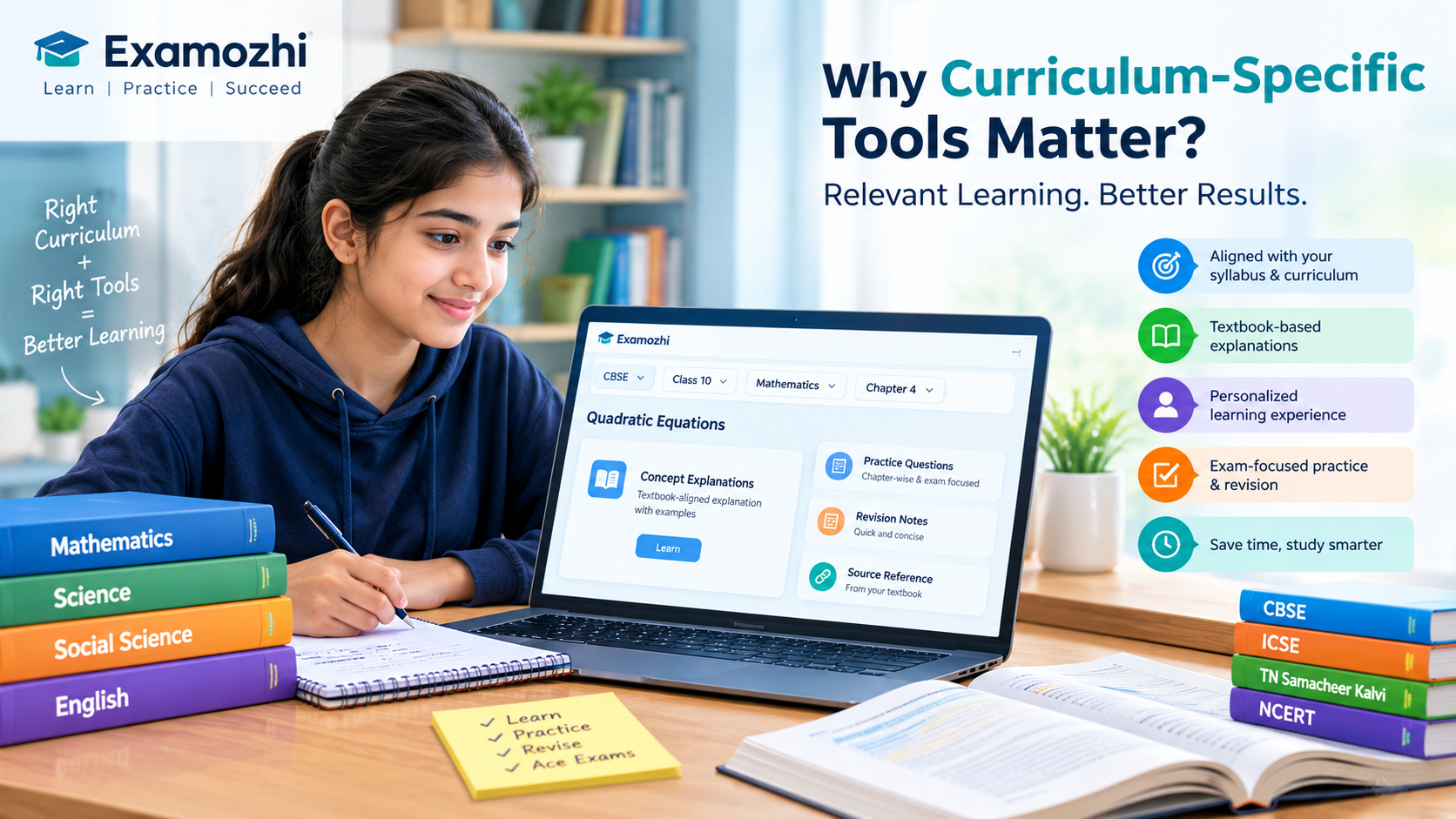
This approach can make AI assistance more relevant to students who are studying for curriculum-based examinations.
3. Personalized Learning Could Become More Common:
- A classroom often has many students learning at different speeds.
- One student may understand a concept immediately, while another may need three different explanations.
- Digital learning systems can potentially provide different forms of support.
For example:
Student A: Needs a basic explanation.
Student B: Needs an example.
Student C: Needs additional practice.
Student D: Wants an advanced application.
Instead of providing exactly the same explanation to everyone, AI-powered systems can adapt the interaction based on the student's request.
Personalized learning may include:
- Different explanation levels
- Customized practice questions
- Individual revision plans
- Additional examples
- Targeted feedback
- Topic-based quizzes
- Learning progress insights
However, personalization should support teachers and students rather than remove human guidance from education.
4. Multilingual Learning Will Become Increasingly Important:
India's linguistic diversity makes multilingual education particularly important.
Students may study subjects in English, Hindi, Tamil, Telugu, Bengali, Marathi, Malayalam, Kannada, or other languages.
AI-powered educational systems can help by making it easier to:
- Translate explanations
- Search content in different languages
- Understand difficult terminology
- Ask questions in a preferred language
- Compare concepts across languages
Examozhi's platform, for example, supports asking questions in Tamil, English, Hindi, and romanized forms, with responses available in the student's language. Examozhi
Why This Matters?
Language should not become an unnecessary barrier to understanding a curriculum.
At the same time, students should continue learning the important academic terminology used in their prescribed textbooks and examinations.
5. AI Literacy Will Become Part of Curriculum Readiness:
The future curriculum is not only about using AI tools.
Students also need to understand AI itself.
UNESCO's AI Competency Framework for Students identifies four broad areas:
- Human-centred mindset
- Ethics of AI
- AI techniques and applications
- AI system design
The framework also describes progression through Understand, Apply, and Create. UNESCO
This means future curriculum-based learning may increasingly include questions such as:
- What is AI?
- How does AI use data?
- What are the limitations of AI?
- How can AI create bias?
- How should AI be used responsibly?
- How can students create with AI?
Important Takeaway
Future-ready curriculum learning will require students to understand both subject knowledge and the technology surrounding that knowledge.
6. Computational Thinking Will Become More Important:
India is already moving toward greater integration of computational thinking and AI into school education.
In August 2026, the Ministry of Education stated that NCERT, in collaboration with CBSE, had introduced a dedicated Computational Thinking and Artificial Intelligence Curriculum for Classes III to VIII from the 2026–27 academic year. The curriculum emphasizes areas including logical reasoning, pattern recognition, algorithm design, data literacy, and responsible AI. Press Information Bureau
This is significant because computational thinking is useful beyond computer science.
It encourages students to:
- Break large problems into smaller parts
- Identify patterns
- Develop logical solutions
- Understand processes
- Work with data
- Think systematically
These skills can support learning across many subjects.
7. Learning Will Become More Skill-Oriented:
The future of curriculum-based learning will not be limited to memorizing information.
NEP 2020 emphasizes experiential, inquiry-driven, discovery-oriented, and learner-centred education. Government initiatives also highlight the integration of skills into education. Press Information Bureau
This could lead to more learning activities based on:
- Problem-solving
- Projects
- Research
- Experiments
- Collaboration
- Communication
- Creativity
- Computational thinking
- Real-world applications
Traditional Learning:
Read → Memorize → Write
Emerging Learning Model:
Understand → Explore → Practise → Apply → Create → Reflect
The first model will not disappear completely, particularly where examinations require knowledge recall.
But the second model can help students develop a deeper understanding of what they learn.
8. Digital Textbooks Will Become More Powerful:
A digital textbook does not have to be simply a PDF version of a printed book.
Future digital textbooks could potentially provide:
- Searchable chapters
- Concept-based navigation
- Interactive explanations
- Audio support
- Language support
- Practice questions
- Progress tracking
- AI-powered search
- Accessible content
- Links between related concepts
This could make textbooks much easier to navigate.
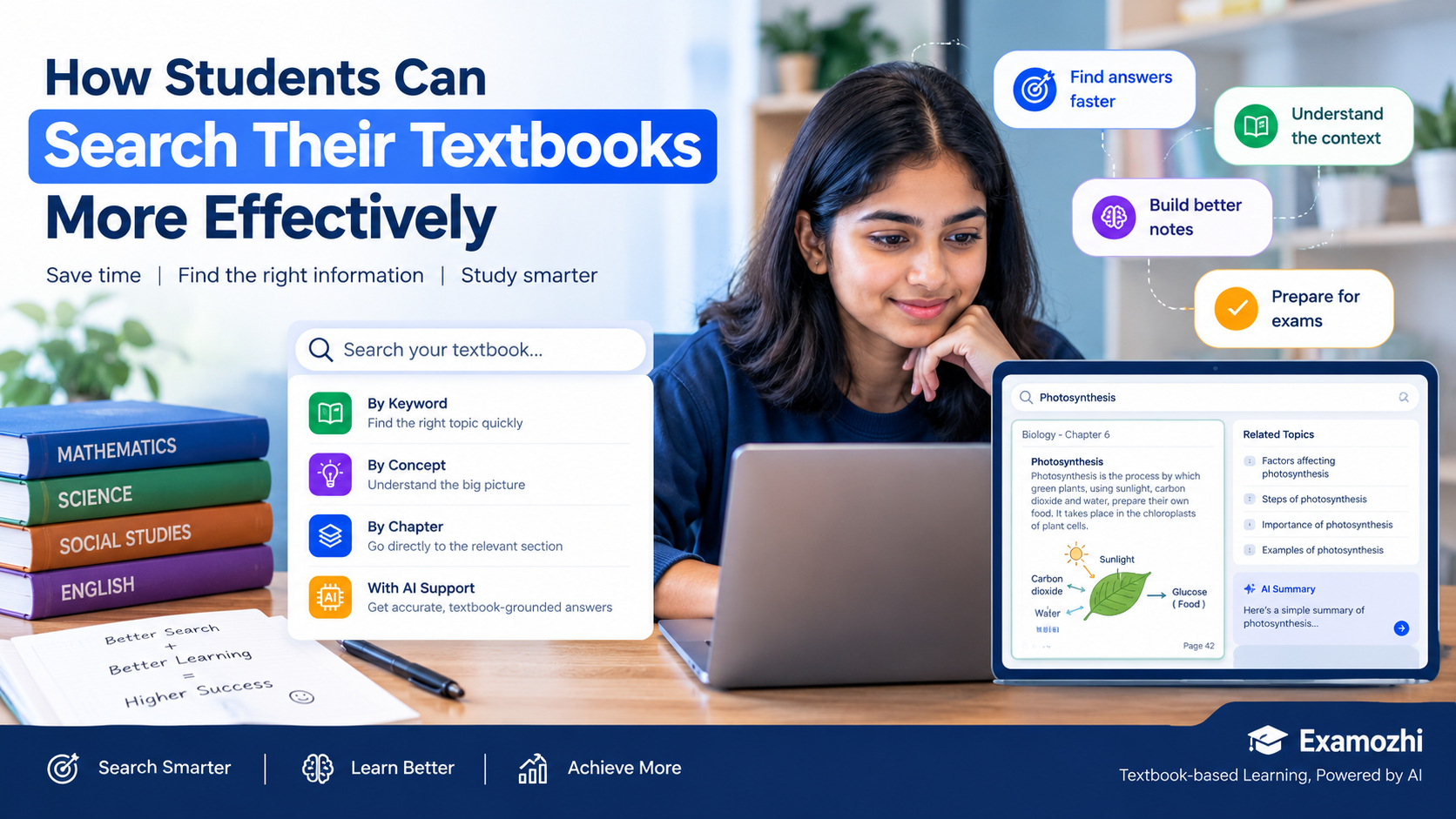
For example, instead of manually searching through hundreds of pages for a concept, a student could search directly for the topic and reach the relevant section.
Examozhi's curriculum infrastructure illustrates this direction by organizing content through structures such as class → subject → chapter → topic, while also providing semantic search and AI-powered educational features. Examozhi
9. Assessment Could Become More Continuous:
Traditional assessment often focuses heavily on examinations.
Technology can support more frequent forms of practice and feedback.
For example:
Learn → Take a short quiz → Identify mistakes → Practise again → Retest
AI can potentially generate questions based on specific topics and adjust practice according to areas where a student needs improvement.
However, automated assessment has limitations.
Human teachers still play an important role in interpreting student performance, providing meaningful feedback, and understanding learning difficulties.
The future is therefore more likely to involve technology-supported assessment rather than completely automated education.
10. Collaborative Learning Will Not Disappear:
Technology sometimes creates the impression that students can learn entirely alone.
That is not the ideal future.
Students also learn through:
- Group discussions
- Peer learning
- Classroom activities
- Projects
- Debate
- Teacher interaction
- Collaborative problem-solving
Digital tools can actually strengthen some of these activities.
For example, Examozhi's Live Study Rooms allow students to study together through voice while asking questions from the textbook and seeing the same grounded answer. Examozhi
This demonstrates an important principle:
Technology can connect students rather than simply isolate them.
11. Teachers Will Remain Central to Curriculum-Based Learning:
Even with advanced AI systems, teachers will remain essential.
AI can provide:
Information + Practice + Assistance
Teachers provide:
Context + Judgment + Mentorship + Human Connection
UNESCO's teacher AI competency work also emphasizes the need for teachers to develop the knowledge, skills, and values required to use AI effectively while preserving human agency. UNESCO Document Repository
The future classroom may therefore look less like:
Teacher vs Technology
and more like:
Teacher + Student + Technology
AI can handle some repetitive learning support while teachers focus on deeper instruction, discussion, feedback, motivation, and student development.
12. Curriculum Versioning Will Matter More in Digital Learning:
- Textbooks and curricula can change.
- Students may also use different editions during transition periods.
- This creates an important challenge for digital learning systems:
Which textbook edition should the answer come from?
- Modern curriculum platforms can address this by maintaining different textbook editions and identifying the current version.
- Examozhi's developer documentation describes curriculum versioning, allowing current and older textbook editions to coexist and enabling systems to retrieve a particular edition when needed. Examozhi
This can become increasingly important as digital curriculum systems grow.
Why It Matters?
An accurate answer is not enough if it comes from the wrong curriculum edition.
13. The Future Will Need Responsible AI Use:
More technology does not automatically mean better education.
Students need to understand the risks of AI, including:
- Incorrect information
- Bias
- Privacy concerns
- Overdependence
- Academic-integrity issues
- Reduced independent thinking
UNESCO emphasizes that students should develop critical and ethical approaches to AI, including awareness of privacy, equality, non-discrimination, transparency, and accountability. UNESCO Document Repository
Therefore, responsible AI use should become part of digital learning.
A Simple Rule for Students:
Use AI to support your thinking — not to replace your thinking.
14. What the Future Indian Learning Experience Could Look Like:
Imagine a student preparing for an examination.
They open their digital curriculum and select:
Class → Subject → Chapter → Topic
They then:
- Read the textbook content
- Ask questions about difficult concepts
- Receive textbook-grounded explanations
- Generate practice questions
- Attempt the questions independently
- Review mistakes
- Revise important concepts
- Take a short assessment
- Discuss difficult areas with classmates or teachers
This creates a learning cycle that connects:
Textbook + AI + Teacher + Practice + Student
That is potentially one of the strongest directions for Indian curriculum-based learning.
Traditional vs Future Curriculum-Based Learning:
| Traditional Approach | Emerging Approach |
|---|---|
| Printed textbook | Digital + interactive textbook |
| Manual searching | AI-powered curriculum search |
| Same explanation for everyone | Personalized explanations |
| Manual question preparation | AI-assisted question generation |
| Periodic revision | Continuous practice |
| Single-language resources | Multilingual learning support |
| Teacher-led learning | Teacher + technology-supported learning |
| Memorization-focused activities | Understanding + application |
| Fixed learning resources | Searchable curriculum knowledge |
The traditional approach will not disappear. Instead, technology can add new layers around it.
15. The Role of Platforms Like Examozhi:
The future of Indian curriculum-based learning will depend partly on educational platforms that understand the structure of Indian curricula.
Examozhi is designed around this idea.
Its platform provides curriculum-grounded AI assistance, allowing students to ask questions from actual textbooks and access source-backed answers. It also provides capabilities such as AI explanations, summaries, question generation, multilingual search, curriculum search, and textbook-based study support. Examozhi
For students, the important concept is not simply "AI learning."
It is:
AI + The Right Curriculum + The Right Source
That combination can make educational AI more useful for exam preparation and curriculum-based learning.
What Students Should Prepare for:
Students preparing for the future should develop a combination of academic knowledge and modern learning skills.
Core skills to develop:
- Critical thinking
- Problem-solving
- Communication
- Digital literacy
- AI literacy
- Research skills
- Creativity
- Collaboration
- Independent learning
- Responsible technology use
Students should not focus only on learning how to operate the latest AI tool.
Tools will change. Learning skills remain valuable.
The Future Is Curriculum + Technology + Human Thinking
The future of Indian curriculum-based learning is unlikely to be defined by technology alone.
Instead, it will depend on how effectively technology works with:
Curriculum
↓
Teachers
↓
Students
↓
AI and Digital Tools
↓
Practice and Assessment
↓
Real-World Skills
This combination can make education more accessible, personalized, interactive, and relevant while keeping the curriculum at the centre.
Final Thoughts
The future of Indian curriculum-based learning is not about replacing textbooks, teachers, or examinations with AI.
It is about making the existing learning ecosystem more connected, searchable, personalized, interactive, and accessible.
AI can help students understand difficult concepts. Digital textbooks can make information easier to find. Personalized learning can support different learning needs. Multilingual tools can reduce language barriers. Computational thinking can prepare students for emerging technologies.
But the foundation remains the same:
Students need to understand what they learn, practise independently, think critically, and apply their knowledge.
India's education ecosystem is already moving toward AI, computational thinking, experiential learning, digital infrastructure, and future-ready skills. Press Information Bureau
The most successful future learning environment will therefore not be the one with the most technology.
It will be the one that uses technology to help students learn better.