What Is El Niño? Understanding Its Causes, Effects and Global Impact
El Niño is a periodic warming of the central and eastern Pacific Ocean that disrupts weather patterns across the planet. This guide explains what El Niño is, what causes it, how it differs from La N...
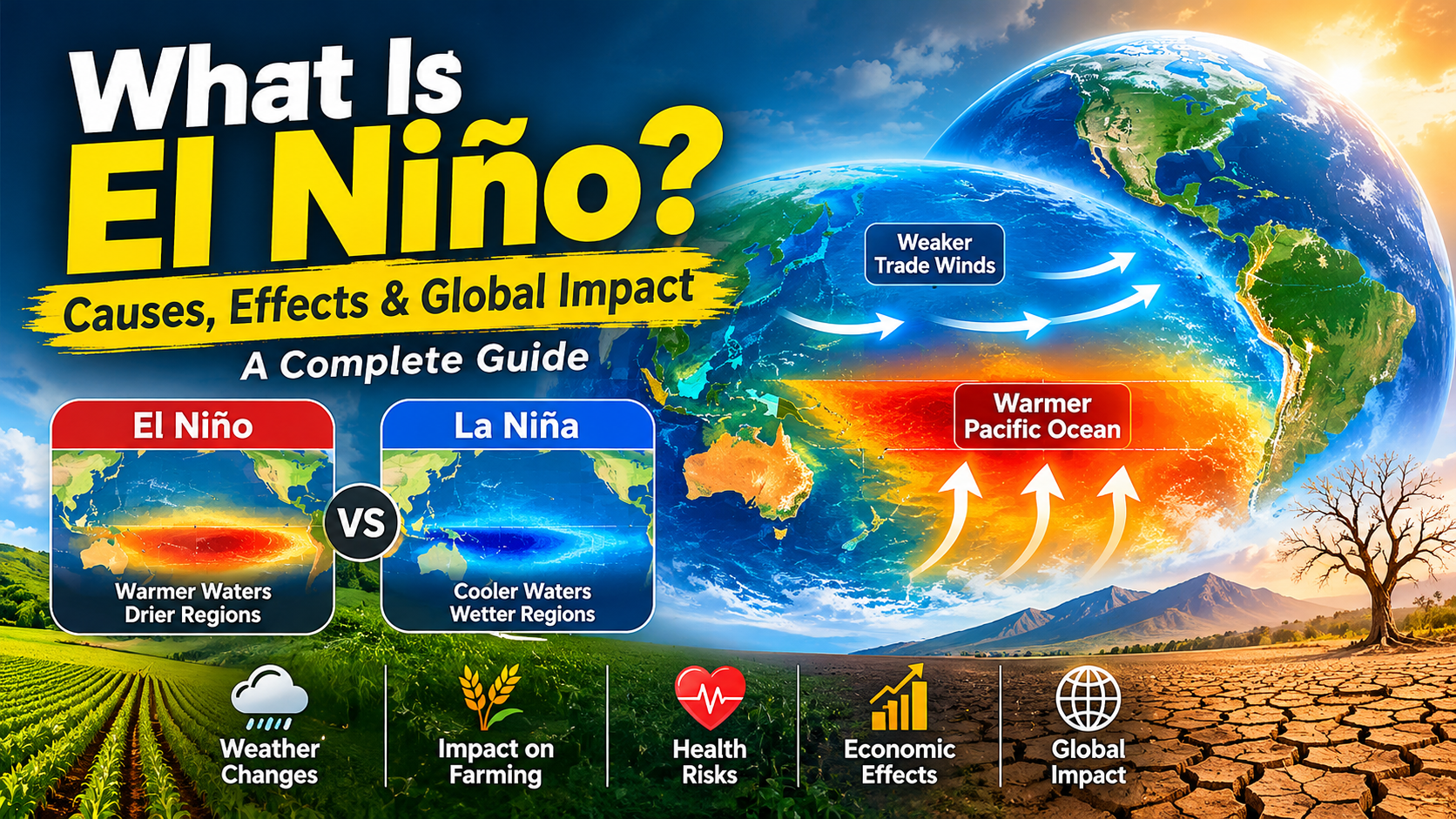
What is El Niño? It is a natural warming of the Pacific Ocean that reshapes weather patterns across the planet, and in 2026 forecasters are watching one of the strongest events on record develop. Its effects are expected to reach farms, power grids, supply chains and households around the world.
What Is El Niño?
El Niño is a climate pattern in which surface waters in the central and eastern tropical Pacific Ocean become much warmer than average. The name is Spanish for "the little boy" (a reference to the Christ child), because Peruvian fishermen noticed the warm water arriving around Christmas.
El Niño is one phase of a larger cycle called the El Niño–Southern Oscillation (ENSO). ENSO swings between three states:
- El Niño: warmer than normal Pacific waters
- La Niña: cooler than normal Pacific waters
- ENSO-neutral: neither extreme
Scientists generally declare El Niño when sea surface temperatures in a key area called the Niño-3.4 region stay at least 0.5°C above normal for an extended period, and the atmosphere responds in step with the ocean.
What Causes El Niño?
Under normal conditions, strong trade winds blow east to west across the tropical Pacific. They push warm surface water toward Asia and Australia, while cold, nutrient-rich water rises along the coast of South America.
During El Niño, this system weakens:
- Trade winds slacken or even reverse. Warm water that was piled up in the western Pacific flows back east.
- The ocean surface warms in the east and centre. The warm pool moves toward South America.
- Rainfall patterns shift. Heavy rain follows the warm water, leaving other regions drier than usual.
- The atmosphere reinforces the ocean. Changes in air pressure (the "Southern Oscillation") feed back into the winds, which strengthens the warming.
El Niño events typically return every two to seven years and often last around nine to twelve months. Scientists are still working to understand exactly what triggers each one, which is why forecasts always carry some uncertainty.
El Niño vs La Niña: What's the Difference?
| Feature | El Niño | La Niña |
|---|---|---|
| Pacific Ocean temperature | Warmer than average | Cooler than average |
| Trade winds | Weaker | Stronger |
| Typical global temperature effect | Pushes global temperatures higher | Slightly cools global temperatures |
| Rainfall | Floods in some regions, drought in others | Mirror-image shifts |
| Frequency | Every 2–7 years | Every 2–7 years |
El Niño in 2026: Where Things Stand
The 2026 event is a major one. According to NOAA's Climate Prediction Center, in its September 10, 2026 update, an El Niño Advisory was in effect, and the agency reported a greater than 90% chance of a very strong event during the Northern Hemisphere fall and winter of 2026–27. The same update gave roughly a 75% chance that the October–December 2026 season could be historic, exceeding any El Niño in the record dating back to 1950.
Forecasts can change from month to month, so check the latest NOAA ENSO Diagnostic Discussion for current numbers.
The Global Effects of El Niño
Because the tropical Pacific is such a large heat source, changes there ripple through the atmosphere worldwide. Common (though not guaranteed) effects include:
1. Rising global temperatures
El Niño releases stored ocean heat into the atmosphere. Years with strong El Niño events, such as 1997–98 and 2015–16, have often set global temperature records, and they add to the long-term warming trend from climate change.
2. Drought in some regions
Australia, Indonesia, parts of Southeast Asia, southern Africa and northern South America often turn drier. This raises the risk of crop failures, water shortages and wildfires.
3. Floods and heavy rain elsewhere
Coastal Peru and Ecuador, the southern United States and parts of East Africa often see heavier rainfall and a higher flood risk.
4. Impact on India and the monsoon
In India, El Niño is historically associated with a weaker or erratic southwest monsoon, which matters enormously for kharif crops such as rice, pulses and oilseeds. Other factors, especially the Indian Ocean Dipole, can offset or amplify the effect, so El Niño does not guarantee a poor monsoon. It does raise the odds of heatwaves, uneven rainfall and pressure on food prices, and southern states including Tamil Nadu can see disrupted northeast monsoon patterns as well.
5. Health risks
Warmer and wetter conditions can expand the range of mosquito-borne diseases such as dengue and malaria, while heatwaves strain public health systems. Flooding can raise the risk of cholera and other water-borne illness.
6. Fisheries and ecosystems
Warm water cuts off the upwelling of nutrients along the Pacific coast of South America, which can collapse anchovy catches and harm marine life. Coral reefs also suffer bleaching during prolonged ocean heat.
7. Economic and business impact
Crop shortfalls, power demand spikes during heat, shipping disruptions and commodity price swings all trace back to El Niño. For businesses, this means more volatile demand, supply chain risk and rapidly changing customer behaviour.
How Businesses Can Prepare for El Niño
You do not need to be a farmer or an energy company to feel the effects. Retailers, schools, healthcare providers, logistics firms and e-commerce brands all see demand shift when weather patterns change. Practical steps include:
- Track forecasts: Follow trusted sources such as NOAA, the India Meteorological Department and the WMO.
- Build data visibility: Internal dashboards that combine sales, inventory and weather indicators help teams respond before problems escalate. Custom software and dashboards make that practical.
- Automate routine work: AI solutions such as chatbots, document automation and semantic search keep operations running when customer enquiries or workloads spike.
- Keep your website fast and reliable: Seasonal surges (for example, cooling products during a heatwave) can overload a slow site. A well-engineered web application or e-commerce store protects sales when demand jumps.
- Adapt your marketing: Weather-driven demand changes quickly. Strong SEO and content marketing lets you rank for the questions customers are searching for right now, such as "what is El Niño" or "how will El Niño affect prices".
- Stay reachable on mobile: Customers check weather alerts and shop from their phones. Consider a dedicated mobile app for your business.
Frequently Asked Questions About El Niño
What is El Niño in simple words?
El Niño is a natural warming of the Pacific Ocean near the equator that changes wind and rainfall patterns around the world.
How often does El Niño occur?
Roughly every two to seven years, with no fixed schedule. Strong events are less common than moderate ones.
Is El Niño caused by climate change?
No. El Niño is a natural cycle that existed long before modern warming. Climate change, however, adds extra heat on top of it, which can make heatwaves, droughts and floods during El Niño years more intense.
Does El Niño always cause a weak monsoon in India?
Not always. It increases the likelihood of a weak or uneven monsoon, but other factors such as the Indian Ocean Dipole also matter.
How long does El Niño last?
A typical event lasts about nine to twelve months, usually peaking in late autumn or winter in the Northern Hemisphere.
What comes after El Niño?
The system often returns to ENSO-neutral conditions, and sometimes swings to La Niña the following year.
Key Takeaways
- El Niño is a periodic warming of the Pacific that reshapes global weather.
- It is driven by weakened trade winds and shifting ocean heat.
- Effects include record warmth, droughts, floods, health risks and economic disruption.
- The 2026 event is forecast to be very strong, so preparation matters.
- Businesses that use data, automation and a strong online presence handle volatile conditions better.
Build a Business That Stays Resilient, With RootPro
At RootPro Technologies, we build fast websites, mobile apps, AI solutions, digital marketing campaigns and custom software for businesses across India. If you want to make your operations more data-driven and your online presence stronger, we would love to talk.