SP3D Career Opportunities 2026: Skills, Jobs & Scope
Explore SP3D career opportunities in 2026: top job roles, skills needed and future scope in piping design. Learn SP3D with Talent Brothers.
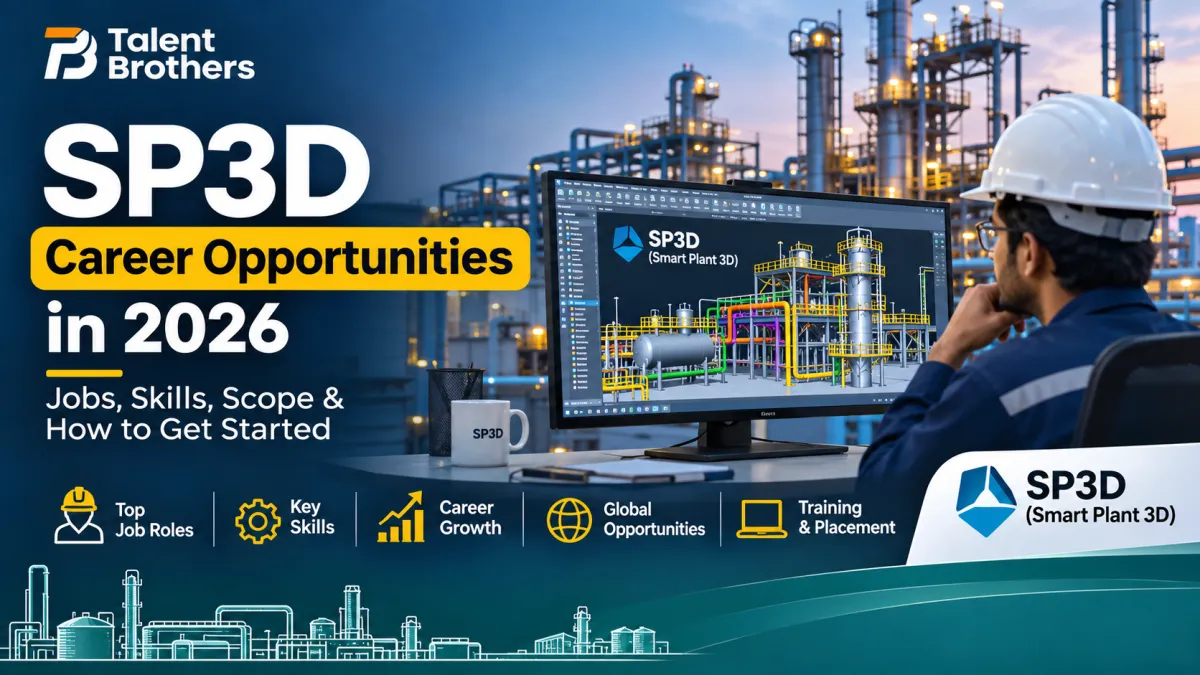
SP3D Career Opportunities: Skills, Job Roles and Future Scope in 2026
If you are an engineering graduate, diploma holder or working professional looking for a career in plant design, SP3D career opportunities deserve a serious look. Oil and gas, petrochemical, power and infrastructure companies all rely on 3D plant design software to build safer and more efficient facilities. SP3D (Smart Plant 3D, now widely known as Smart 3D) remains one of the most in-demand tools in the EPC (Engineering, Procurement and Construction) industry.
This guide covers what SP3D is, the job roles it opens up, the skills employers expect, the future scope in 2026 and beyond, and how to start your training.
What Is SP3D (Smart Plant 3D)?
SP3D is a 3D plant design and engineering software developed by Intergraph and now part of Hexagon. Engineers use it to model, design and document process plants, refineries, power plants and offshore facilities.
With SP3D, design teams can:
- Build intelligent 3D models of piping, equipment, structures and supports
- Generate isometric drawings, plot plans and material take-offs (MTO) automatically
- Run clash detection to catch design conflicts before construction
- Keep drawings, specifications and data consistent across disciplines
- Collaborate across engineering teams working on the same project
Because the models are data-driven, errors drop, rework is reduced and project timelines improve. This is why EPC companies prefer engineers who already know the tool.
Why Choose a Career in SP3D in 2026?
1. Strong demand from core industries
Oil and gas, refineries, petrochemicals, fertilizers, power plants, pharma, water treatment and infrastructure projects all need skilled 3D designers. As long as these industries build and upgrade facilities, design professionals will be needed.
2. Opportunities in India and abroad
Many Indian engineering firms handle global EPC projects, and Gulf countries and other international markets regularly hire piping designers with SP3D experience.
3. A technical career with growth
SP3D is not just software training. It builds a foundation in piping engineering, layout planning and plant design, which can lead to senior design and project roles.
4. Accessible entry points
Mechanical, civil, chemical, production and industrial engineers, as well as diploma holders and ITI graduates with design interest, can enter this field with the right training.
Top SP3D Job Roles
| Job Role | What You Do |
|---|---|
| SP3D Piping Designer | Create 3D piping models, route pipelines and generate isometrics |
| Piping Draughtsman / CAD Technician | Prepare detailed piping drawings and layouts |
| 3D Modeler | Build equipment, structural and piping models in SP3D |
| Piping Design Engineer | Apply piping codes, specifications and engineering logic to the design |
| Structural Designer (SP3D) | Model steel structures, platforms and supports |
| Equipment Layout Designer | Plan equipment placement and plot plan arrangements |
| Isometric / MTO Engineer | Extract isometrics, bills of material and reports |
| Piping Lead / Design Lead | Manage design teams, review models and coordinate disciplines |
| Project Engineer (Design) | Oversee design deliverables, schedules and client coordination |
Most professionals start as designers or modelers and move toward lead and engineer-level roles as they gain project experience.
Key Skills Needed for SP3D Careers
Technical skills
- SP3D software proficiency: modeling, catalog and spec usage, and drawing extraction
- Piping fundamentals: pipe sizes, schedules, fittings, flanges and valves
- P&ID reading: understanding process flow and instrumentation drawings
- Piping codes and standards: familiarity with ASME B31.3, B16.5, B16.9 and similar standards
- Equipment and plot plan layout: knowledge of pumps, vessels, heat exchangers and layout rules
- Pipe supports: support types and placement logic
- Isometric drawings and MTO: generating and verifying output
- Clash detection and model review: resolving interferences across disciplines
Complementary tools worth learning
- AutoCAD
- Navisworks (model review)
- CAESAR II (pipe stress analysis basics)
- Other 3D design tools such as PDS or AVEVA E3D
Soft skills
- Attention to detail
- Spatial visualization
- Teamwork with process, structural and instrumentation engineers
- Time management and clear communication
Future Scope of SP3D in 2026 and Beyond
The plant design field continues to evolve, and SP3D skills fit well with where the industry is heading.
1. Continued investment in energy and industrial projects. Refinery expansions, petrochemical complexes, green hydrogen, LNG and power projects keep generating design work.
2. Digitalization and smart plants. Intelligent 3D models and digital twins are becoming standard in plant design, and SP3D’s data-centric approach aligns with this trend.
3. Global outsourcing of engineering. International EPC firms continue to outsource design work to skilled teams in India, which creates steady demand for trained designers.
4. Career progression. With experience, an SP3D designer can grow into piping lead, design manager or project manager roles, or build a freelance and consulting career.
5. Upskilling advantage. Professionals who combine SP3D with piping engineering knowledge and complementary tools stand out in a competitive job market.
While tools will keep advancing, strong fundamentals in piping design and plant engineering will keep you relevant.
Who Should Learn SP3D?
- Mechanical, civil, chemical and production engineering graduates
- Diploma holders in mechanical and allied streams
- Piping draughtsmen and CAD operators wanting to upgrade
- Working professionals shifting into plant design
- Freshers aiming for EPC and oil and gas careers
How to Start Your SP3D Career: Learn With Talent Brothers
Getting the right training is the first step. Talent Brothers offers industry-focused technical training designed to help learners build job-ready skills.
Their Smart Plant 3D (SP3D) Training is available for learners across Chennai, Tamil Nadu, Kerala, Bangalore and Hyderabad, so you can pick a location that suits you.
What to look for in a quality SP3D course:
- Hands-on practice on real project-style models
- Coverage of piping basics along with software training
- Experienced trainers with industry exposure
- Practical assignments on isometrics, MTO and clash detection
- Placement assistance and career guidance
👉 Ready to begin? Visit the SP3D course page at Talent Brothers for syllabus details, batch timings and enrollment, or explore more programs at talentbrothers.com.
Frequently Asked Questions (FAQs)
1. Is SP3D a good career option in 2026?
Yes. SP3D remains widely used in EPC, oil and gas, petrochemical and power projects, so trained designers continue to find opportunities in India and abroad.
2. What is the eligibility to learn SP3D?
Mechanical, civil, chemical and production engineers and diploma holders are the most common learners. Basic understanding of engineering drawings is helpful.
3. Do freshers get jobs after SP3D training?
Freshers often start as piping designers, modelers or draughtsmen. Strong practical skills, a good project portfolio and solid piping fundamentals improve your chances.
4. What is the difference between SP3D and PDS?
PDS is an older plant design system, while SP3D is the newer, more advanced, data-centric platform. Many companies have moved toward SP3D.
5. Do I need piping knowledge before learning SP3D?
It helps, but a good course teaches piping basics along with the software.
6. Where can I learn SP3D in Chennai, Kerala, Bangalore or Hyderabad?
You can explore the SP3D training program at Talent Brothers, which covers these locations.
Final Thoughts
SP3D career opportunities in 2026 are promising for anyone who combines software skills with solid piping and plant design knowledge. With demand from core industries, global project exposure and clear growth paths, SP3D is a strong choice for engineers and diploma holders alike.
If you want to turn that potential into a career, start with structured, hands-on training. Check out the SP3D course at Talent Brothers and take your first step toward a rewarding career in plant design.