How Digital Transformation Is Changing Indian Schools
Digital transformation is changing how Indian schools manage students, teachers, attendance, fees, examinations, communication, and academic data. Discover the practical benefits, challenges, technolo...
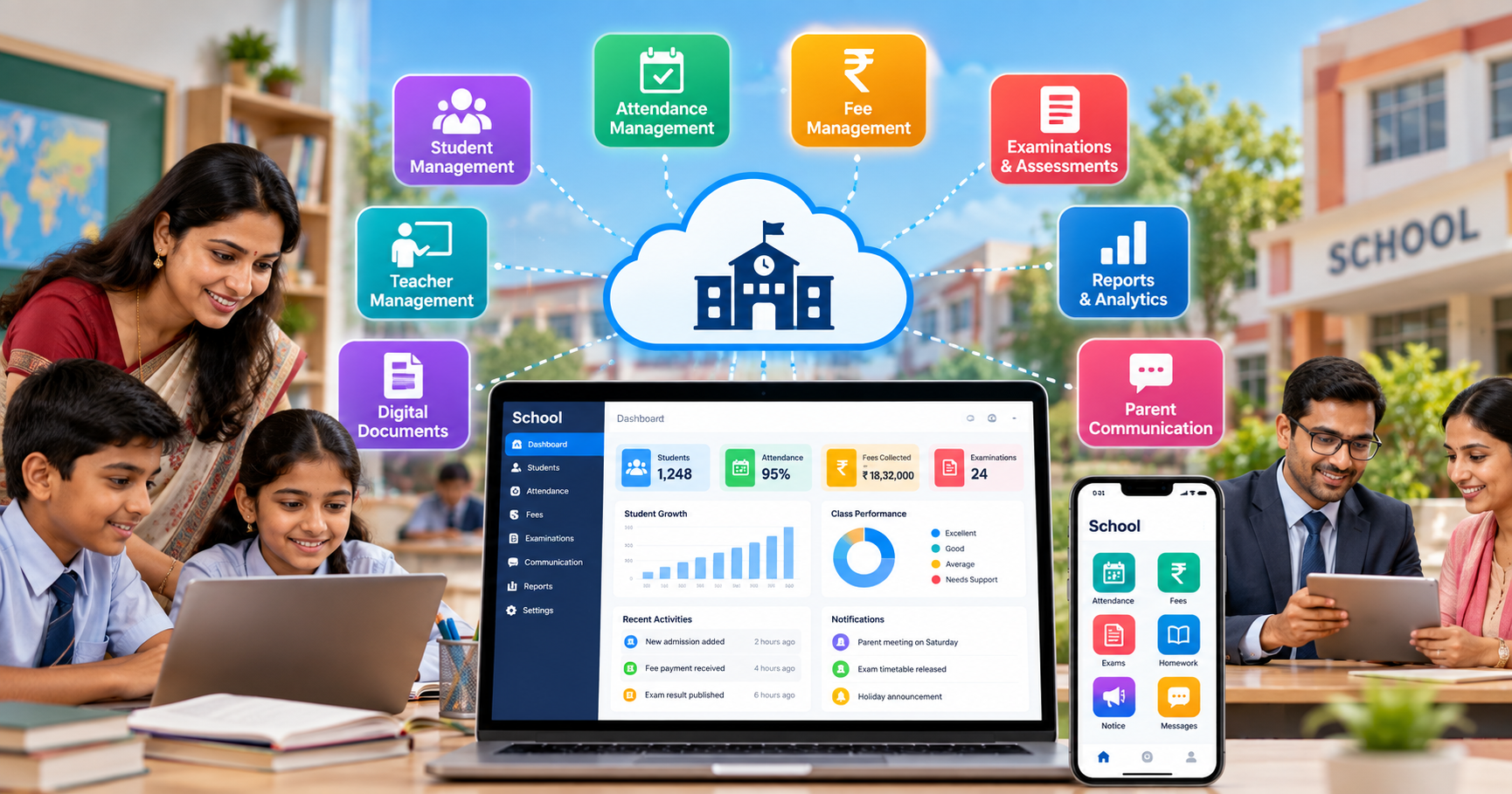
Indian schools are moving beyond traditional registers, spreadsheets, paper notices, and disconnected administrative processes. Today, digital technology is increasingly becoming part of how schools manage information, communicate with parents, organize academic activities, conduct assessments, and monitor daily operations.
This shift is known as digital transformation in education.
Digital transformation is not simply about replacing paper with computers. It involves redesigning school processes so that technology can make information easier to manage, repetitive work easier to automate, communication more organized, and decision-making more informed.
For school owners, principals, teachers, administrators, parents, and education professionals, understanding this change is important because technology is becoming increasingly connected with everyday school operations.
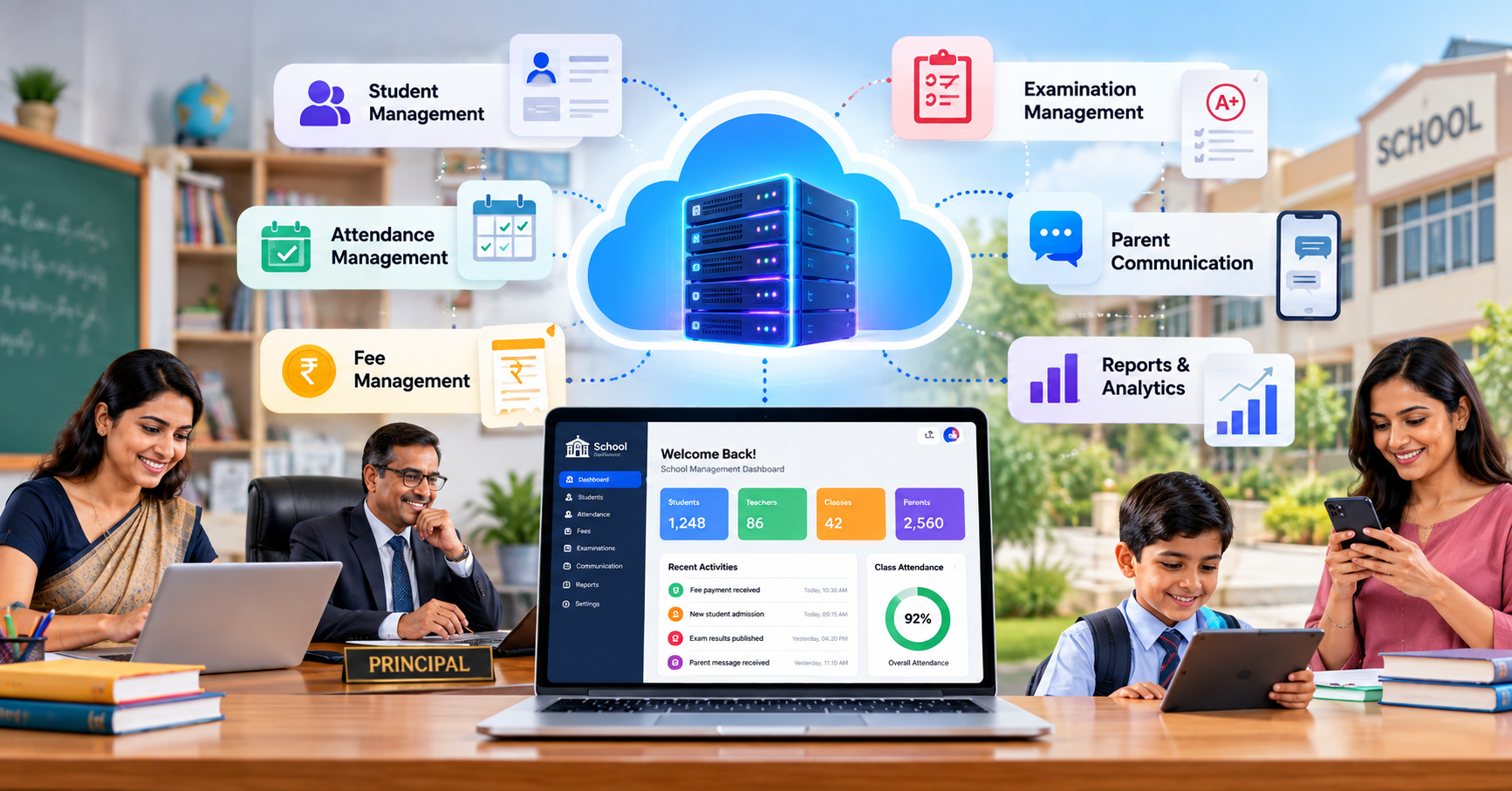
From student management and attendance to fee collection, examinations, communication, reporting, and analytics, digital systems are changing how schools operate.
What Is Digital Transformation in Schools?
Digital transformation in schools means using digital technologies to improve administrative, academic, communication, and operational processes.
A school may use technology for:
- Student information management
- Attendance tracking
- Fee management
- Examination management
- Digital assessments
- Parent communication
- Teacher administration
- Academic performance tracking
- Reports and analytics
- Document management
- School announcements
- Mobile applications
- Workflow automation
The important distinction is between simply using technology and actually improving a process through technology.
For example, converting a paper attendance register into an Excel sheet is digitization. Connecting attendance records with student profiles, reports, communication, and administrative workflows represents a broader form of digital transformation.
A school management platform such as SchooLagam can be considered when a school wants to organize multiple administrative processes through a digital environment.
Why Are Indian Schools Moving Toward Digital Systems?
Schools manage large amounts of information every day.
Student details, attendance, fees, examinations, academic performance, teacher information, parent communication, documents, and administrative records all need to be maintained accurately.
Traditional methods can create difficulties when information is spread across:
- Paper registers
- Excel spreadsheets
- Individual computers
- Messaging applications
- Physical files
- Separate software systems
This can make information difficult to find and update.
Digital transformation provides an opportunity to connect these processes.
Instead of treating each administrative activity as a separate task, schools can create digital workflows where relevant information is available to authorized users when required.
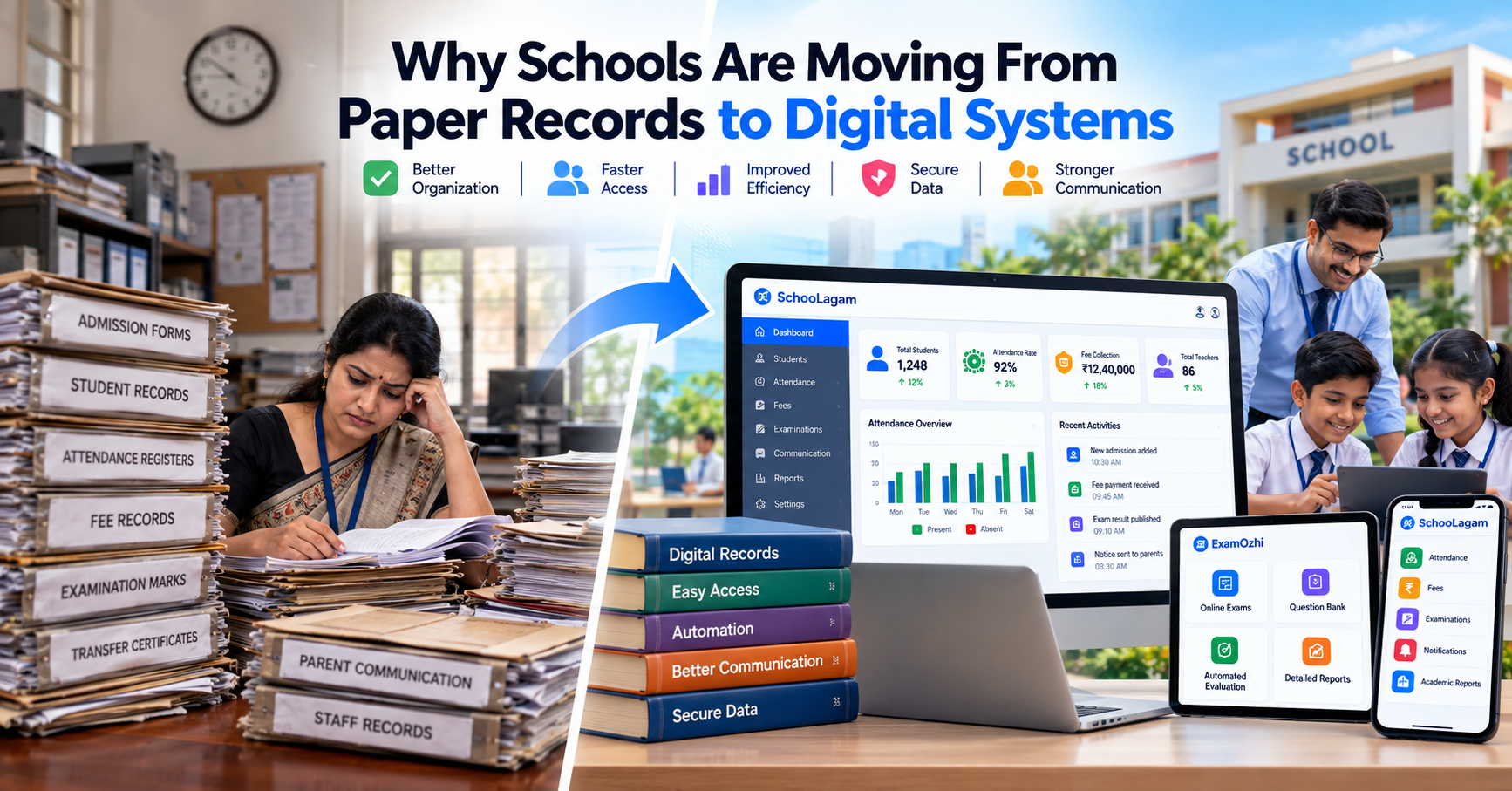
Traditional School Management vs Digital School Management
| Traditional Approach | Digital Approach |
|---|---|
| Paper registers | Digital records |
| Manual attendance | Digital attendance |
| Physical fee receipts | Digital fee records |
| Separate examination records | Digital assessment records |
| Manual report preparation | System-supported reporting |
| Notice-board communication | Digital communication |
| Physical document storage | Digital document management |
| Manual searching | Digital search |
| Multiple disconnected files | Centralized information |
Digital systems do not automatically solve every school-management problem. The results depend on software quality, implementation, data accuracy, staff training, and how effectively the school adopts the system.
How Digital Transformation Is Changing School Administration
1. Student Management Is Becoming More Organized
Student information is one of the most important categories of school data.
Traditionally, student records may be distributed across admission forms, registers, spreadsheets, certificates, and other documents.
Digital student management allows schools to organize relevant information in a structured profile.
Depending on the system, this may include:
- Student name
- Admission information
- Class and section
- Parent or guardian details
- Contact information
- Attendance
- Academic records
- Examination results
- Fee information
- Documents
A centralized digital environment can make it easier for authorized staff to find and update student information.
This is one of the areas where a school ERP platform such as SchooLagam can be evaluated as part of a school's digital transformation strategy.
2. Attendance Management Is Becoming Digital
Attendance is a daily activity, but managing attendance information manually can become time-consuming.
Teachers may need to mark attendance, maintain registers, calculate percentages, prepare reports, and communicate attendance-related information.
Digital attendance systems can bring these activities into a more structured workflow.
Depending on the system, schools may be able to:
- Record attendance digitally
- View attendance history
- Generate attendance reports
- Monitor attendance patterns
- Access student attendance information
- Support parent communication
Digital attendance can also reduce the need for repetitive manual calculations.
However, schools should select attendance technology based on their actual requirements, infrastructure, and staff workflow.
3. Fee Management Is Becoming More Structured
Fee management is another area where digital transformation can make administrative work more organized.
Schools may need to maintain:
- Fee categories
- Payment records
- Due amounts
- Receipts
- Payment history
- Student information
- Financial reports
When this information is distributed across registers and spreadsheets, reconciliation can require additional effort.
Digital fee-management workflows can provide authorized staff with a centralized view of relevant information.
For schools considering broader digital school administration, SchooLagam's school management tools can be explored alongside the school's specific fee-management requirements.
4. Examinations Are Moving Toward Digital Assessment
Examinations are also becoming part of the digital transformation process.
Schools can use digital technologies for activities such as:
- Online tests
- Digital question papers
- Student assessments
- Online submissions
- Automated evaluation
- Result management
- Performance reports
Digital examinations can be particularly useful when schools want to conduct assessments beyond traditional paper-based workflows.
An online examination platform such as ExamOzhi can be considered by educational institutions looking to organize online examination and assessment activities.
Digital assessment does not necessarily mean that every examination must become online. Schools can choose digital, physical, or hybrid assessment methods depending on the subject, student group, infrastructure, and academic requirements.
5. Parent Communication Is Becoming More Connected
Communication between schools and parents is an important part of education.
Traditionally, schools may communicate through:
- Printed circulars
- Student diaries
- Phone calls
- SMS
- Messaging groups
- Notice boards
Digital systems can provide additional communication channels.
Schools may use technology to communicate information related to:
- Attendance
- Fees
- Examinations
- Events
- Announcements
- Academic activities
- Important notices
The objective should be to make communication more organized rather than simply increasing the number of messages sent to parents.
A structured school management platform can help schools bring relevant communication into the broader administrative workflow.
6. Teachers Can Spend Less Time on Repetitive Administration
Teachers perform many administrative tasks in addition to teaching.
These may include:
- Attendance
- Marks entry
- Assessment records
- Student documentation
- Reports
- Communication
- Academic planning
When repetitive activities are digitized and organized properly, teachers may spend less time maintaining separate records.
This can allow more attention to be given to:
- Classroom teaching
- Student interaction
- Feedback
- Lesson planning
- Academic support
- Individual student needs
Technology should support teachers rather than add unnecessary administrative complexity.
7. School Management Gets Better Access to Reports
Principals and school owners need information to understand how the institution is functioning.
Digital systems can help organize reports relating to:
- Student strength
- Attendance
- Fees
- Examination performance
- Academic activities
- Administrative operations
- Communication
Instead of waiting for multiple departments to manually prepare information, management may be able to access relevant reports through a centralized system.
This can support more timely administrative decisions.
8. Data Analytics Is Becoming More Important
Digital transformation creates another important opportunity: using school data for analysis.
A school may have information about:
- Attendance
- Academic performance
- Examination results
- Student enrollment
- Fee status
- Class performance
When relevant information is organized properly, schools can identify patterns and ask better questions.
For example:
- Which classes have attendance concerns?
- Which subjects require additional academic support?
- How are students performing across assessments?
- Which administrative processes take the most time?
- What information is repeatedly requested by parents?
Analytics should be used to support professional decision-making, not to replace the judgment of teachers and school administrators.
9. Cloud Technology Is Supporting Flexible Access
Cloud-based technology has changed how organizations access software and information.
Instead of depending entirely on one computer inside a school office, cloud-based systems can allow authorized users to access information through connected devices, depending on the platform and permissions.
This can support:
- Remote access
- Mobile access
- Centralized information
- Multi-user workflows
- Data synchronization
However, schools should carefully evaluate security, access control, internet connectivity, data backup, support, and vendor policies before selecting a cloud-based system.
10. Mobile Applications Are Becoming Part of School Communication
Smartphones are already widely used by parents, teachers, and administrators.
As a result, mobile-friendly school systems can make information easier to access.
Potential mobile functions include:
- Attendance information
- Notifications
- School announcements
- Fee information
- Examination information
- Academic updates
- Parent communication
A mobile application should be designed around useful school workflows rather than simply providing another place for users to log in.
Digital Transformation and AI in Indian Schools
Artificial intelligence is becoming another area of interest within education technology.
AI can potentially support school operations through:
- Automated document processing
- Report generation
- Data analysis
- Communication assistance
- Administrative automation
- Content support
- Pattern identification
For example, AI-assisted systems could help administrators process large amounts of information or generate summaries from structured data.
However, AI implementation requires careful consideration of:
- Data privacy
- Accuracy
- Human review
- Access control
- Responsible use
- Appropriate data handling
Schools should avoid treating AI output as automatically correct. Teachers and administrators should remain involved wherever professional judgment is required.
Organizations such as RootPro Technologies work in areas including software development, AI, automation, and digital transformation, which are relevant when organizations are evaluating customized technology solutions.
Digital Transformation Beyond Standard School Software
Not every school has identical requirements.
A small school may primarily need student management, attendance, fees, and communication.
A larger institution may require:
- Multiple campuses
- Complex user permissions
- Custom reports
- Third-party integrations
- Custom workflows
- Advanced analytics
- Specialized applications
In such cases, customized software development and education technology solutions from RootPro Technologies can be considered when standard software does not fully match the institution's operational requirements.
The important principle is to start with the school's actual problem rather than starting with technology.
Benefits of Digital Transformation for Different Stakeholders
| Stakeholder | Potential Benefit |
|---|---|
| School Owners | Better operational visibility |
| Principals | Easier monitoring and reporting |
| Teachers | Less repetitive administrative work |
| Administrators | More organized records |
| Students | Easier access to relevant academic information |
| Parents | More structured communication |
| Management | Better access to operational information |
The actual benefits depend on implementation, software capabilities, staff adoption, infrastructure, and school processes.
Challenges Schools Should Consider
Digital transformation also introduces new responsibilities.
1. Staff Training
Teachers and administrators need sufficient training to use new systems confidently.
2. Data Migration
Existing paper and spreadsheet records may need to be cleaned and transferred carefully.
3. Data Security
Schools handle sensitive information and should establish appropriate security and access-control practices.
4. Internet Connectivity
Cloud-based systems depend on reliable connectivity for many workflows.
5. Change Management
People may initially prefer familiar manual processes. Schools should provide support during the transition.
6. Cost Planning
Schools should consider not only software costs but also devices, internet connectivity, training, maintenance, and support.
How Schools Can Start Their Digital Transformation Journey
Schools do not need to digitize everything at once.
A practical approach can be divided into phases.
Phase 1: Identify Problems
List the administrative activities that consume the most time.
For example:
- Attendance
- Student records
- Fee management
- Examination records
- Parent communication
Phase 2: Define Requirements
Decide which functions are essential and which are optional.
Phase 3: Select Technology
Compare available systems based on:
- Features
- Ease of use
- Security
- Scalability
- Mobile access
- Reporting
- Support
- Integration
Phase 4: Clean Existing Data
Review old records before transferring them.
Remove:
- Duplicate records
- Incorrect information
- Outdated entries
- Incomplete records
Phase 5: Train Users
Provide practical training to teachers, administrators, and management.
Phase 6: Start With Core Workflows
Begin with important areas such as:
- Student management
- Attendance
- Fees
- Examinations
- Communication
Phase 7: Measure Adoption
After implementation, review:
- How frequently staff use the system
- Which processes improved
- What difficulties users experience
- What additional features are required
Before and After Digital Transformation
| Before Digital Transformation | After Digital Transformation |
|---|---|
| Multiple paper records | Structured digital records |
| Manual calculations | Automated or system-supported calculations |
| Separate spreadsheets | Connected information |
| Physical notices | Digital communication options |
| Manual examination records | Digital assessment workflows |
| Difficult report preparation | System-supported reporting |
| Limited information visibility | Better access for authorized users |
The "after" state is not automatically better simply because it is digital. The system must be properly configured, maintained, and adopted by the people using it.
The Role of Digital Assessment Platforms
Examinations are an important part of school operations, and digital assessment can complement broader school management systems.
Schools may use online assessment tools for:
- Practice tests
- Internal assessments
- Online examinations
- Objective tests
- Question banks
- Digital evaluation
- Performance analysis
ExamOzhi is an example of a platform focused on online examinations and digital assessments for educational institutions.
A school considering digital assessment should evaluate factors such as question management, assessment formats, evaluation methods, reporting, user access, and student experience.
The Future of Digital Transformation in Indian Schools
The future of school technology is likely to involve greater integration between different digital systems.
Schools may increasingly combine:
- School ERP systems
- Cloud platforms
- Mobile applications
- Digital assessments
- AI tools
- Data analytics
- Communication systems
- Automated workflows
Instead of having many independent systems, schools may increasingly look for connected digital ecosystems.
This could allow information to move more efficiently between administrative and academic processes while maintaining appropriate access controls.
However, technology should remain a tool for education.
The fundamental goals of schools remain teaching, learning, student development, communication, and effective administration.
A Practical Digital Transformation Checklist
Before implementing new technology, school management can ask:
Administration
- What processes currently take the most time?
- Where is information duplicated?
- Which reports are difficult to prepare?
Teachers
- Which administrative activities create unnecessary workload?
- What information do teachers need regularly?
Students
- Which digital services would improve their academic experience?
- How will technology affect accessibility?
Parents
- What information do parents need?
- How should communication be delivered?
Technology
- Is the system easy to use?
- Is it mobile-friendly?
- Can it scale with the school?
- Can it integrate with other systems?
Security
- Who can access student information?
- How are accounts protected?
- How are backups handled?
- How are permissions managed?
Conclusion
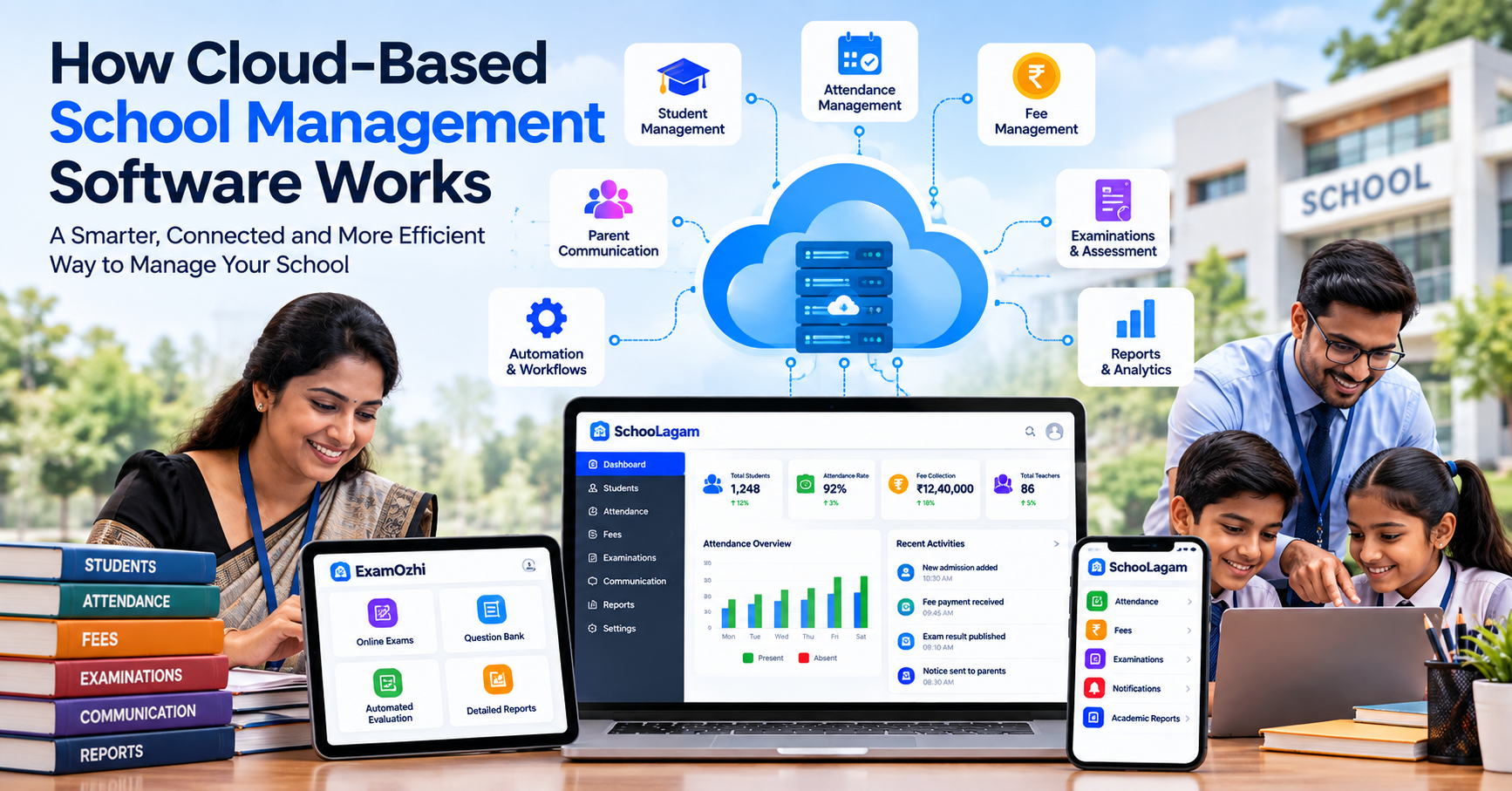
Digital transformation is changing Indian schools by connecting technology with everyday academic and administrative processes.
The transformation can be seen in student management, attendance, fee administration, examinations, parent communication, reporting, analytics, cloud access, mobile applications, and automation.
But successful digital transformation is not about purchasing the largest number of software tools.
It starts with understanding the school's real problems.
Schools should identify repetitive processes, define their requirements, select appropriate technology, prepare their data, train users, and introduce digital workflows gradually.
For schools exploring integrated digital administration, SchooLagam can be explored for school management and ERP-related requirements.
For organizations that need software development, AI, automation, or customized digital transformation solutions, RootPro Technologies can be considered based on the specific requirements.
For online examinations and digital assessments, ExamOzhi can be explored as part of a school's assessment technology ecosystem.
The future of education technology is not about replacing teachers or traditional educational values. It is about using technology thoughtfully so educators and administrators can spend less time managing repetitive processes and more time focusing on students and education.
Frequently Asked Questions
1. What is digital transformation in schools?
Digital transformation in schools means using digital technologies to improve academic, administrative, communication, and operational processes. It can include student management, attendance, fee management, examinations, parent communication, reporting, analytics, cloud systems, mobile applications, and automation. The goal is not simply to replace paper with software but to redesign workflows so that information and processes can be managed more efficiently.
2. How does digital transformation benefit teachers?
Digital transformation can reduce repetitive administrative work such as attendance recording, marks entry, report preparation, and maintaining separate student records. This can give teachers more time for classroom preparation, student interaction, feedback, and academic support. The benefit depends on whether the technology is easy to use and properly integrated into the teacher's existing workflow.
3. How can school ERP software support digital transformation?
A school ERP can bring multiple administrative processes into a connected digital environment. Depending on the platform, this may include student management, attendance, fees, communication, examinations, reporting, and other workflows. Schools should evaluate the features, security, usability, scalability, and support provided by the particular ERP before implementation.
4. Can digital transformation help parents?
Yes. Digital school systems can provide parents with more structured access to relevant school information, depending on the platform. This may include attendance, fee information, examination updates, announcements, and other communication. The exact functionality depends on the school's chosen system and how the school configures communication with parents.
5. Is AI useful for school management?
AI can potentially support areas such as data analysis, document processing, reporting, communication assistance, and administrative automation. However, schools should consider privacy, accuracy, access control, and human review before introducing AI into important workflows. AI should support teachers and administrators rather than replace professional judgment where human decision-making is required.
6. What is the role of online examination platforms?
Online examination platforms can support digital tests, assessments, question management, evaluation, and examination reporting. They can be used for appropriate internal assessments, practice tests, and online examinations depending on school requirements. Platforms such as ExamOzhi can be evaluated by institutions looking for dedicated digital assessment capabilities.
7. How should a school start digital transformation?
A practical starting point is to identify the school's most time-consuming manual processes. Schools can then define requirements, evaluate suitable technology, clean existing data, train staff, and implement core workflows gradually. Starting with areas such as student management, attendance, fees, examinations, and communication can provide a structured foundation for broader digital transformation.
Transform Your School with Smarter Digital Solutions
Digital transformation works best when technology is selected according to real operational and educational requirements.
For school management and administrative workflows, SchooLagam provides a school management and ERP-oriented digital platform that schools can explore for areas such as student management, attendance, fees, examinations, communication, and other administrative processes.
For organizations that require software development, AI, automation, or customized digital transformation, RootPro Technologies provides technology solutions that can be considered according to specific business and organizational requirements.
For educational institutions looking to conduct online examinations and digital assessments, ExamOzhi provides an online examination and assessment platform that can support digital testing workflows.
Before selecting any technology, schools should review their requirements, workflows, security needs, user expectations, and implementation capacity.
The goal is not to digitize everything simply because technology is available. The goal is to use the right digital tools to create a more organized, connected, and effective school environment.