Benefits of Centralized School Data Management for Schools
Centralized school data management helps schools organize student records, attendance, fees, examinations, communication, and academic information in one structured digital system. Learn how centralized data improves efficiency, accuracy, collaboration, reporting, security, and decision-making for modern schools in…
Benefits of Centralized School Data Management
A school generates a large amount of information every day. Student records, attendance, fee details, examination results, academic progress, teacher information, parent communication, documents, and administrative reports all need to be created, updated, stored, and accessed regularly.
When this information is spread across paper registers, Excel files, individual computers, messaging applications, and separate systems, managing a school can become unnecessarily complicated.
This is where centralized school data management becomes valuable.
Instead of maintaining important information in multiple locations, schools can organize their data through a structured digital system where authorized users can access the information they need from a common platform.
For school owners, principals, teachers, administrators, students, and parents, centralized data management can improve visibility, reduce repetitive work, support communication, and make everyday administration more organized.
What Is Centralized School Data Management?
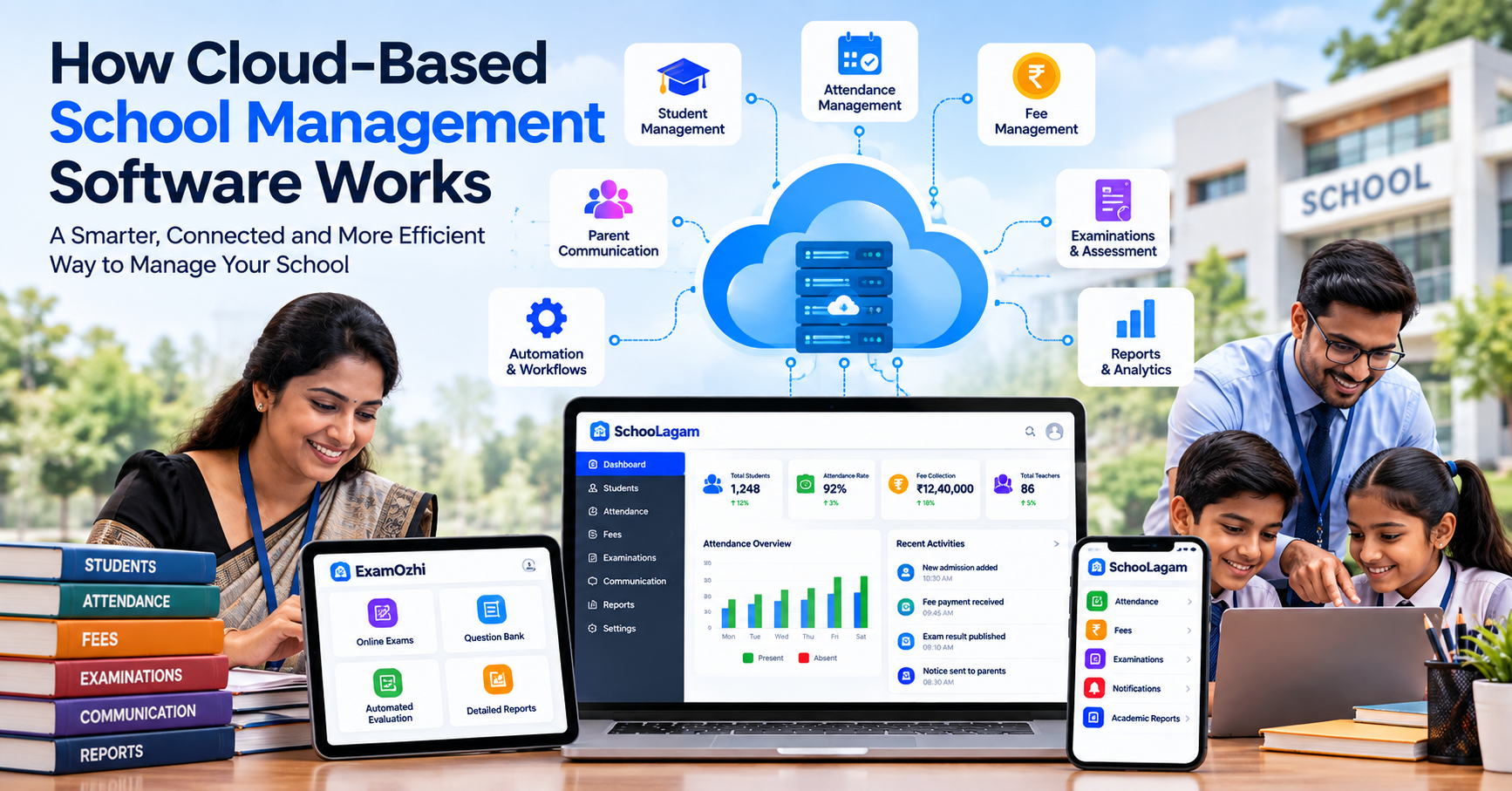
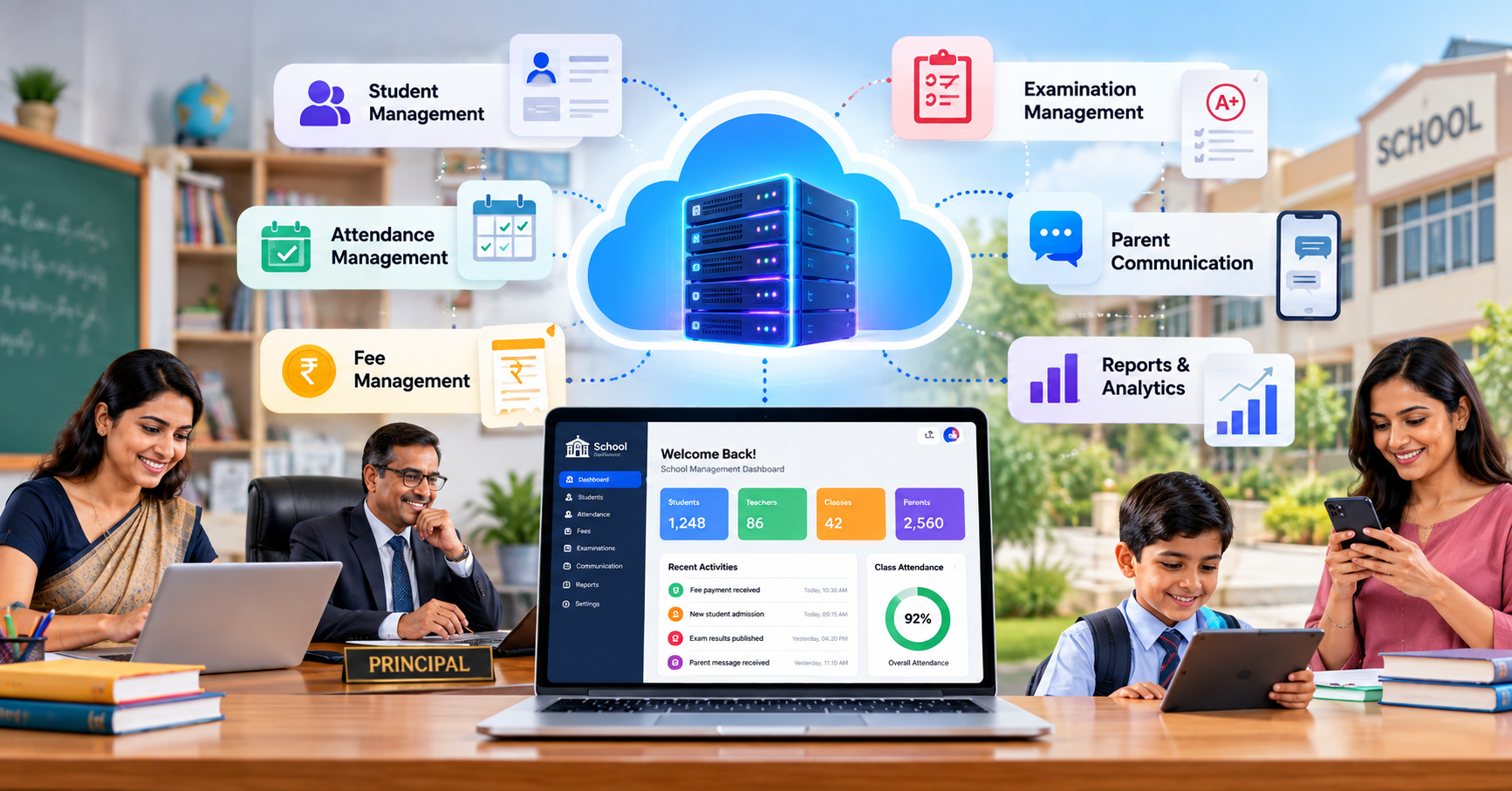
Centralized school data management means storing and managing important school information through a connected system rather than maintaining separate records in different places.
A centralized system may bring together areas such as:
- Student information
- Attendance
- Fee records
- Class and section information
- Teacher information
- Examination records
- Academic performance
- Parent communication
- School notices
- Reports
- Administrative documents
- Timetables
- Assessment information
The exact features available depend on the software selected and how the school configures it.
A school management platform such as SchooLagam can be considered when schools want to bring different administrative and academic processes into a more organized digital environment.
The important idea is not simply storing information digitally. The real benefit comes from connecting relevant information so that authorized users can access and use it efficiently.
Why Schools Need Better Data Management
Traditional school administration often involves multiple records being maintained by different people.
For example, attendance may be maintained by teachers, fee information by the accounts department, examination results by academic staff, and student information by the administration office.
This can create several challenges.
Common problems with decentralized records
- Duplicate data entry
- Difficulty finding older records
- Different versions of the same information
- Manual calculation errors
- Delayed reporting
- Repeated paperwork
- Communication gaps
- Difficulty tracking student information
- Time-consuming administrative work
- Limited visibility for school management
Consider a simple example.
If a student's address changes, the information may need to be updated in several places. If different records are not updated consistently, staff members may unknowingly work with outdated information.
Centralized data management aims to reduce this type of fragmentation.
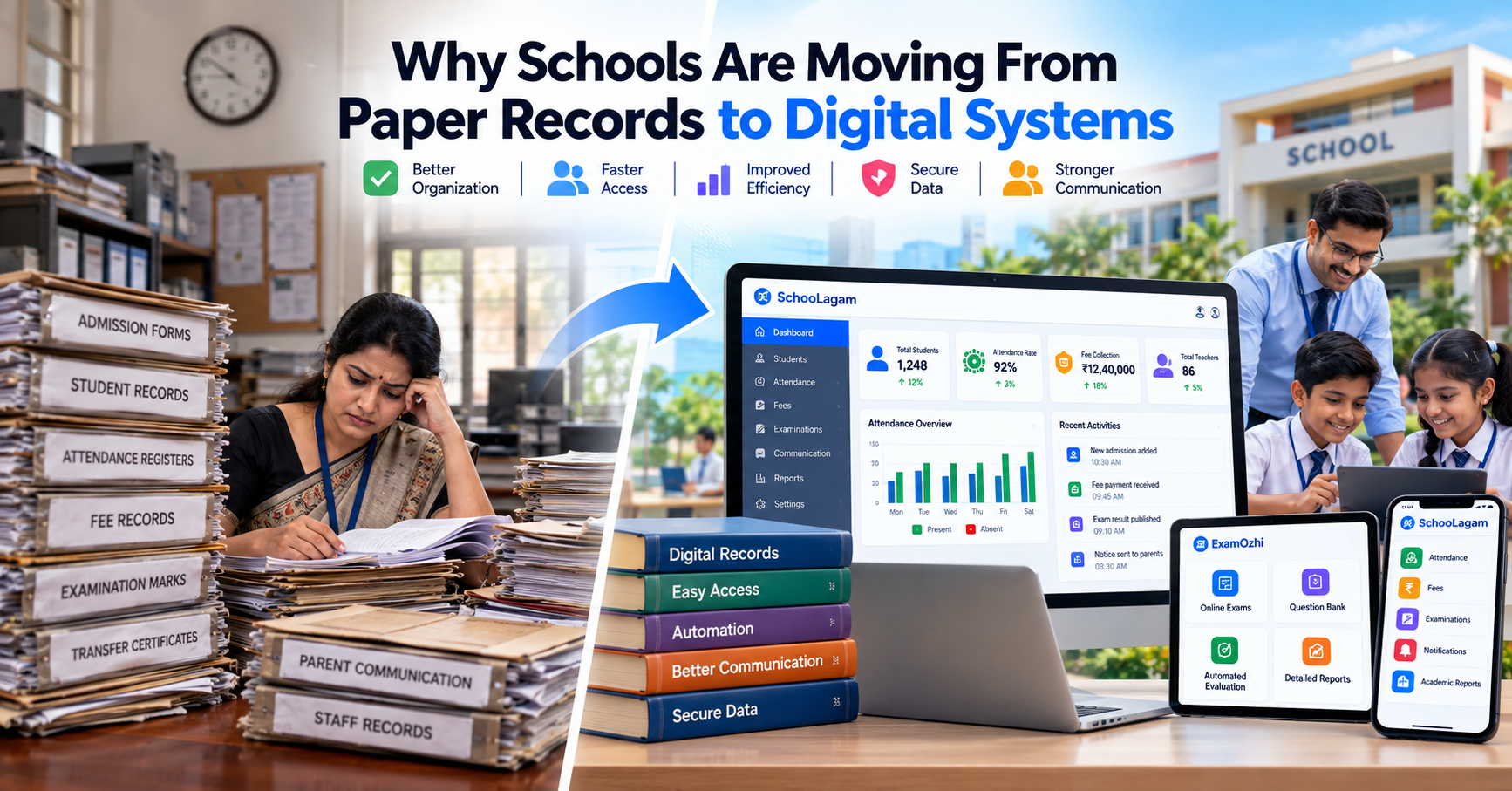
Traditional Records vs Centralized Digital Data
| Traditional Approach | Centralized Digital Approach |
|---|---|
| Information stored in registers and separate files | Information organized in a connected system |
| Manual searching | Digital search and retrieval |
| Repeated data entry | Reusable centralized records |
| Physical documents | Digital records |
| Manual report preparation | System-supported reporting |
| Difficult cross-department visibility | Better information visibility |
| Higher dependence on individual records | Shared system with controlled access |
| Communication may happen through multiple channels | Centralized communication workflows |
Digital systems do not automatically eliminate every administrative challenge. Proper implementation, staff training, data quality, and security practices are still important.
How Centralized School Data Management Benefits Schools
1. Creates a Single Source of Information
One of the biggest benefits of centralized data management is having a common source of school information.
Instead of searching through multiple spreadsheets, registers, folders, and messages, authorized staff can work with information maintained within the same system.
For example, student information can be connected with:
- Class details
- Attendance
- Fees
- Examination records
- Academic information
- Parent information
This can make it easier for administrators to understand the overall status of a student or class.
A school ERP platform such as SchooLagam can help schools structure different administrative processes within a digital environment.
2. Reduces Repetitive Administrative Work
Administrative teams often spend considerable time entering the same information into different records.
Centralization can reduce unnecessary duplication.
For example, once student information is maintained in a centralized system, the same information may be available to authorized modules or workflows instead of being manually recreated for every process.
This can be particularly useful for:
- Student registration
- Attendance
- Fee management
- Report preparation
- Parent communication
- Examination records
- Administrative reporting
The objective should not be to automate everything simply because technology is available. Schools should identify repetitive processes where digital workflows genuinely reduce effort.
3. Improves Student Record Management
Student records are among the most important information maintained by a school.
A centralized system can organize student information in a structured format, making it easier for authorized staff to access relevant records.
Depending on the system, information may include:
- Student profile
- Parent or guardian details
- Contact information
- Class and section
- Attendance
- Academic records
- Examination performance
- Fee information
- Documents
This creates a more organized student information lifecycle from admission through subsequent academic years.
4. Makes Attendance Management More Organized
Attendance is a routine activity that happens every school day.
When attendance records are maintained manually, staff may need to prepare registers, transfer information, calculate attendance percentages, and create reports separately.
Digital attendance management can bring these activities into a structured workflow.
Teachers can record attendance, while authorized administrators can access attendance information for reporting and monitoring.
Parents may also benefit when schools provide appropriate communication or access mechanisms.
For schools exploring this type of digital workflow, digital school management through SchooLagam can be evaluated alongside the school's operational requirements.
5. Simplifies Fee Information Management
Fee administration involves more than simply recording whether a payment was made.
Schools may need to track:
- Student details
- Fee categories
- Payment records
- Pending amounts
- Receipts
- Payment history
- Due dates
- Financial reports
When information is maintained across multiple files, reconciliation can become time-consuming.
A centralized system can provide a structured location for authorized staff to review fee-related information.
This can also help schools improve communication around payment information, provided the system supports the required communication workflows.
6. Supports Better Examination Management
Examinations generate large amounts of information.
Schools may need to manage:
- Examination schedules
- Subjects
- Question papers
- Student assessments
- Marks
- Results
- Performance reports
- Academic analysis
Digital assessment tools can help schools organize these activities.
For institutions that conduct online tests or digital assessments, ExamOzhi as an online examination platform can be considered for managing digital examination workflows.
The advantage of keeping assessment information digitally is that results can become easier to organize, retrieve, analyze, and communicate.
7. Improves Academic Performance Tracking
Student performance should not be viewed only through individual examination marks.
Schools may need to look at patterns across:
- Subjects
- Assessments
- Classes
- Terms
- Attendance
- Academic progress
Centralized data makes it easier to bring relevant information together.
For example, if a school notices that a student has declining performance alongside irregular attendance, teachers and administrators may have more context for discussing the situation with the parent.
Technology should support professional judgment rather than replace teachers' understanding of individual students.
8. Makes Reporting More Efficient
School administrators regularly need reports.
These may include:
- Student strength
- Attendance reports
- Fee reports
- Examination results
- Class performance
- Teacher information
- Administrative summaries
Preparing each report manually can take time.
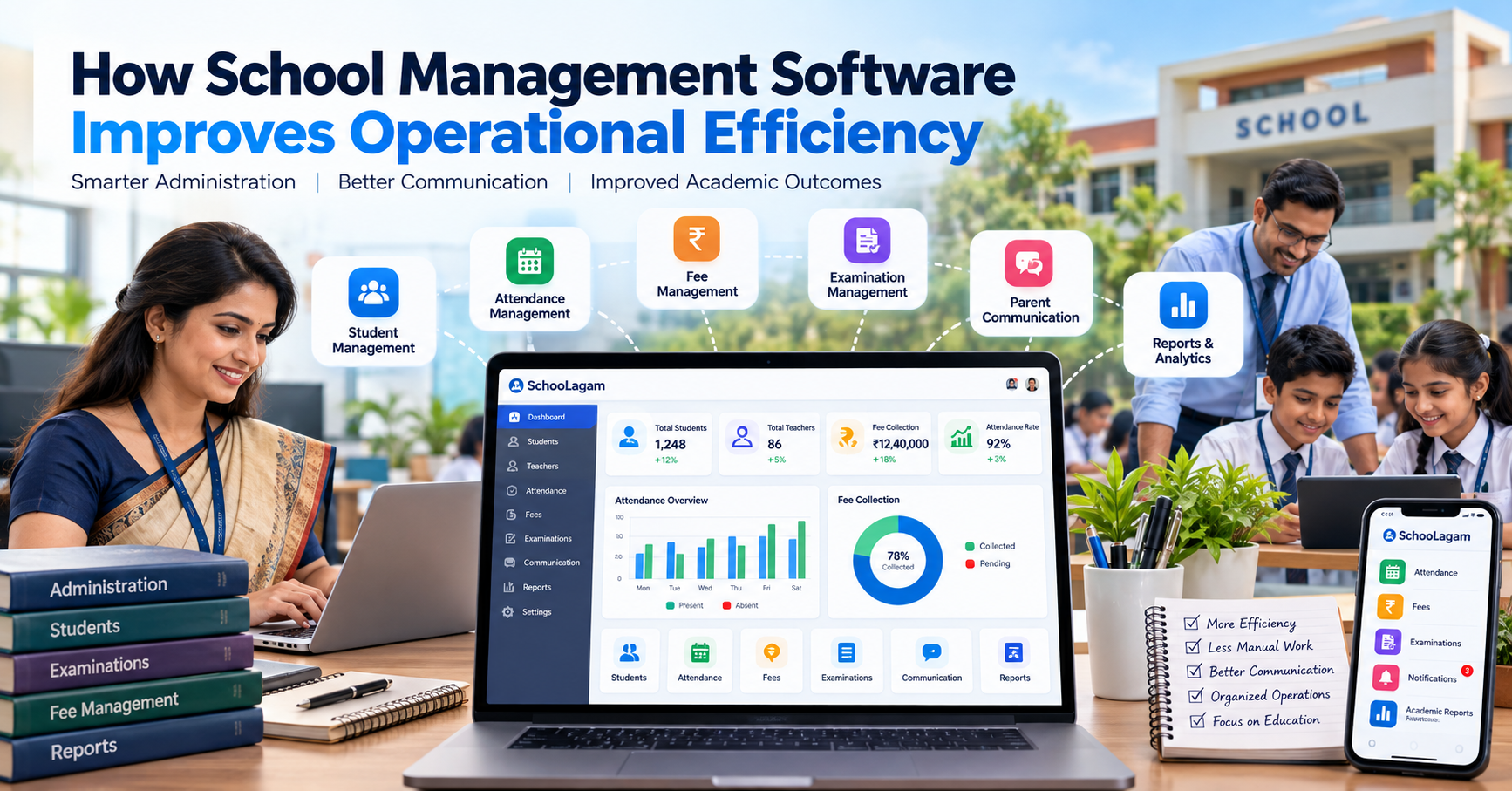
A centralized system can make reporting more structured by allowing authorized users to work with information already stored within the platform.
This can help school management spend less time collecting basic information and more time reviewing what the information means.
9. Improves Communication Between School and Parents
Communication is an important part of school administration.
Parents may need information about:
- Attendance
- Fees
- Examinations
- School events
- Notices
- Academic activities
- General announcements
When communication is fragmented across different channels, important information can become difficult to track.
A centralized school management system can provide structured communication workflows, depending on the features available.
This is one area where digital school management platforms such as SchooLagam can fit into a broader school communication strategy.
10. Supports Teachers by Reducing Administrative Burden
Teachers have responsibilities beyond classroom teaching.
They may also need to manage:
- Attendance
- Marks
- Assessments
- Student records
- Reports
- Parent communication
- Academic documentation
A well-designed digital system can reduce repetitive administrative activities and provide teachers with organized access to relevant information.
This does not mean technology replaces teachers.
Instead, the objective is to allow teachers to spend more time on teaching, student interaction, feedback, and academic support.
11. Gives School Management Better Visibility
School owners and principals need a broad view of school operations.
Centralized data can help them review information from different areas without depending entirely on individual spreadsheets or physical records.
For example, management may need to understand:
- Student enrollment
- Attendance patterns
- Fee status
- Examination performance
- Administrative activity
- Communication activity
When relevant information is organized in one system, decision-making can become more evidence-based.
12. Helps Maintain Data Consistency
Data consistency is an important challenge when multiple departments maintain separate records.
Suppose the administration office has one phone number for a parent while another department has an older number.
This creates confusion.
Centralized data management can reduce these inconsistencies by providing a common record that authorized users can update.
However, schools should establish clear rules about:
- Who can edit information
- Which information can be changed
- How changes are verified
- How duplicate records are handled
- How incorrect data is corrected
Technology works best when supported by clear administrative processes.
13. Enables Better Data Security and Access Control
Centralized data management also raises an important question:
Who should be able to access school information?
Schools handle sensitive information, so access should be controlled appropriately.
A school technology implementation should consider:
- User accounts
- Password policies
- Role-based access
- Administrative permissions
- Data backups
- Secure connections
- Data retention
- Staff access procedures
For example, a teacher may need access to student attendance and academic information but may not need access to financial administration records.
A good system should allow schools to define access according to roles and responsibilities.
14. Supports Mobile and Remote Access
Modern school administration does not always happen from one office computer.
Principals, administrators, teachers, and authorized staff may need access to information from different locations.
Cloud-based and mobile-friendly systems can support this type of working environment, depending on the platform.
This can be particularly useful for:
- School management
- Parent communication
- Attendance
- Notifications
- Reports
- Administrative monitoring
However, schools should always evaluate connectivity, device security, user permissions, and support requirements before implementation.
Centralized Data and AI in School Management
The next stage of digital transformation involves using data not only for storage but also for analysis and automation.
Artificial intelligence and automation can potentially support areas such as:
- Report generation
- Data analysis
- Administrative workflows
- Communication assistance
- Pattern identification
- Document processing
- Academic insights
For schools requiring customized technology development or integration beyond standard software, organizations such as RootPro Technologies and its software development solutions can be considered when planning broader digital transformation requirements.
AI should be implemented carefully.
Schools should understand what data is being processed, how it is protected, who can access the output, and where human review is necessary.
Centralized Data for Different School Stakeholders
| Stakeholder | Potential Benefits |
|---|---|
| School Owners | Better operational visibility and structured reports |
| Principals | Easier monitoring and decision support |
| Teachers | Reduced repetitive administration |
| Administrators | Organized records and workflows |
| Students | More organized academic and assessment information |
| Parents | Better access to relevant school communication |
| Management Teams | Improved reporting and coordination |
The exact benefits depend on the software, school processes, implementation quality, and user adoption.
Manual vs Centralized Digital Data Management
| Activity | Manual Process | Centralized Digital Process |
|---|---|---|
| Student records | Registers/files | Digital student profiles |
| Attendance | Paper register | Digital attendance records |
| Fees | Receipts/spreadsheets | Centralized fee information |
| Exams | Separate documents | Digital assessment records |
| Reports | Manual compilation | System-supported reports |
| Communication | Multiple channels | Structured communication |
| Searching | Physical/manual search | Digital search |
| Data updates | Multiple locations | Centralized update process |
The purpose of centralization is not simply to replace paper with screens. It is to create a more connected way of managing information.
How Schools Can Implement Centralized Data Management
Moving to centralized digital data management should be planned carefully.
Step 1: Identify Existing Data
Start by listing what the school currently manages.
For example:
- Student records
- Attendance
- Fees
- Examination data
- Teacher records
- Parent details
- Documents
- Communication records
Step 2: Identify Current Problems
Ask staff where they spend unnecessary time.
For example:
- Where is information duplicated?
- Which reports take the longest to prepare?
- Which records are difficult to find?
- Which information frequently contains errors?
- Where do communication gaps happen?
These answers help identify the areas where digital transformation can provide practical value.
Step 3: Choose the Right Technology
Schools should evaluate software based on actual requirements rather than selecting a system only because it has many features.
Important considerations include:
- Required modules
- Ease of use
- User permissions
- Data security
- Mobile access
- Reporting
- Integration capabilities
- Support
- Scalability
- Data migration
- Training requirements
Step 4: Start With Important Workflows
Schools do not necessarily need to digitize everything at the same time.
A phased approach may begin with:
- Student management
- Attendance
- Fee management
- Examination management
- Communication
- Reports and analytics
Once staff become comfortable with the system, additional workflows can be introduced.
Step 5: Train Staff
Technology adoption depends heavily on users.
Teachers and administrators should understand:
- How to log in
- How to enter information
- How to update records
- How to generate reports
- How to handle mistakes
- How to protect account credentials
- Who to contact for technical support
Training should be practical rather than limited to a single demonstration.
Step 6: Review Data Quality
Before importing old information into a new system, schools should check for:
- Duplicate records
- Missing information
- Incorrect contact details
- Outdated records
- Formatting differences
Clean data produces more useful results.
What Makes Centralized School Data Management Successful?
Technology alone does not guarantee successful digital transformation.
Schools should combine software with good processes.
Important factors include:
- Clear responsibilities
- Reliable data entry
- Staff training
- Appropriate access controls
- Regular backups
- Defined workflows
- User support
- Periodic system reviews
- Data privacy practices
The objective should always be to make school operations more organized without creating unnecessary complexity.
The Future of Centralized School Data
School data management is likely to become increasingly connected.
Future school systems may combine:
- Cloud computing
- Artificial intelligence
- Data analytics
- Mobile applications
- Digital assessments
- Automated communication
- Workflow automation
- Integrated reporting
For example, a school may eventually have a connected environment where attendance, assessments, student records, communication, and administrative information work together rather than existing as separate systems.
Digital assessment platforms such as ExamOzhi can form part of this wider ecosystem by supporting online examinations and digital assessments.
At the same time, schools should avoid adopting technology simply because it is new. Every technology decision should be connected to a genuine educational or administrative requirement.
Practical Checklist for Schools
Before implementing a centralized data management system, school management can review this checklist:
Data
- What information needs to be centralized?
- Are existing records accurate?
- Are duplicate records present?
- What information is sensitive?
Users
- Who will use the system?
- What access does each role require?
- What training will users need?
Technology
- Does the system support required workflows?
- Is it accessible on the devices used by staff?
- Does it provide suitable reports?
- Can it scale with the school?
Security
- Are user permissions clearly defined?
- Are backups available?
- Are account security practices established?
- Is access reviewed periodically?
Implementation
- Will the school use a phased rollout?
- Who will manage implementation?
- How will staff support be provided?
- How will the school measure adoption?
Conclusion
Centralized school data management is about more than storing information in a digital database.
It is about creating a structured environment where important school information can be organized, accessed, updated, and used responsibly.
When student records, attendance, fees, assessments, communication, and reports are managed through connected digital workflows, schools can reduce unnecessary administrative effort and improve visibility across different areas of operation.
The transition should be practical and carefully planned.
Schools should first understand their existing problems, identify the workflows that need improvement, select appropriate technology, train staff, and establish clear data management and security practices.
For schools exploring digital school management, platforms such as SchooLagam can be evaluated as part of the broader move toward organized digital administration.
For organizations looking for customized software, automation, AI, or wider digital transformation, RootPro Technologies provides technology and software development solutions that can be considered according to specific requirements.
For digital examinations and assessments, ExamOzhi provides an online examination and assessment platform that can form part of a school's digital ecosystem.
The goal is simple: make school information easier to manage, easier to understand, and more useful for the people responsible for education and administration.