Why textbook still matter in the age of AI?
Discover why textbooks still matter in the age of AI and how students can combine reliable textbook knowledge with AI tools for smarter learning and exams.
Why Textbooks Still Matter in the Age of AI?
A student preparing for an exam now has two very different options. They can open their textbook and carefully work through a chapter, or they can ask an AI assistant to explain the entire topic in seconds.
The second option sounds easier. But does a faster answer always lead to better learning?
Artificial intelligence has changed how students search for information, clarify doubts, generate practice questions, and revise lessons. Yet textbooks continue to play a fundamental role in education, particularly where students must understand specific concepts, follow a prescribed curriculum, and prepare for examinations.
The importance of textbooks in the age of AI lies in their ability to provide structured, curriculum-aligned knowledge that students can study, question, verify, and build upon.
AI can make that knowledge more accessible and interactive, but it does not automatically replace the educational purpose of a well-designed textbook.
The most effective approach is not to choose between textbooks and AI. It is to understand how they complement one another.
1. Why Are Textbooks Still Important in the Age of AI?
Textbooks are more than collections of definitions and answers. A well-designed textbook introduces concepts in a logical order, builds connections between lessons, and provides a foundation for structured learning.
For example, a mathematics textbook may introduce basic algebraic expressions before moving to equations and more advanced problems.
This progression matters because understanding advanced topics often depends on mastering earlier concepts.
Textbooks provide structured knowledge
Unlike a conversational AI assistant that responds to individual questions, a textbook generally follows a predefined learning sequence.
This helps students:
Build foundational knowledge before tackling advanced topics.
Understand relationships between chapters and concepts.
Follow a curriculum relevant to their class or examination.
Revise systematically instead of studying random topics.
Refer back to information when reviewing difficult lessons.
Key takeaway: Textbooks provide learning structure, while AI can provide additional explanations and interaction.
2. AI Can Give Answers, but Textbooks Provide Context
One of the biggest advantages of AI is its ability to respond to questions quickly.
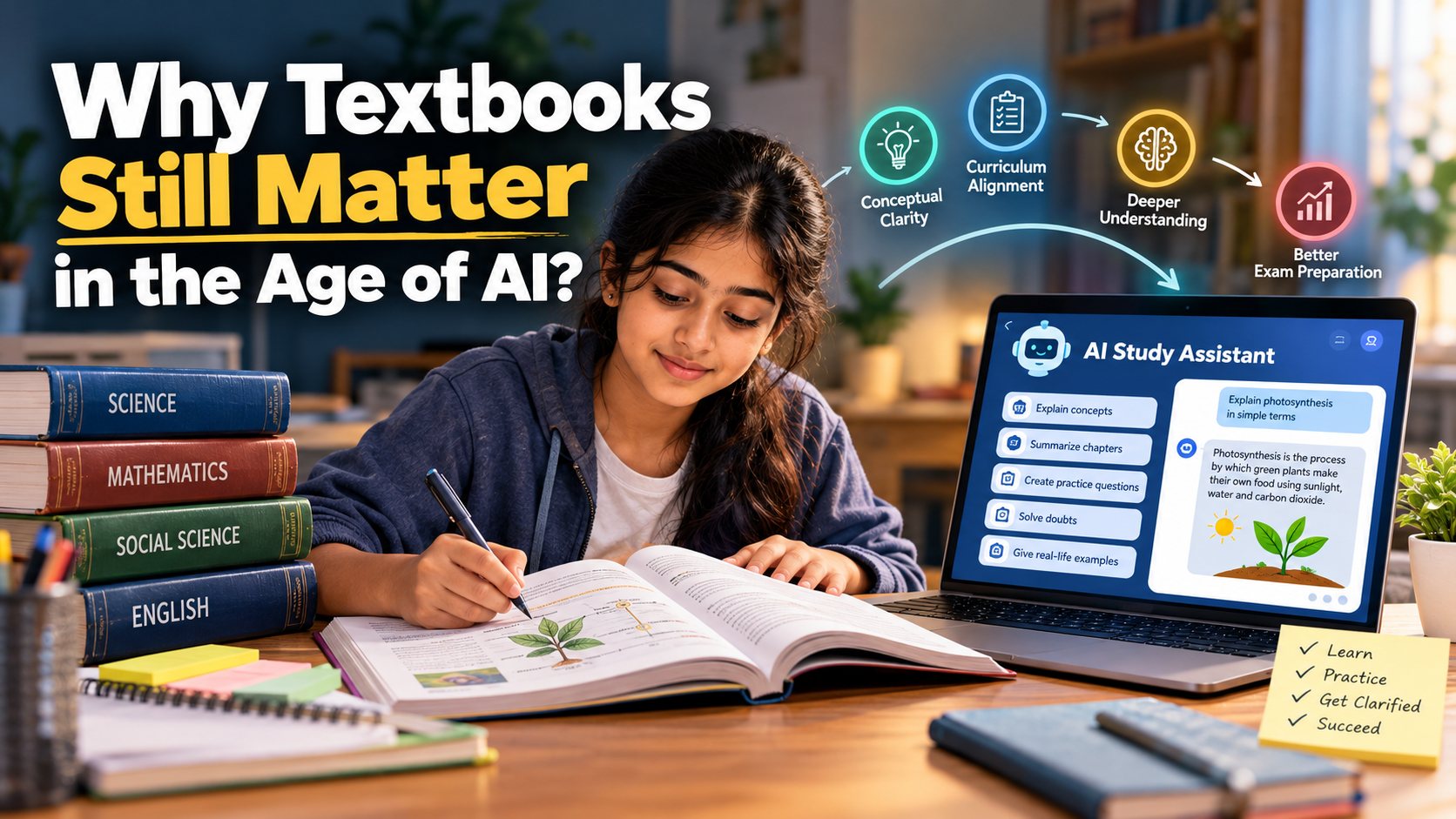
A student studying photosynthesis could ask:
Explain photosynthesis in simple words.
An AI assistant may provide an immediate explanation, examples, and even a practice question.
However, the answer might not always match the exact terminology or depth required by the student's syllabus.
Why context matters
Consider a student preparing for a Class 10 science examination.
A general AI tool might explain a biological process using terminology from college-level biology. Although the explanation could be scientifically accurate, it may introduce details that are unnecessary or confusing for the student's current learning objectives.
A prescribed textbook provides a clearer reference for what the student is expected to understand at that particular level.
This does not mean every textbook is perfect or that information outside textbooks is unimportant. It means curriculum-specific learning benefits from having an established reference.
For examinations, the right answer must not only be accurate; it must also address the actual question and assessment requirements.
3. Textbooks Help Students Develop Deeper Understanding
Learning requires more than receiving information.
Students need opportunities to read, interpret, compare, question, recall, and apply concepts.
Textbooks can support these activities through explanations, worked examples, diagrams, exercises, and chapter reviews.
Reading requires active interpretation
When students read a complex passage, they must identify important information and connect it to what they already know.
This can encourage them to slow down and reflect on the material.
The Education Endowment Foundation's research on reading comprehension strategies supports the value of explicitly teaching learners to monitor understanding, make inferences, and engage with texts.
These learning strategies are relevant whether the material appears in a physical textbook or a digital one.
The danger of skipping directly to answers
Imagine two students studying the same mathematics problem.
Student A: Reads the example, attempts the problem, makes a mistake, reviews the explanation, and solves it again.
Student B: Asks AI for the complete solution and memorizes the steps without attempting the problem.
Both may end up seeing the correct answer.
However, Student A has completed more of the independent problem-solving process.
AI should help students work through difficulties, not consistently remove those difficulties before learning can take place.
4. Textbooks and AI: Understanding the Difference
Textbooks and AI systems offer different strengths.
The goal is not to declare one universally better than the other, but to understand when each is most useful.
| Learning Need | Textbooks | AI Study Tools |
|---|---|---|
| Curriculum alignment | Prescribed learning sequence | Depends on source and tool |
| Concept explanations | Structured, edited content | Interactive explanations |
| Learning progression | Organized chapters | Flexible, question-driven |
| Practice questions | Exercises and examples | Additional generated questions |
| Source verification | Identifiable pages and editions | Requires reliable source grounding |
| Doubt clarification | Fixed explanations | Follow-up questions |
| Offline access | Printed books work offline | Many services require internet |
| Personalization | Mostly fixed content | Can adapt explanations and difficulty |
Which is better for students?
Use textbooks for structure, syllabus coverage, and reference material. Use AI for clarification, additional practice, and interactive revision.
Combining both can provide a more balanced learning experience.
5. Why Textbook Accuracy Matters During Exam Preparation
Students preparing for board examinations need to follow the expected syllabus and assessment format.
For example, a Class 10 student may need to understand a concept at a different level from a university student studying the same subject.
This creates a challenge for general-purpose AI tools.
AI answers can be incomplete or inaccurate
Generative AI systems can sometimes produce:
- Incorrect definitions
- Unsupported facts
- Unnecessary advanced explanations
- Wrong calculations
- References that do not exist
- Answers that do not match the prescribed syllabus
UNESCO's Guidance for Generative AI in Education and Research emphasizes the importance of safe, ethical, human-centred use of generative AI in education.
How students can verify an AI answer
Before relying on an AI-generated explanation, students should ask:
- Does this match my prescribed textbook?
- Is the explanation appropriate for my class?
- Can I find supporting information in the relevant chapter?
- Are important definitions and formulas correct?
- Can I explain the answer in my own words?
The best study tool is not necessarily the one that gives the longest answer. It is the one that helps students arrive at reliable understanding.
6. How Textbook-Grounded AI Brings Both Approaches Together
The value of textbooks becomes even more evident when AI systems are designed to work directly with curriculum content.
This approach is often called textbook-grounded AI.
Instead of relying solely on a language model's general knowledge, a textbook-grounded system retrieves relevant material from an identified educational source before generating a response.
How textbook-grounded AI works
Step 1 — Student asks a question
For example: "What is Newton's second law?"
Step 2 — Relevant textbook content is retrieved
The system searches educational material associated with the relevant curriculum.
Step 3 — AI explains the concept
The response is generated using the retrieved material.
Step 4 — Source information is provided
Where supported, students can check the relevant textbook page or reference.
Step 5 — Student verifies and practises
The student reviews the explanation and attempts related questions.
This process is associated with Retrieval-Augmented Generation (RAG), a technique that combines information retrieval with generative AI.
Source grounding can improve relevance and traceability, although it does not guarantee that every generated answer will be correct.
An example: Examozhi
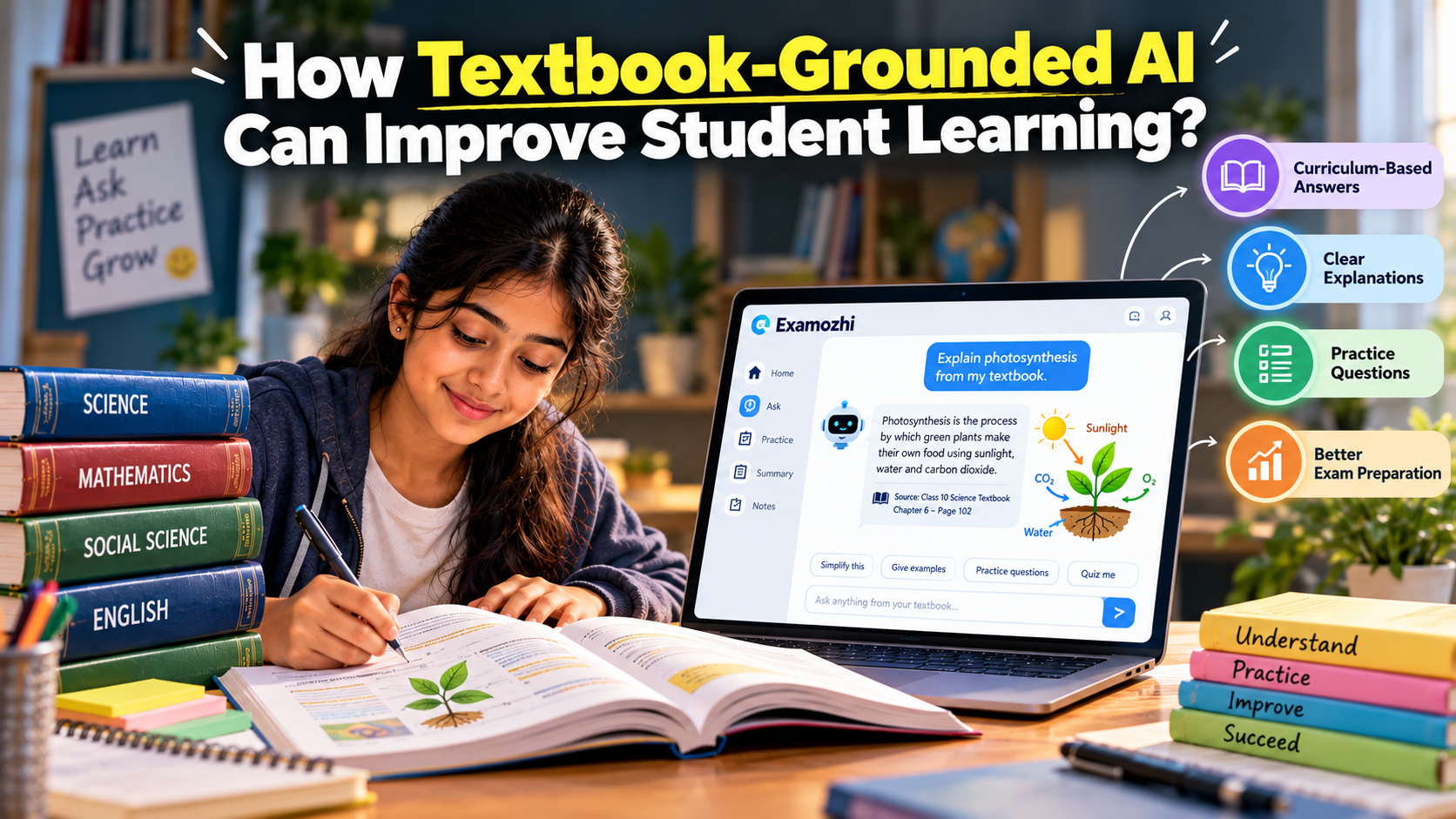
Examozhi takes a textbook-grounded approach to AI-powered education.
The platform is designed to help students ask questions using their actual curriculum material and receive source-backed explanations.
Students can also explore textbook-based answers associated with Indian educational content.
This connects modern AI assistance with a familiar educational foundation: the textbook students are already expected to learn from.
7. Can AI Replace Textbooks Completely?
AI may reduce the amount of time students spend searching for explanations, but replacing textbooks entirely raises several educational questions.
A. Who decides what students should learn?
A curriculum is designed around specific objectives, topics, and expected learning outcomes.
AI can help explain those topics, but students still need a structured way to determine which concepts matter for their course.
B. How can students verify information?
Without a reliable reference, students may struggle to distinguish a correct explanation from a convincing but inaccurate one.
C. Will students develop independent learning skills?
When every challenge receives an immediate generated answer, students may have fewer opportunities to work through problems independently.
D. What happens without internet access?
Printed textbooks remain useful in settings where devices, electricity, or reliable internet access are limited.
E. Can every student access AI equally?
Not necessarily. Access can vary depending on connectivity, devices, language support, and cost.
UNESCO's Global Education Monitoring Report on Technology in Education stresses that digital technology should serve learners' needs rather than replace the human relationships and educational principles on which effective learning depends.
The future is better understood as the evolution of textbooks and educational technology together—not the automatic disappearance of books.
8. Why Textbooks Matter for Indian Students
India has a diverse education system with multiple boards, languages, textbooks, and assessment approaches.
Students may follow curricula such as:
- CBSE
- ICSE
- NCERT-based courses
- Tamil Nadu State Board (Samacheer Kalvi)
- Other state-board curricula
Although many subjects share common concepts, their organization, presentation, and examination expectations can differ.
For example, a student studying science through the Tamil Nadu State Board may benefit from explanations connected to the relevant Samacheer Kalvi textbook, rather than relying on a generic internet summary.
Curriculum-based learning requires relevance
Students must understand not only the general topic but also:
- The concepts prescribed for their class
- Important definitions and terminology
- Examples covered in their lessons
- Chapter exercises
- Relevant diagrams
- The level of explanation expected in examinations
This is why curriculum-based learning remains important even when AI can explain almost any topic.
An AI tool becomes more educationally useful when it helps students interact with the material they actually need to study.
9. A Practical Study Method: Textbook First, AI Second
Students do not need to choose between traditional reading and AI-powered learning.
A balanced routine can combine the strengths of both.
The Textbook + AI Study Method
Step 1 — Read the textbook
Start with the relevant chapter and identify its main concepts, definitions, examples, and exercises.
Step 2 — Highlight difficult topics
Mark sections that are confusing or need additional explanations.
Step 3 — Ask AI for clarification
Use questions such as:
"Explain this topic in simpler words, using the terminology from my textbook."
Step 4 — Return to the textbook
Check whether the explanation matches the prescribed material.
Step 5 — Practise independently
Attempt exercises without immediately asking AI for answers.
Step 6 — Review mistakes
Use AI to explore where your reasoning went wrong, then confirm corrections using reliable learning material.
Step 7 — Revise and recall
Close the book and AI tool, and try explaining the concept from memory.
The most important principle
Read → Understand → Ask → Verify → Practise → Recall
This keeps the student actively involved in learning while using AI to make difficult parts more manageable.
10. How Teachers and Parents Can Encourage Balanced Learning
Teachers and parents also have an important role in helping students use AI effectively.
Rather than treating all AI use as harmful or allowing unrestricted dependence, they can encourage thoughtful use.
For teachers
Teachers can:
- Recommend reliable textbooks and learning resources.
- Explain which AI-assisted activities are permitted.
- Encourage students to attempt questions independently.
- Use AI-generated questions as supplementary practice after checking their accuracy.
- Teach students how to verify sources.
- Encourage classroom discussion and reasoning.
For parents
Parents can:
- Encourage regular textbook reading.
- Ask children to explain what they learned.
- Help maintain balanced study routines.
- Discuss the limitations of AI-generated answers.
- Encourage students to use technology for understanding rather than copying.
Students benefit when teachers, parents, textbooks, and technology work toward the same learning goals.
11. What the Future of Textbooks Could Look Like
The textbook of the future may not be limited to printed pages.
It could increasingly become part of a connected educational experience.
For example, a digital textbook might offer:
Interactive explanations: Students select a difficult paragraph and request clarification.
Practice-question generation: Students create additional questions from a chapter.
Multilingual assistance: Concepts can be explained in a language the student understands.
Source-backed answers: Students see where information appears in the textbook.
Collaborative learning: Students discuss the same lesson with friends.
Personalized revision: Students practise topics where they need additional help.
These features are possible applications of educational AI, rather than guaranteed capabilities of every digital textbook.
Examozhi's live study rooms, for example, connect group revision with textbook-grounded questions and source references.
The broader opportunity is to make textbook knowledge more interactive, accessible, and useful without weakening its educational foundation.
12. The Real Future: AI and Textbooks Working Together
The discussion around AI and textbooks is often framed as a competition between old and new.
But this overlooks a more useful possibility.
Textbooks answer the question: What should I learn?
AI can help answer: How can I understand and practise this?
Teachers provide human guidance, students develop understanding through active effort, and technology offers additional ways to engage with educational material.
This creates a balanced model:
Curriculum + Textbooks + Teachers + AI + Independent Practice
Each component contributes something different.
Technology should make knowledge easier to access, explore, and understand—not make students less capable of learning independently.
Conclusion: Textbooks Still Matter More Than Ever
The importance of textbooks in the age of AI is not about rejecting technology. It is about preserving reliable, structured, curriculum-aligned learning while taking advantage of new educational tools.
AI can explain difficult concepts, generate practice questions, support revision, and make textbook content more interactive.
But students still need trusted references, independent reasoning, consistent practice, and a clear understanding of what their curriculum requires.
The smartest approach is not textbooks versus AI.
It is textbooks with AI.
Let textbooks provide the foundation. Let AI support understanding. Let independent practice turn information into knowledge.