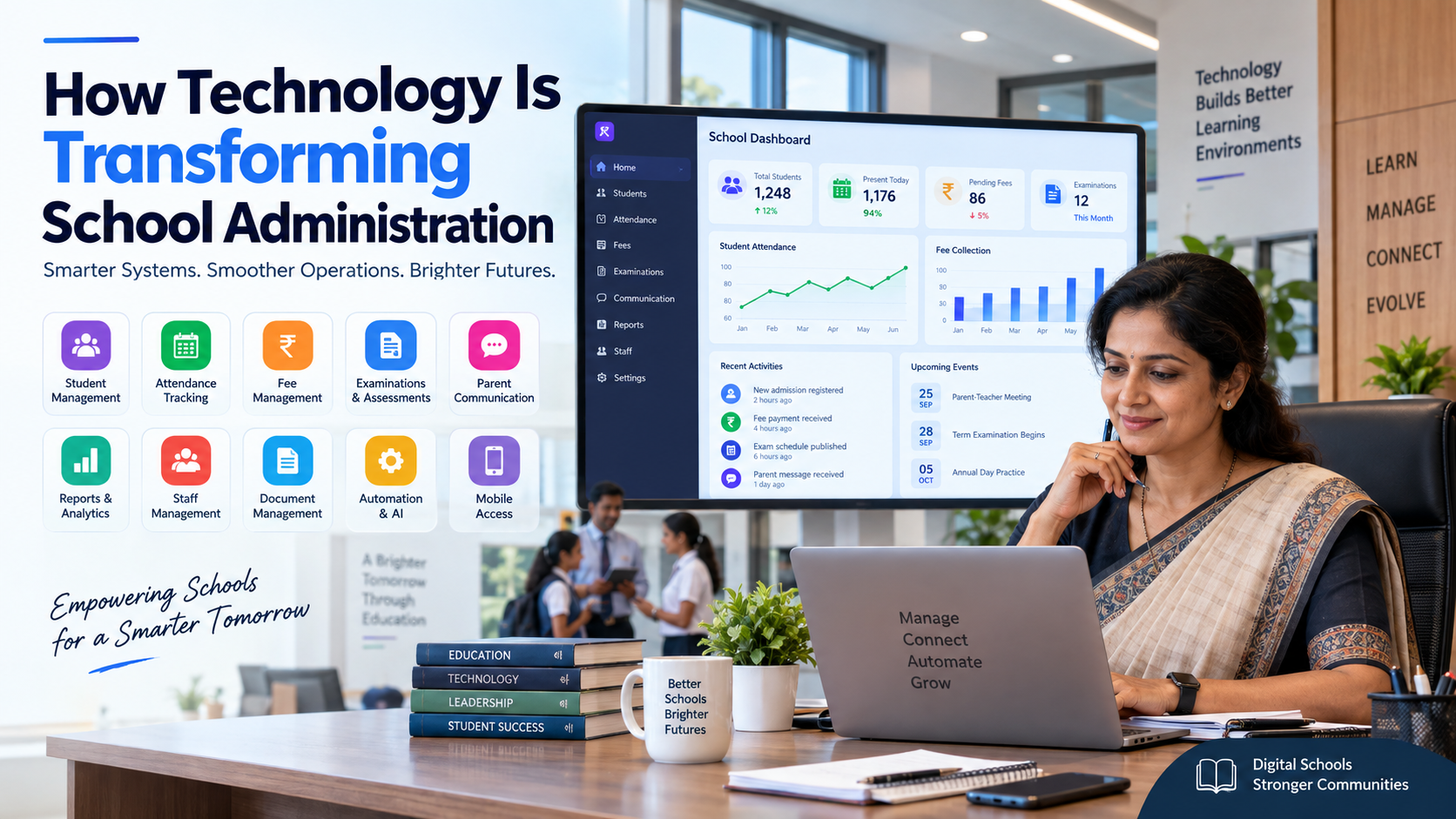
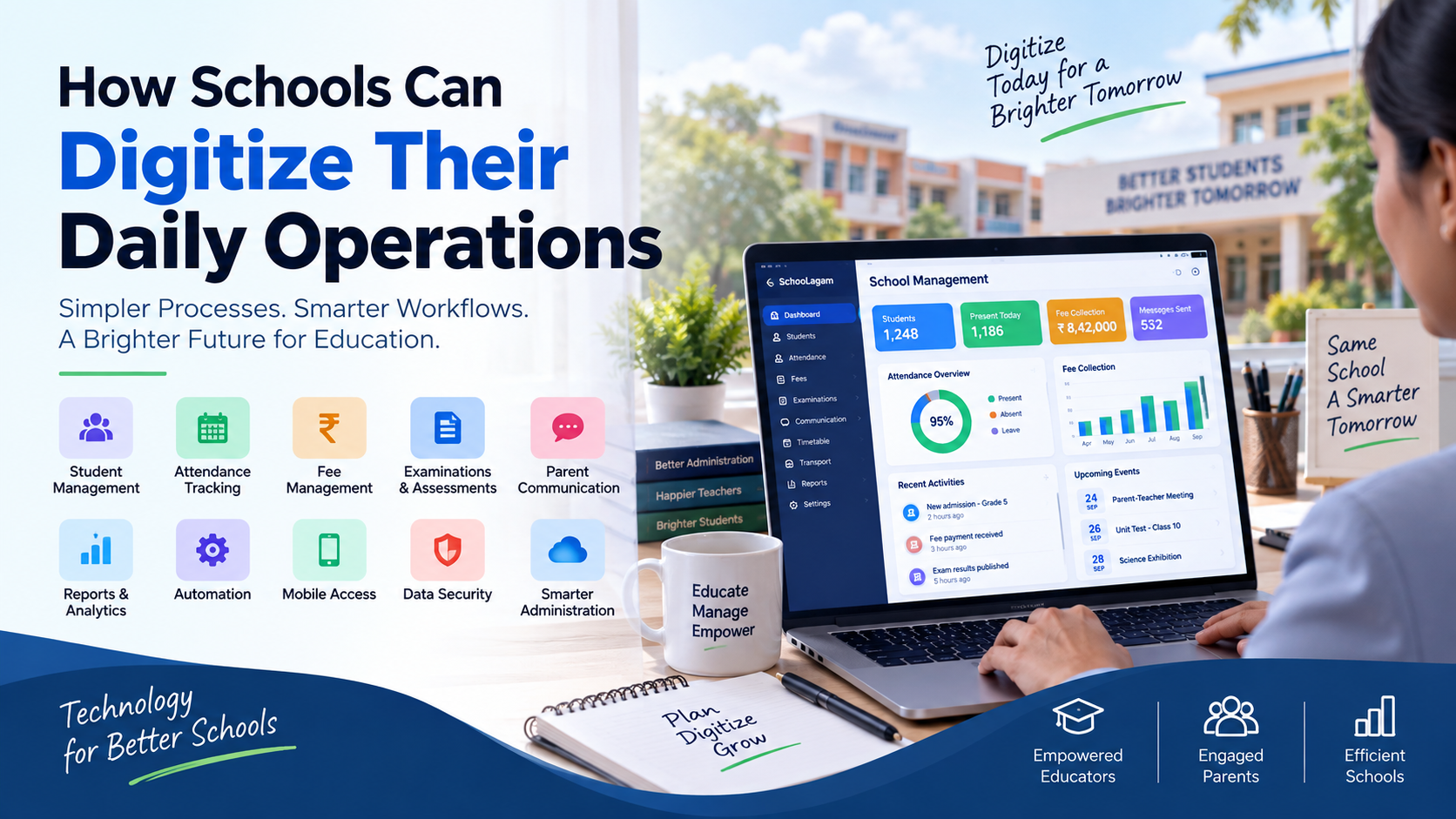
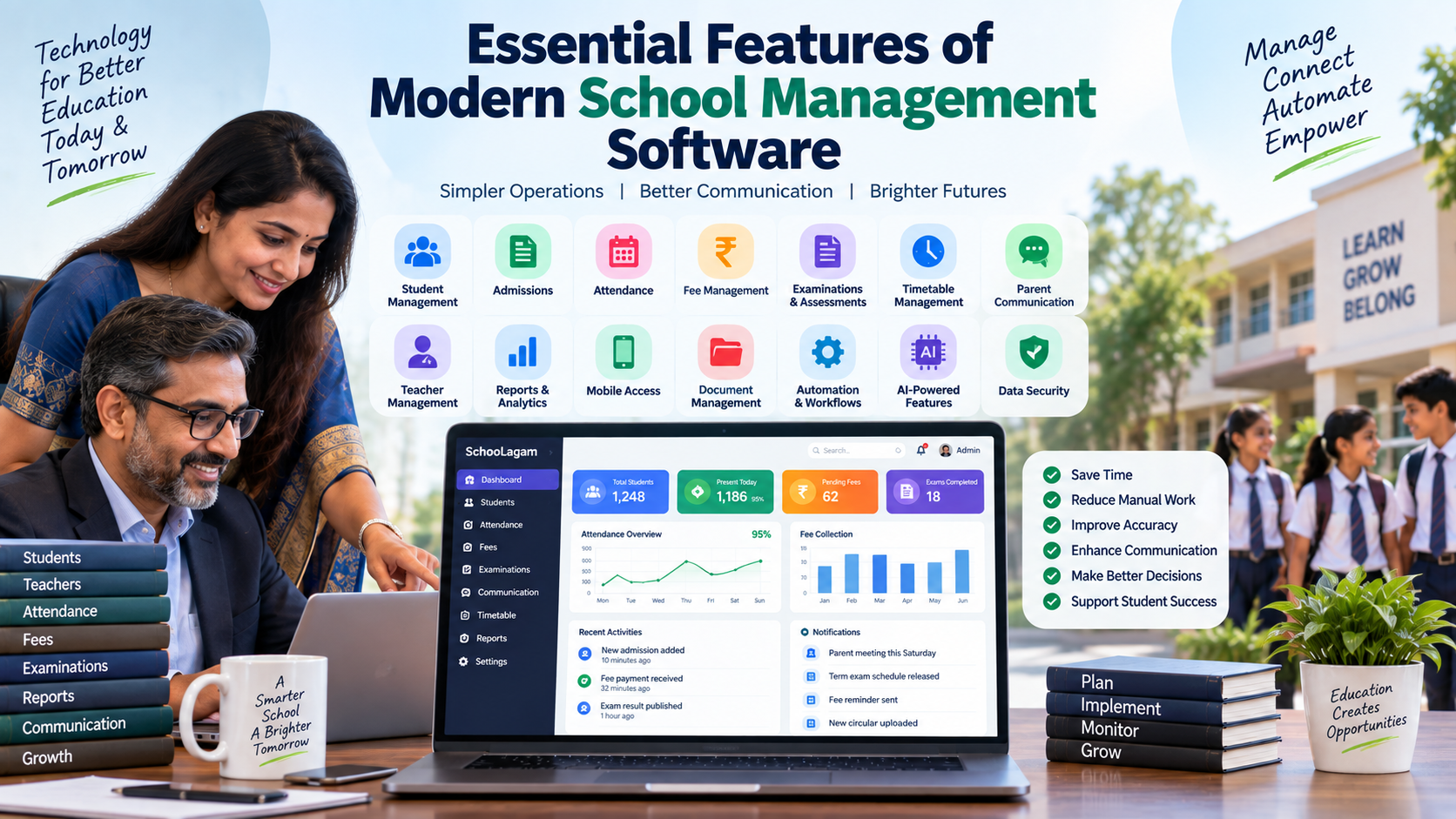
Why Schools Need School Management Software in 2026
Discover why schools need school management software in 2026 to simplify administration, automate workflows, improve communication, and support smarter decisions.
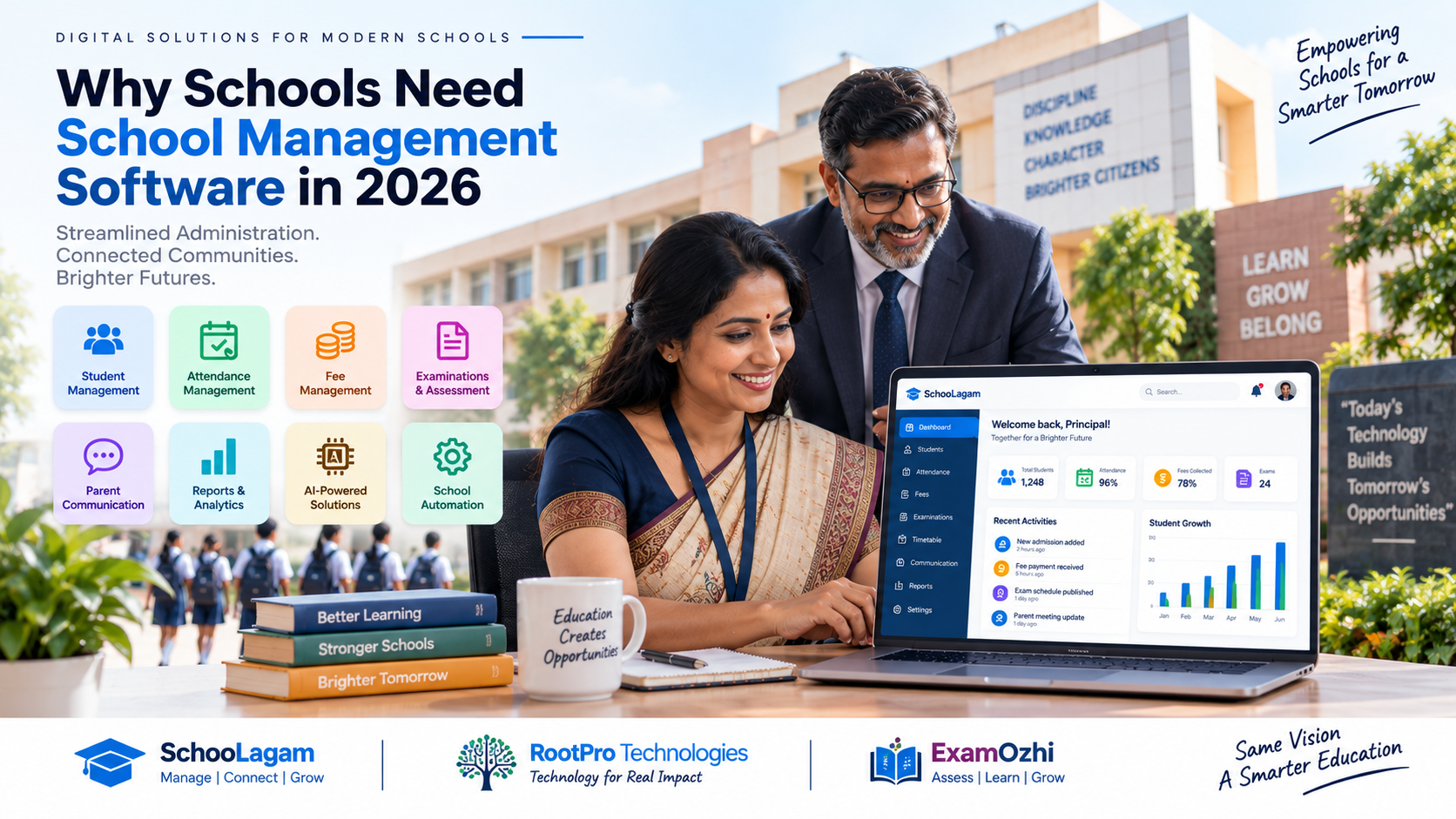
A modern school is no longer managing only classrooms, teachers and examinations. Every day, schools handle student records, attendance, fees, admissions, timetables, examinations, parent communication, academic data, staff information, documents and a growing volume of digital information.
The challenge is not simply having more data. The real challenge is managing that information efficiently while keeping teachers, administrators, parents and students connected.
In 2026, this is where school management software becomes increasingly relevant.
A school management system can bring multiple operational activities into a centralized digital environment. Instead of relying on registers, disconnected spreadsheets and multiple communication channels, schools can organize important workflows through integrated software.
The goal is not to replace teachers or administrators with technology. It is to give them better tools so that repetitive administrative work can be reduced and important information can become easier to access.
For Indian schools navigating increasing operational complexity, digital transformation can therefore be approached as a practical improvement in the way everyday work is organized.
Why School Management Matters More in 2026
The expectations surrounding schools have changed.
Parents want timely information. Teachers need efficient tools. Administrators need accurate records. School leadership needs visibility into operations. Students increasingly interact with digital learning and assessment systems.
At the same time, schools have to manage information across multiple departments.
A typical school may need to coordinate:
- Student admissions
- Student records
- Attendance
- Fees
- Examinations
- Timetables
- Parent communication
- Academic performance
- Staff information
- Reports
- Documents
- Transport
- Events and announcements
When every activity operates independently, administrative work can become fragmented.
A centralized school management system can connect appropriate workflows and provide authorized users with a more consistent view of school operations.
This is one reason schools are exploring platforms such as SchooLagam for integrated school management, attendance, fees, communication and other digital workflows.
The Problems With Traditional School Administration
Many schools still depend on a combination of:
- Paper registers
- Excel spreadsheets
- Printed forms
- Separate software applications
- Manual calculations
- Phone calls
- Messaging applications
- Physical notices
- Manually prepared reports
None of these tools is inherently wrong.
The problem occurs when a school becomes dependent on too many disconnected processes.
Consider a Simple Attendance Workflow
A teacher records attendance.
Then an administrator may need to collect or enter the information.
A report may need to be prepared.
Parents may need to be informed about absences.
The same information may therefore be handled several times.
With an appropriately configured digital workflow, the process can be more connected:
Teacher records attendance → System updates the student record → Relevant report is generated → Appropriate parent notification can be triggered
The exact workflow depends on the school's software and policies, but the principle is simple:
Enter information once and use it appropriately across connected workflows.
Manual vs Digital School Management
| Area | Traditional Approach | Digital Approach |
|---|---|---|
| Student records | Registers/files | Centralized database |
| Attendance | Paper or spreadsheets | Digital attendance |
| Fees | Manual registers | Digital attendance |
| Receipts | Physical records | Digital receipts |
| Communication | Notices/calls/messages | Centralized notifications |
| Reports | Manual preparation | System-generated reports |
| Examination records | Separate files | Digital examination records |
| Data access | Search through documents | Digital examination records |
| Analytics | Manual calculations | Dashboards and reports |
| Workflow automation | Limited | Configurable automation |
Digital transformation does not mean that every process should become automatic.
It means schools can identify repetitive, structured activities where software can reduce unnecessary work.
1. School Management Software Brings Operations Together
One of the strongest reasons schools need digital management systems in 2026 is integration.
Instead of managing every department separately, an ERP-style platform can connect different parts of school administration.
For example:
Student → Class → Attendance → Fees → Exams → Academic Records → Parent Communication
When these records are connected, administrators do not have to repeatedly recreate the same information.
This can also improve consistency.
If a student's class, parent details or other information changes, the school can update the appropriate central record instead of manually changing multiple disconnected files.
Schools can explore SchooLagam as one option for bringing different school management workflows into a centralized digital environment.
2. Attendance Management Becomes Easier
Attendance is one of the most repetitive administrative tasks in schools.
A digital attendance system can help teachers and administrators manage:
- Daily attendance
- Class-wise attendance
- Student attendance history
- Late arrivals
- Absence records
- Attendance reports
- Parent updates
Modern systems can also introduce additional technology where appropriate.
However, schools considering biometric or AI-based attendance should evaluate privacy, consent, accuracy, security and operational requirements before implementation.
The important point is that attendance data can become more useful when it is connected to the wider student record.
3. Digital Fee Management Reduces Repetitive Work
Fee management is another area where manual administration can consume considerable time.
Schools may need to manage:
- Fee structures
- Payment schedules
- Student dues
- Receipts
- Outstanding balances
- Payment records
- Reminders
- Collection reports
A digital fee management system can organize these activities in one place.
The benefit is not simply collecting fees digitally.
The larger benefit is creating a structured financial workflow where authorized administrators can see relevant information without searching through multiple registers.
4. Teachers Need Less Administrative Friction
Teachers are educators first, but they often have administrative responsibilities as well.
Their routine work can include:
- Taking attendance
- Entering marks
- Maintaining student records
- Preparing reports
- Communicating with parents
- Managing timetables
- Coordinating examinations
- Tracking assignments
A good school management system should make these activities easier rather than adding another layer of complexity.
The Goal Should Be
Less repetitive administration → More time for teaching and student support.
This does not mean technology eliminates teachers' responsibilities.
Instead, software can handle structured tasks while teachers continue making professional decisions that require human judgment.
5. Better Parent Communication
Communication is a major part of the relationship between a school and families.
Parents may need information about:
- Attendance
- Fees
- Examinations
- Events
- Announcements
- Academic activities
- Timetables
- School notices
When communication is spread across multiple channels, important information can become difficult to track.
A centralized school communication system can provide a more organized way to distribute appropriate information.
6. Examinations Are Becoming More Digital
Examinations remain one of the most important academic processes in schools, but technology is changing how assessments can be created, delivered and analyzed.
Digital assessment workflows can support:
- Online tests
- Question banks
- Question generation
- Student assessments
- Marks management
- Result processing
- Performance analysis
- Digital reports
This is where a specialized assessment platform can complement a school ERP.
ExamOzhi provides curriculum-focused education technology that can support question generation and other learning and assessment use cases.
For schools and education technology teams, such tools can be considered alongside broader school management systems when developing digital assessment workflows.
7. AI Is Adding a New Layer to School Management
One of the significant technology developments relevant to schools in 2026 is the increasing use of artificial intelligence.
AI can assist with structured tasks such as:
- Information search
- Document processing
- Report generation
- Communication drafting
- Question generation
- Data analysis
- Workflow recommendations
- Timetable assistance
The important distinction is that AI should support school staff rather than remove human responsibility from important decisions.
For example, an AI system may identify students whose attendance requires attention. A teacher or administrator should still review the context before deciding what action to take.
RootPro Technologies provides technology services covering AI solutions, custom software, automation and digital transformation.
This type of technology expertise can be relevant to schools that want to move beyond basic record management toward more intelligent workflows.
8. School Leadership Needs Better Visibility
A principal or school owner should not have to wait for multiple departments to prepare spreadsheets before understanding what is happening in the school.
Digital dashboards can potentially bring together information such as:
- Attendance
- Fee collection
- Student numbers
- Teacher workload
- Examination results
- Admissions
- Operational activity
This creates an opportunity for more data-informed management.
The software does not make the decision.
It simply makes relevant information easier to access.
9. Student Management Becomes More Organized
Student information is at the center of school operations.
A student record may contain:
- Personal information
- Parent details
- Class and section
- Attendance
- Academic history
- Examination results
- Fee information
- Documents
Maintaining this information across multiple files increases the possibility of duplication and outdated records.
A centralized student management system can provide authorized users with a common record.
This is especially useful as schools grow or operate multiple departments.
10. Mobile Access Matters
School operations do not happen only in an office.
Teachers may need information inside classrooms.
Parents may check notifications from home.
Administrators may need to review information while away from their desks.
Mobile-friendly school management systems can therefore support:
- Attendance
- Notifications
- Fee information
- Academic updates
- Timetables
- Communication
- Student information
When evaluating software, schools should consider not only whether an application exists, but whether it is genuinely useful for each user group.
11. Data and Analytics Can Support Better Decisions
Schools generate data every day.
The challenge is turning that data into useful information.
For example:
Raw data → Attendance records
Useful information → Attendance pattern
Action → School reviews the student's situation and determines whether support is required.
This creates a simple progression:
Data → Information → Insight → Human decision
School management software can help with the first three stages.
The fourth still requires people.
12. School Data Security Should Be a Priority
Digital transformation also creates responsibility.
Schools handle sensitive information about students, parents, teachers and finances.
Before choosing a platform, administrators should ask:
1. Who can access student information?
2. Are permissions role-based?
3. How are accounts protected?
4. Are backups available?
5. Is important activity logged?
6. Where is the data hosted?
7. How can data be exported?
8. What happens when an employee leaves?
9. How is access revoked?
10. What security documentation is available?
Security should not be treated as an optional feature that is considered after implementation.
It should be part of the software selection process.
13. School Management Software Can Improve Administrative Efficiency
A well-designed system can reduce repetitive work across several departments.
Examples:
Admission: Manual application tracking → Structured admission workflow
Attendance: Paper register → Digital attendance
Fees: Manual ledger → Digital fee management
Communication: Repeated individual messages → Centralized notifications
Examinations: Separate spreadsheets → Digital examination records
Reports: Manual compilation → System-generated reports
This does not mean every school will achieve the same outcome.
Implementation quality matters.
14. Before and After Digital Transformation
Before
- Multiple registers
- Repeated data entry
- Manual reminders
- Difficult report preparation
- Fragmented communication
- Limited visibility
- Paper-heavy processes
- Manual administrative workflows
After
- Centralized records
- Connected workflows
- Automated notifications
- Digital reports
- Centralized communication
- Dashboards and analytics
- Digital documentation
- More structured processes
The purpose of digital transformation is not to make a school dependent on technology for every decision.
It is to make routine information management more structured.
15. Different Stakeholders Benefit in Different Ways
For School Owners
It can provide greater visibility into:
- Operations
- Fees
- Admissions
- Attendance
- Academic information
- Reports
For Principals
It can support:
- School-wide dashboards
- Teacher workload visibility
- Attendance monitoring
- Academic reporting
- Administrative coordination
For Teachers
It can help with:
- Attendance
- Marks
- Student information
- Timetables
- Communication
- Reports
For Students
It can provide:
- Academic information
- Timetables
- Examination information
- Digital assessments
- Notifications
For Parents
It can provide:
- Attendance updates
- Fee information
- Announcements
- Examination information
- Academic updates
16. School ERP vs Separate Software Tools
Schools sometimes use different applications for different functions.
For example:
- One tool for attendance
- Another for fees
- Another for examinations
- Another for communication
- Excel for reporting
This can work, but integration becomes important as the number of tools increases.
Approach | Advantage | Potential Challenge |
|---|---|---|
| Paper-based | Familiar | Difficult to scale |
| Spreadsheets | Flexible | Limited workflow automation |
| Separate applications | Specialized features | Data fragmentation |
| Integrated ERP | Connected workflows | Requires implementation planning |
| Custom software | Tailored processes | Requires development and maintenance |
The right choice depends on the school's size, budget, technical requirements and existing systems.
17. When Should a School Consider Custom Software?
Not every school needs a completely custom application.
A standard school ERP may be sufficient when the school's processes match the available modules.
Custom software becomes more relevant when a school has requirements such as:
- Unique workflows
- Multiple specialized departments
- Custom reporting
- Existing systems that need integration
- Specific mobile requirements
- Special approval processes
- Custom AI workflows
RootPro Technologies provides custom software development and technology solutions for organizations looking to build solutions around their specific workflows.
18. How Schools Can Start Digital Transformation in 2026
Schools do not need to digitize every department simultaneously.
A phased approach can be easier to manage.
Phase 1: Identify Problems
Ask:
- Which tasks consume the most administrative time?
- Where are errors occurring?
- Which records are difficult to access?
- Where are parents asking for better communication?
Phase 2: Prioritize
Start with high-value processes such as:
- Student management
- Attendance
- Fees
- Communication
Phase 3: Implement
Configure the selected platform and migrate required data.
Phase 4: Train
Train:
- Teachers
- Administrators
- Principals
- Support staff
Phase 5: Measure
Review:
- Adoption
- Workflow completion
- Data quality
- User feedback
- Administrative effort
Phase 6: Expand
After the core system is stable, consider:
- Examinations
- Analytics
- Automation
- Mobile workflows
- AI
19. How to Choose School Management Software in 2026
Schools should not select software simply because it has a long list of features.
Instead, evaluate it against real workflows.
Create a Requirements Checklist
Ask whether the platform supports:
Administration:
- Student records
- Admissions
- Staff management
Academics:
- Timetables
- Marks
- Examinations
- Academic reports
Finance:
- Fees
- Payments
- Receipts
- Reports
Communication:
- Parent notifications
- Announcements
- Teacher communication
Technology:
- Mobile access
- Integrations
- APIs
- Data export
Security:
- User permissions
- Authentication
- Backups
- Audit controls
Support:
- Training
- Onboarding
- Technical support
- Updates
20. The Future of School Management
The future of school administration is likely to involve greater integration between software, mobile applications, analytics, automation and AI.
Instead of isolated systems, schools may increasingly use connected technology ecosystems.
A possible future workflow could look like:
Student Data → Attendance → Analytics → AI Insight → Teacher Review → Parent Communication
Similarly:
Curriculum → Question Generation → Digital Assessment → Results → Performance Analysis
Education technology platforms can increasingly help schools search, understand, create and act on structured educational information.
But technology should remain accountable to educators and institutions.
The future of digital schools should therefore be about better human decision-making supported by better technology, rather than technology making every decision.
21. Why 2026 Is a Practical Time to Review School Technology
The question for schools in 2026 is not whether technology exists.
It clearly does.
The more practical question is:
Are our current systems helping our staff work efficiently, or are they creating additional administrative effort?
A school may already have some digital tools and still have fragmented workflows.
For example:
- Digital attendance but manual fee records
- Online fees but spreadsheet-based reporting
- A parent application but separate examination records
- AI tools without integration into school workflows
Digital transformation becomes more valuable when systems are connected around actual school processes.
That is why schools should review their technology ecosystem rather than simply adding another application.
Frequently Asked Questions
Why do schools need school management software in 2026?
Schools increasingly manage large amounts of student, academic, financial and communication data. School management software can organize these activities through centralized records, digital workflows, automation and reporting.
Is school management software useful for small schools?
Yes. A smaller school may initially need student records, attendance, fees and parent communication, while a larger school may require advanced reporting, transport, examination workflows and integrations.
How does school ERP software help teachers?
A school ERP can centralize tasks such as attendance, marks, student information, timetables and communication. This can reduce repetitive data entry and make information easier to access.
Can school management software automate attendance and fee management?
Many school management platforms provide digital workflows for attendance and fees. Schools should review the exact features, integrations and policies before implementation.
How can AI help school management?
AI can assist with information search, document processing, communication drafting, analytics, question generation and workflow recommendations. Schools should maintain human review for important decisions.
Can school ERP and online examination platforms work together?
They can potentially complement one another. A school ERP can manage student and administrative records, while a specialized assessment platform can focus on tests, question generation and digital assessment.
How much does school management software cost?
There is no single cost for every school. Pricing can depend on student numbers, modules, users, integrations, support, hosting and customization.
What should schools check before buying school management software?
Schools should evaluate functionality, usability, security, mobile access, integrations, data migration, support and pricing. Teachers and administrators should also participate in the evaluation.
Transform Your School with Smarter Digital Solutions
School technology should solve real problems.
Whether the goal is to reduce repetitive administration, improve parent communication, organize attendance and fees, introduce digital assessments or build AI-assisted workflows, schools should start with their actual operational requirements.
SchooLagam
Schools looking for an integrated digital school management approach can explore SchooLagam for school operations, attendance, fees, communication, student management, administration and other digital workflows.
RootPro Technologies
Organizations that require custom software development, AI solutions, automation or broader digital transformation can explore RootPro Technologies and its technology services.
ExamOzhi
For schools and educational organizations exploring online assessments, curriculum-focused question generation and digital learning workflows, ExamOzhi provides education technology capabilities that can complement existing school systems.
The right technology strategy depends on each school's size, existing systems, budget, workflows and long-term goals.
The important first step is to identify where technology can remove unnecessary manual work while improving the experience for administrators, teachers, students and parents.
2026 can be an opportunity to move from disconnected administrative processes toward a more organized, connected and data-informed school environment.